Mandal Commission Explained: How OBC Reservations Reshaped Indian Politics
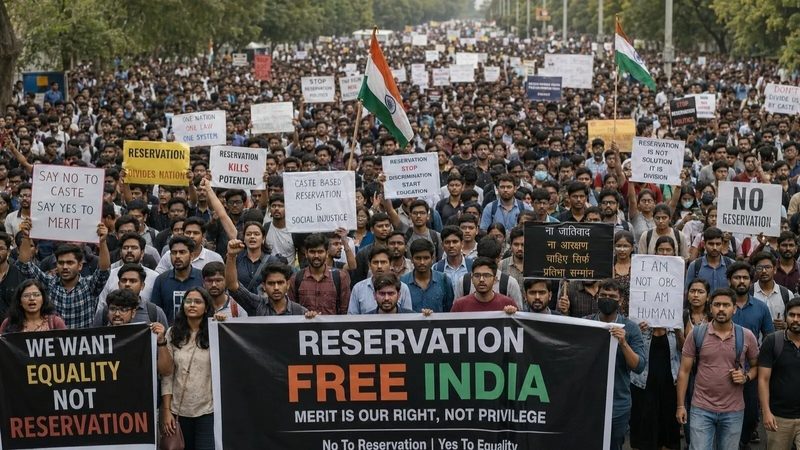
In 1990, Prime Minister V. P. Singh announced the implementation of the Mandal Commission’s decade-old recommendation: 27 per cent reservation for Other Backward Classes in central government jobs. The decision ignited some of the fiercest agitations in independent India’s history, redrew the country’s political map, and made caste the central axis of Indian politics. The Mandal Commission’s story is essential to understanding modern India.
What the Mandal Commission was
The Second Backward Classes Commission, chaired by B. P. Mandal, was appointed in 1979 to identify socially and educationally backward classes and recommend measures for their advancement. Using 1931 census data, the last caste census available, combined with field surveys, the Commission estimated that Other Backward Classes formed about 52 per cent of India’s population. Its 1980 report recommended 27 per cent reservation in central government employment and public sector undertakings for OBCs, which, added to the existing 22.5 per cent for SCs and STs, would take total reservations to 49.5 per cent, just under the Supreme Court’s 50 per cent ceiling.
Why the report gathered dust for a decade
The Commission submitted its report in 1980 to the Indira Gandhi government, which shelved it: implementing OBC reservations promised to alienate upper-caste voters who formed the Congress’s core support. Successive governments avoided the issue for the same reason. It took V. P. Singh, heading a fragile National Front government dependent on outside support and seeking to outflank both the Congress and the BJP, to dust off the report in August 1990. The timing, political rather than administrative, ensured the decision would be received as a political bombshell rather than a policy measure.
The backlash: agitations and self-immolations
The announcement triggered massive protests, particularly among upper-caste students in northern India. Demonstrations swept university campuses, and a wave of self-immolations, beginning with Delhi University student Rajiv Goswami, horrified the nation. The agitation’s intensity reflected genuine anxieties about merit and shrinking opportunities, but also the fury of communities confronting the loss of unchallenged dominance. The protests paralysed parts of the country for months and deepened the social divide the policy was meant to address.
The Supreme Court’s verdict: Indra Sawhney
The legal challenge culminated in the Supreme Court’s 1992 judgment in Indra Sawhney versus Union of India. The Court upheld OBC reservations but imposed crucial conditions: the creamy layer, the socially advanced among OBCs, must be excluded; total reservations cannot ordinarily exceed 50 per cent; and reservations apply to initial appointments, not promotions, a position later modified by amendments. The judgment gave Mandal constitutional legitimacy while setting the boundaries within which all subsequent reservation policy operates.
How Mandal reshaped politics
Mandal’s political consequences dwarfed its administrative ones. It catalysed the rise of OBC-led regional parties in the Hindi heartland, the Samajwadi Party and Rashtriya Janata Dal, built explicitly on backward-caste mobilisation. It forced every party to address OBC representation in tickets and cabinets. And it created the famous Mandal versus Kamandal divide, with the BJP’s Ram temple movement offering an alternative Hindu-unity mobilisation against caste fragmentation. The interplay of these two mobilisations defined the politics of the 1990s and echoes still.
Mandal’s second wave
Mandal’s logic was extended in 2006 when the government introduced 27 per cent OBC reservation in central educational institutions, including elite engineering and medical colleges, triggering a second wave of protests. The Supreme Court upheld the measure while insisting on the creamy layer exclusion. Demands have since grown to extend reservations to the private sector and to breach the 50 per cent ceiling, while the call for a caste census seeks updated data to replace the 1931 figures the Commission relied upon. Each proposal reignites the Mandal debate in new form.
FAQs
What is the creamy layer? The relatively affluent and socially advanced section within OBCs, excluded from reservation benefits to target them at the genuinely disadvantaged.
Does Mandal apply to private sector jobs? No. OBC reservations apply to government employment and public educational institutions; the private sector remains outside their scope.
What is the 50 per cent ceiling? The Supreme Court’s rule that total reservations should not ordinarily exceed half of available seats or posts, though some states have since tested this limit.
Mandal turned caste from a social fact into the organising principle of democratic competition, and Indian politics has never looked back.
Compiled by the Khabar 24h Editorial Desk from publicly available sources.

Khabar 24h Editorial Desk — our explainers are prepared by the Khabar 24h editorial team using AI-assisted research tools, and every piece is reviewed by a human editor before publishing. We do not claim original reporting: our work is turning complex topics into simple, accurate summaries. Spotted an error? Write to contact@khabar24h.com — our corrections policy aims for same-day review.
More from this author →