Language Politics in India: The Anti-Hindi Agitations and the Three-Language Formula
Few issues have stirred Indian passions like language. The battle over Hindi’s role nearly tore the country apart in the 1960s, gave birth to the Dravidian movement’s greatest triumph, and produced the three-language formula that still governs school curricula. Language politics shaped the map of Indian states, the fall of governments and the very idea of Indian nationhood. Its embers still glow in every debate over Hindi imposition.
The constitutional compromise
The Constituent Assembly deadlocked over the national language question. The compromise, Articles 343-351, made Hindi in the Devanagari script the official language of the Union, with English continuing for 15 years, and recognised a list of regional languages in the Eighth Schedule. The Assembly’s language committee deadlocked so completely that the issue was settled by a single casting vote, a reminder of how close India came to a different linguistic order. The settlement pleased no one fully: Hindi supporters wanted immediate primacy, non-Hindi speakers feared domination. The 15-year deadline for switching to Hindi, set for 1965, became a ticking time bomb under Indian unity.
The anti-Hindi agitations
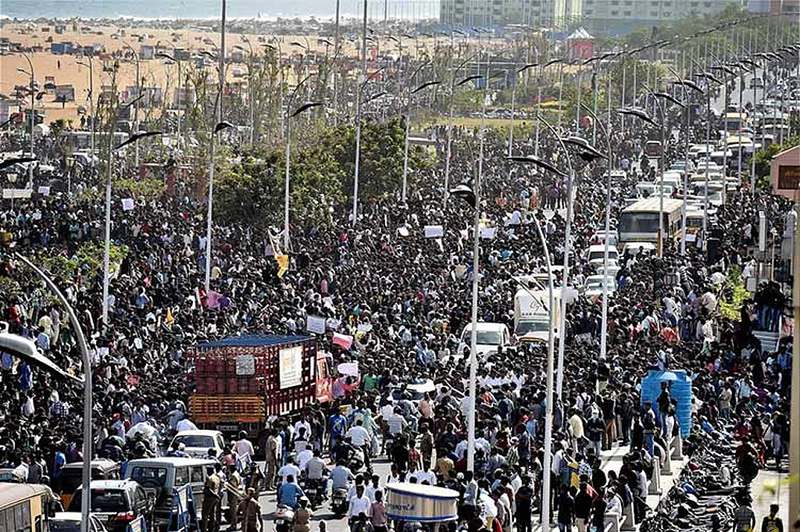
As 1965 approached, Tamil Nadu erupted. The DMK-led anti-Hindi agitation of 1965 saw massive protests, self-immolations and police firing, with dozens killed. The agitation was not merely about language but about identity, jobs and the fear that Hindi speakers would dominate the bureaucracy. The Congress government, shaken, passed the Official Languages Act of 1963 with amendments guaranteeing the indefinite use of English, and Prime Minister Shastri and his successors gave assurances that Hindi would not be imposed. The agitation propelled the DMK to power in Tamil Nadu in 1967, proving language could topple governments.
The linguistic reorganisation of states
Language also redrew India’s map. The demand for Telugu-speaking Andhra Pradesh led to Potti Sriramulu’s death fasting in 1952, forcing the creation of Andhra State and then the States Reorganisation Commission. In 1956, India reorganised its states on linguistic lines, creating the template for subsequent divisions, from Gujarat and Maharashtra in 1960 to the northeastern states and later Telangana. Linguistic states gave regional languages official status and political power, defusing secessionist pressures by accommodating identity within the federation.
The three-language formula
Education policy produced the three-language formula: students should learn Hindi, English and a regional language, later modified so Hindi-speaking states would teach a southern language. In practice, implementation has been patchy and politically fraught. Tamil Nadu rejected the formula outright, teaching only Tamil and English, and every attempt to push Hindi in non-Hindi states triggers protest. The National Education Policy’s language provisions have revived the controversy, with southern states seeing Hindi promotion as imposition by another name.
Language politics today
The old battles echo in new forms. The demand for classical language status, granted to Tamil, Sanskrit, Kannada, Telugu, Malayalam and Odia, confers prestige and funds. Migration has made language the flashpoint of urban politics, from Marathi in Mumbai to Kannada in Bengaluru. And the Hindi-English divide maps onto class and opportunity, with English-medium education the surest ladder of mobility. The delimitation debate has added a new dimension, with southern states fearing that successful population control will cost them parliamentary representation. Language remains what it has always been in India: the most intimate marker of identity and the most explosive of political issues.
Scripts: the politics of writing
Language politics extends to scripts themselves. The script controversies around Kashmiri and Sindhi, the demand for the Roman script for Konkani, and the symbolic weight of Devanagari versus Perso-Arabic scripts in Hindi-Urdu politics all show that writing systems carry religious and cultural associations. Scripts turn orthography into identity, making the alphabet itself a political question in a multilingual nation.
FAQs
Is Hindi India’s national language? No. The Constitution designates Hindi as the official language of the Union; India has no national language.
What is the Eighth Schedule? The constitutional list of recognised languages, now 22, whose speakers are entitled to certain safeguards and representation.
Why does Tamil Nadu oppose the three-language formula? The state views compulsory Hindi as imposition, a legacy of the 1965 agitation, and maintains a two-language policy of Tamil and English.
Language politics taught India its most important lesson about diversity: unity cannot be imposed through uniformity, only built through accommodation.
How India manages its linguistic diversity will remain a test of its democratic imagination.
Compiled by the Khabar 24h Editorial Desk from publicly available sources.

Khabar 24h Editorial Desk — our explainers are prepared by the Khabar 24h editorial team using AI-assisted research tools, and every piece is reviewed by a human editor before publishing. We do not claim original reporting: our work is turning complex topics into simple, accurate summaries. Spotted an error? Write to contact@khabar24h.com — our corrections policy aims for same-day review.
More from this author →