Namo Bharat RRTS Explained: Inside India’s First Regional Rapid Transit System
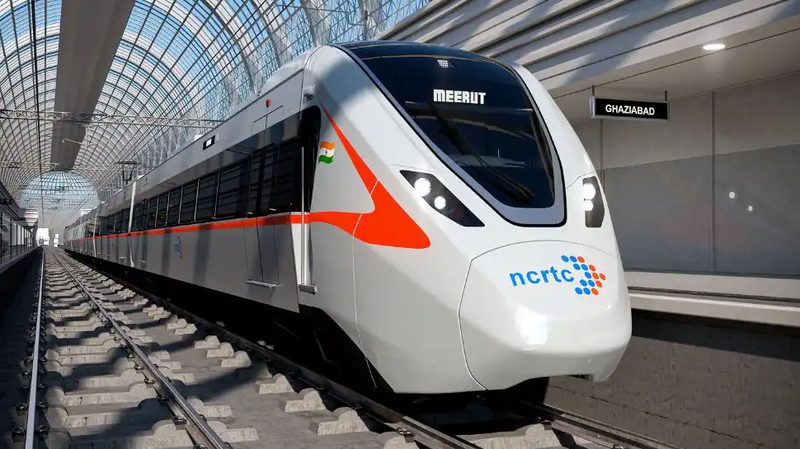
Somewhere between a metro and an intercity express lies a gap that Indian cities have never properly filled: the regional commute. Millions travel daily between Delhi and satellite towns like Meerut, Ghaziabad and Panipat, spending two to three hours each way in buses, shared cabs or slow passenger trains. The Regional Rapid Transit System, branded Namo Bharat, is designed for exactly this traveller. The first corridor, Delhi-Ghaziabad-Meerut, opened in stages from 2023, with trains running at up to 160 kilometres per hour and covering the 82-kilometre stretch in under an hour. It is India’s first RRTS, built to global rapid-rail standards, and a template for similar corridors planned around the country’s biggest metros.
What an RRTS is
A Regional Rapid Transit System connects a metropolitan core with its surrounding regional centres at speeds far above a metro but with metro-like frequency. Namo Bharat trains run every 10 to 15 minutes at peak, stop at stations spaced several kilometres apart, and are designed for a top speed of 180 kmph with 160 kmph in service. The coaches are aerodynamic, air-conditioned and equipped with transverse seating, luggage racks, Wi-Fi, charging points and dedicated space for wheelchairs. One coach in each train is reserved for women, and there is a premium coach with wider seats and extra legroom for those willing to pay more. Platform screen doors, automatic train operation and ETCS Level 2 signalling put the system on par with rapid rail networks in Europe and East Asia.
The Delhi-Meerut corridor
The 82-kilometre Delhi-Ghaziabad-Meerut corridor runs from Sarai Kale Khan in Delhi to Modipuram in Meerut, with stations at Anand Vihar, Sahibabad, Ghaziabad, Guldhar, Duhai, Muradnagar, Modi Nagar and Meerut South among others. Parts of the alignment are elevated, parts underground in dense urban stretches. The corridor was built by the National Capital Region Transport Corporation, a joint venture of the central government and the states of Delhi, Haryana, Rajasthan and Uttar Pradesh. Opening in phases, the full corridor puts Meerut within an hour of central Delhi, a journey that previously took two to three hours by road. Fares are priced between metro and intercity rail, with the premium coach costing roughly one and a half times the standard fare.
Technology under the hood
Namo Bharat is the first rail system in India to deploy ETCS Level 2 signalling with automatic train operation over LTE communication, which allows precise, high-frequency running. The trains are manufactured in India at Alstom’s Savli plant in Gujarat, with stainless-steel coaches designed for rapid acceleration and regenerative braking. Stations feature platform screen doors for safety, universal accessibility, and integration with metro, bus and railway stations wherever the corridors intersect. The system is designed for interoperability: future RRTS corridors will use the same standards, so trains could theoretically run across corridors.
The coming network
Three corridors were prioritised in the first phase for the National Capital Region: Delhi-Meerut, Delhi-Alwar and Delhi-Panipat. The Delhi-Alwar corridor would connect the capital with Gurugram, Rewari and Alwar, serving one of the country’s busiest commuter belts, while Delhi-Panipat would serve the industrial towns of Haryana. Progress on the second and third corridors has depended on state government approvals and funding commitments, which has made the programme as much a test of federal coordination as of engineering. Beyond the NCR, other states have studied RRTS-style systems for corridors like Mumbai-Pune and Bengaluru-Tumakuru, though none has advanced as far as Delhi’s.
Why it matters
The RRTS changes the economic geography of a region. When Meerut is 55 minutes from Delhi, people can live in one city and work in the other, housing pressure on the capital eases, and businesses can locate where land is cheaper without losing access to the metro’s labour market. This is the logic that made rapid regional rail transformative in Tokyo, Paris and Seoul. Namo Bharat’s real significance is as a proof of concept: if the Delhi-Meerut corridor delivers ridership and financial sustainability, the model can be replicated across India’s urban clusters, knitting together the country’s fast-growing regional economies.
FAQs
How fast does Namo Bharat run? Trains operate at up to 160 kmph in service, with a design speed of 180 kmph, covering Delhi to Meerut in under an hour.
Who operates the RRTS? The National Capital Region Transport Corporation, a joint venture of the central government and the NCR states, builds and operates the corridors.
Is there a women’s coach? Yes, one coach in every Namo Bharat train is reserved for women passengers.
Namo Bharat asks a simple question: what if the daily regional commute took minutes instead of hours? The Delhi-Meerut corridor is India’s first serious answer, and the country’s other mega-regions are watching closely.
Source: The Times of India

Khabar 24h Editorial Desk — our explainers are prepared by the Khabar 24h editorial team using AI-assisted research tools, and every piece is reviewed by a human editor before publishing. We do not claim original reporting: our work is turning complex topics into simple, accurate summaries. Spotted an error? Write to contact@khabar24h.com — our corrections policy aims for same-day review.
More from this author →