Mumbai Coastal Road: The Engineering and the Controversy of the Sea-Facing Highway
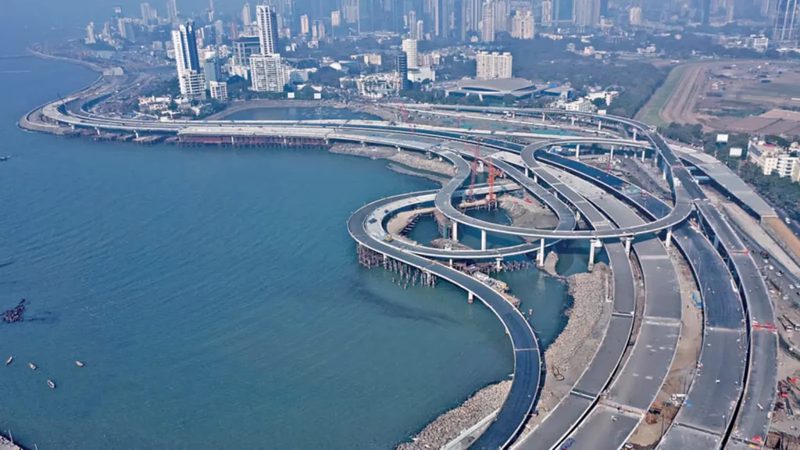
Mumbai’s western seafront, from Marine Drive to Worli, is among the world’s great urban coastlines, and its roads are among the world’s great traffic jams. The Mumbai Coastal Road, a 29-kilometre high-speed corridor from Marine Lines to Kandivali, promises to transform both: a signal-free drive along reclaimed land, sea bridges and India’s first undersea tunnels, cutting the south-to-north commute dramatically. Conceived by the Brihanmumbai Municipal Corporation and opened in phases from 2024, it is the largest infrastructure project the civic body has ever attempted. It is also among the most litigated, with environmentalists challenging the reclamation of the sea. This explainer covers the engineering, the controversy and the traffic math.
What is being built
The coastal road combines reclaimed land corridors, elevated sea bridges, and twin undersea tunnels, the first in India, burrowing beneath the sea near Girgaon Chowpatty. The road is designed as an eight-lane, access-controlled corridor with interchanges at key points, pedestrian underpasses, and a continuous promenade and green spaces along the seaward side. The first phase, from Marine Drive to Worli, opened to traffic in 2024, with the northern extension to Kandivali following. The project also includes the redevelopment of the coastline it creates: new public open spaces on reclaimed land, a rare addition of waterfront to a city starved of it.
Engineering at sea
Building a road in the Arabian Sea required techniques new to India. The undersea tunnels were bored by tunnel boring machines launched from specially built shafts, navigating basalt rock beneath the seabed. Reclamation used engineered fill with seawalls designed for Mumbai’s monsoon wave climate. Interchanges on reclaimed land had to account for settlement and marine conditions. The project’s contractors included international firms with sea-bridge experience, and the BMC created a dedicated project organisation. For a municipal corporation better known for potholes than mega-projects, delivering the coastal road’s marine engineering is an institutional leap.
The environmental battle
The project faced sustained legal challenge from fishing communities and environmentalists. Koli fishing villages argued that reclamation and construction damaged their fishing grounds, intertidal zones and livelihoods; the project’s alignment was modified in places to address these concerns. Environmentalists challenged the coastal regulation zone clearances, arguing that the reclamation would alter coastal dynamics and that the environmental impact assessment was inadequate. The Bombay High Court and the Supreme Court heard the challenges; construction continued under court-monitored conditions. The litigation reflects a deeper tension: Mumbai needs infrastructure desperately, but its coastline is also an ecological and livelihood zone.
Will it fix traffic?
The coastal road will undoubtedly cut travel times along the western corridor: the south Mumbai to Bandra-Worli Sea Link run, which can take over an hour at peak, drops to minutes. But transport planners warn of induced demand: new road capacity fills up, and the traffic relieved on one corridor reappears at the interchanges and on connecting roads. Mumbai’s long-term mobility answer remains public transport: the metro lines under construction, the suburban rail upgrade, and bus priority. The coastal road’s honest role is as one element of a multimodal system, transformative for car users on the western seaboard, but not a substitute for mass transit. Cities that built their way out of congestion with roads alone do not exist.
The promenade dividend
The project’s most beloved element may prove to be the one nobody commutes on: the continuous seafront promenade, gardens and public spaces created on the reclaimed land. Mumbai has among the lowest per-capita open space of any major city, and the coastal road’s green edge, modelled on great waterfronts, gives the public a new relationship with the sea. If maintained well, the promenade will be the project’s democratic face: infrastructure that the carless majority can actually use. The BMC’s record on maintaining public spaces will decide whether it becomes Marine Drive’s worthy successor or another neglected asset.
FAQs
How long is the Mumbai Coastal Road? About 29 km from Marine Lines to Kandivali, built on reclaimed land, sea bridges and undersea tunnels.
What are the undersea tunnels? Twin tunnels near Girgaon Chowpatty, the first undersea road tunnels in India, bored beneath the seabed.
Why was the project controversial? Fishing communities and environmentalists challenged the sea reclamation’s impact on livelihoods and coastal ecology through prolonged litigation.
The coastal road gives Mumbai something it has never had: a fast, free-flowing western corridor and a new public waterfront. Whether it also gives the city lasting traffic relief depends on everything built around it.
Compiled by the Khabar 24h Editorial Desk from publicly available sources.

Khabar 24h Editorial Desk — our explainers are prepared by the Khabar 24h editorial team using AI-assisted research tools, and every piece is reviewed by a human editor before publishing. We do not claim original reporting: our work is turning complex topics into simple, accurate summaries. Spotted an error? Write to contact@khabar24h.com — our corrections policy aims for same-day review.
More from this author →