e-NAM Explained: The Digital Mandi Trying to Fix India’s Farm Markets
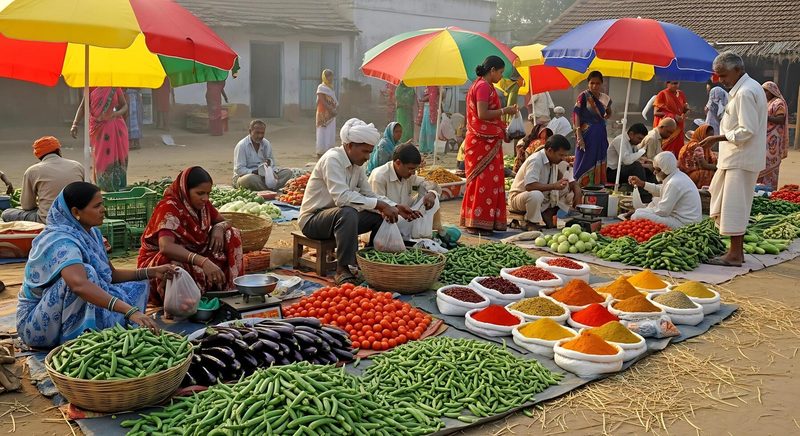
India’s agricultural markets were, for decades, a maze of state-level monopolies: farmers had to sell in their local APMC mandi, paying commissions to intermediaries, with no visibility of prices elsewhere. The electronic National Agriculture Market, e-NAM, launched in 2016, promised to change this by creating a unified national market: online trading across over 1,300 mandis in more than 20 states, with assaying, logistics, and e-payments. It was billed as the reform that would give farmers the true price of their produce. A decade on, the results are a study in the gap between platform and practice.
How e-NAM is supposed to work
The design is elegant. Mandis are integrated onto a single electronic platform: farmers bring produce to the mandi, where it is weighed and assayed for quality; lots are listed online with the assay parameters; traders from anywhere in the network bid electronically; the highest bidder wins; and payment goes directly to the farmer’s bank account, with the produce moved through empanelled logistics. A unified trading licence was meant to let a trader in one state buy in another’s mandi, breaking the local monopsonies of commission agents. The platform also promised transparency: real-time price dissemination through mobile apps, kiosks, and SMS, so farmers know the going rate before they sell. Supporting infrastructure, assaying labs, sorting and grading facilities, and electronic weighbridges, was funded through agri-infrastructure schemes. In theory, the farmer’s choice expands from the local arhatiya to the national market.
What it changed
Where e-NAM works, the gains are real. Studies of integrated mandis show improved price realisation for farmers in several commodities, reduced scope for collusion among local traders when outside bidders participate, and faster, more transparent payments directly to bank accounts. The assaying infrastructure, where functional, introduced quality-based pricing to markets that had traded on visual inspection and relationships. Several states report significant trade volumes on the platform, and the system’s data has improved market intelligence for policymakers. For farmer producer organisations, e-NAM offered a direct channel to distant buyers, bypassing local intermediaries. The platform also demonstrated that agricultural marketing could be digitised at scale, a proof of concept that influenced subsequent reforms.
Why it fell short of the promise
The shortfall is equally well documented. Inter-state trade, the core promise of a national market, remains limited: most e-NAM transactions are still local, with traders reluctant to buy unseen produce across states given quality uncertainty and logistics costs. Assaying infrastructure is patchy: many mandis lack functional labs, and without trusted quality certification, distant bidding does not take off. The APMC Acts that e-NAM sits atop were only partially reformed; in several states, the legal framework still constrains who can trade and where. Small and marginal farmers, the majority, often lack the volumes, transport, and digital literacy to use the platform, and continue selling at the farm gate to aggregators. Critics argue e-NAM digitised the mandi without reforming it: the same intermediaries, now with logins, and the same power structures, now with dashboards. Trade volumes, while large in absolute terms, remain a small fraction of India’s total agricultural marketing.
The farm laws and after
The 2020 farm laws, which sought to permit trade outside APMC mandis entirely, were in some ways e-NAM’s logical extension, and their repeal after the farmer protests froze the broader marketing-reform agenda. Since then, policy has returned to incrementalism: strengthening e-NAM’s infrastructure, onboarding FPOs, and integrating warehouse-based trading through e-NWR. Some states have amended their APMC Acts to allow private markets and direct purchase; others have not. The political lesson of the farm-law episode hangs over all marketing reform: farmers fear, often justifiably, that reforms designed to free them will instead expose them to corporate buyers without the protections of the mandi. e-NAM’s future depends on navigating this trust deficit while fixing its operational gaps.
Can the digital mandi be fixed?
The fix list is known: universal, trusted assaying so distant buyers can bid confidently; genuine inter-state trading with harmonised rules; logistics integration so winning bids translate into actual movement; FPO aggregation so smallholders can participate; and digital literacy at the farm gate. None of this is beyond reach, and the platform’s architecture is sound. But e-NAM’s story illustrates a larger truth about agricultural reform in India: technology can enable markets, but it cannot conjure the trust, infrastructure, and institutional reform that markets need. The digital mandi works where the physical mandi was already functional; where the mandi was broken, the portal alone could not fix it. The next phase of farm marketing reform will have to be built in the mandi yard, not just on the server.
FAQs
What is e-NAM? A pan-India electronic trading portal linking over 1,300 APMC mandis for online bidding, assaying-based quality assessment, and direct bank payments to farmers.
Can farmers sell across states on e-NAM? In principle yes through inter-mandi and inter-state trade, but in practice most transactions remain local due to quality and logistics constraints.
Is e-NAM free for farmers? Yes, farmers trade without platform fees; the costs are borne by the scheme and market functionaries.
e-NAM proved that India’s farm markets can be digitised; it has not yet proved that digitisation alone can fix them. The unified national market remains more aspiration than achievement, but the rails, at least, are laid.
Compiled by the Khabar 24h Editorial Desk from publicly available sources.

Khabar 24h Editorial Desk — our explainers are prepared by the Khabar 24h editorial team using AI-assisted research tools, and every piece is reviewed by a human editor before publishing. We do not claim original reporting: our work is turning complex topics into simple, accurate summaries. Spotted an error? Write to contact@khabar24h.com — our corrections policy aims for same-day review.
More from this author →