Montessori vs Traditional Schools: Teaching Methods Compared
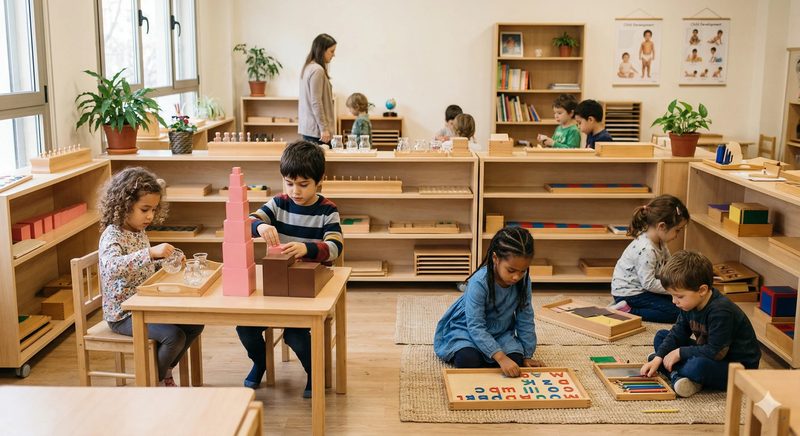
Walk into a Montessori classroom and a traditional classroom and you will think you have entered different centuries: one hums with children choosing their own activities from wooden materials on low shelves, the other runs on timetables, textbooks and a teacher at the board. Montessori vs traditional schools is a choice Indian urban parents increasingly face as Montessori and Montessori-inspired preschools multiply in every metro. The methods differ profoundly in philosophy, and the right choice depends on your child’s temperament, your family’s values and — practically — what happens after preschool. Here is an honest comparison.
The Montessori method: how it actually works
Developed by Dr. Maria Montessori, the method rests on a few core principles: mixed-age classrooms (typically 3-6 together), long uninterrupted work periods where children choose activities, specially designed self-correcting materials that teach through touch, and teachers who observe and guide rather than instruct. Children learn to pour, button, count with bead chains and trace sandpaper letters — progressing at their own pace from concrete to abstract. There are no tests, no homework and no comparisons; assessment is continuous observation. The famous outcomes are independence, concentration and intrinsic motivation — children who choose challenging work because they want to, not for stars or ranks.
The traditional method: structure and its strengths
Traditional schooling — same-age classes, teacher-led instruction, textbooks, periodic tests and homework — is what most Indian parents experienced. Its strengths are real and often undervalued in progressive discourse: systematic coverage of a full curriculum, clear benchmarks that tell parents exactly where a child stands, preparation for the examination culture that dominates Indian secondary education, and efficiency at scale. A good traditional teacher can inspire deeply, and structured phonics and maths instruction produce strong foundational skills. The weaknesses are equally real: one pace for thirty children, limited autonomy, and assessment systems that reward memorisation over understanding.
Head-to-head comparison
- Learning pace: Montessori is individualised; traditional is lockstep with the class.
- Motivation: Montessori builds intrinsic motivation through choice; traditional uses extrinsic rewards — marks, ranks, praise.
- Social mix: Montessori’s mixed ages teach mentoring naturally; traditional same-age classes build cohort bonds.
- Assessment: Montessori observes continuously without tests; traditional tests periodically with clear scores.
- Teacher role: Montessori guide and observer; traditional instructor and authority.
- Cost in India: genuine Montessori preschools charge 1-3 lakh rupees a year in metros; traditional preschools are often cheaper.
What research says about outcomes
Well-conducted studies, including randomised lottery-based research, find that authentic Montessori programmes produce modest advantages in academic and social outcomes — better executive function, stronger reading and maths in early years, and more developed social understanding. The key qualifier is authentic: outcomes depend on trained Montessori teachers and proper materials, and India has many schools using the name with neither. Traditional schooling’s outcomes depend entirely on teacher quality. By upper primary, differences narrow; what predicts long-term success most is not the preschool method but continued parental engagement and later school quality.
The transition question: what comes after
This is the most practical consideration. Most Montessori programmes in India run only through kindergarten or early primary, after which children join traditional CBSE, ICSE or state-board schools. Children from good Montessori backgrounds typically transition well — they are independent learners — but may initially find rigid timetables, homework and test pressure jarring. Parents should prepare children for this shift in the final Montessori year and choose a primary school that values understanding over rote. A few schools offer Montessori through elementary years; these suit families committed to the philosophy long-term.
FAQs
Is Montessori better than traditional school?
Neither is universally better. Montessori suits self-directed children and parents valuing independence; traditional schooling suits families wanting clear benchmarks and structured preparation for India’s exam system.
How do I spot a fake Montessori?
Ask about teacher training (AMI or equivalent diplomas), observe a classroom — children should be choosing work independently — and check for authentic materials, not plastic toys with the name attached.
Will my child cope with Class 1 after Montessori?
Usually yes, and often ahead in reading and number sense. Brief them on the new structure, and expect a few weeks of adjustment to tests and homework.
Choose Montessori for the early years if you find an authentic programme and value independence and love of learning; choose a good traditional preschool if you want structured school-readiness and clear progress markers. Either way, visit classrooms, watch the children — happy, absorbed children are the truest quality signal — and remember that your engagement at home outweighs the method on the gate.
Source: Association Montessori Internationale

Khabar 24h Editorial Desk — our explainers are prepared by the Khabar 24h editorial team using AI-assisted research tools, and every piece is reviewed by a human editor before publishing. We do not claim original reporting: our work is turning complex topics into simple, accurate summaries. Spotted an error? Write to contact@khabar24h.com — our corrections policy aims for same-day review.
More from this author →