Government Jobs After 12th: SSC, Railways, Defence and Bank Exams
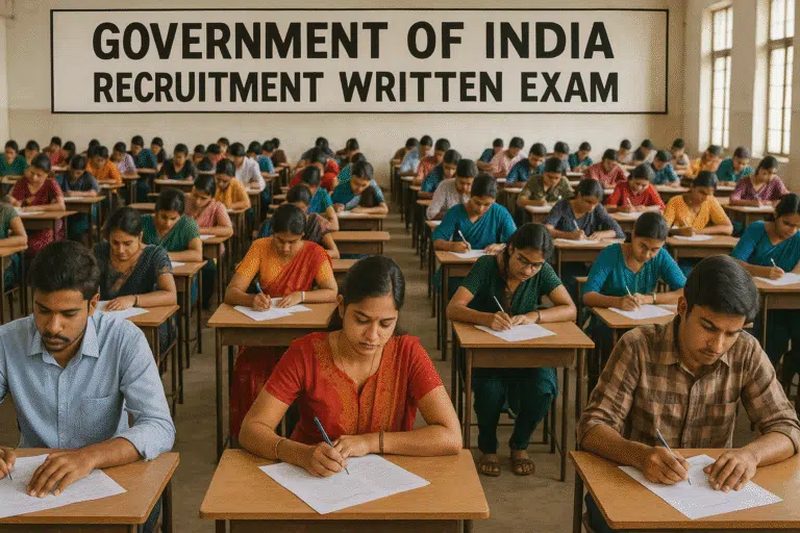
For lakhs of Indian families, a government job remains the ultimate career prize: respect, security, pension-grade stability and a salary that arrives on time every month. Government jobs after 12th are real and numerous — the Staff Selection Commission, railways, defence forces, public-sector banks and state governments all recruit at the 12th-pass level every year. Competition is fierce, with applicant-to-seat ratios in the hundreds, but the syllabus is finite and the preparation playbook is well understood. This guide maps the major routes, what they pay, and how to prepare smartly.
SSC: the biggest 12th-level recruiter
The SSC CHSL (Combined Higher Secondary Level) exam recruits Lower Division Clerks, Data Entry Operators and Postal Assistants across central-government ministries — the classic 12th-pass sarkari naukri. The exam has two tiers: a computer-based objective test (quant, reasoning, English, GK) and a descriptive/skill test. SSC MTS recruits multitasking staff with an even simpler syllabus, while SSC GD Constable offers paramilitary positions. Starting salaries run 25,000-40,000 rupees monthly with full government benefits, and promotions over a career can reach gazetted levels. Preparation needs 6-12 months of focused study; previous-year papers are the backbone.
Railways: RRB NTPC, Group D and ALP
- RRB NTPC: clerical and commercial posts (ticket collector, clerk, goods guard) — 12th pass eligible for undergraduate-level posts, with salaries of 25,000-35,000 rupees.
- RRB Group D: track maintainer, assistant and helper posts — Class 10 eligibility, the highest-volume railway recruitment.
- RRB ALP: Assistant Loco Pilot — needs ITI or engineering diploma, but among the best-paid technical entries.
Railway exams test maths, reasoning, general awareness and science at the 10th-12th level; the two-stage CBT format rewards speed and accuracy. Railway jobs add travel perks and housing that boost effective compensation well beyond salary.
Defence: Agniveer, NDA and paramilitary
The Agniveer scheme recruits 12th-pass youth into the Army, Navy and Air Force with a four-year tenure, attractive pay (30,000-40,000 rupees monthly) and a substantial Seva Nidhi exit package — 25 per cent are retained for full service. The NDA, for unmarried candidates after 12th, offers the officer route with a degree from the academy. Paramilitary forces (BSF, CISF, CRPF, ITBP) recruit constables at 12th/10th level with solid pay and benefits. Defence careers suit the physically fit and disciplined; preparation must include running and physical standards alongside written exams.
Banking, state government and other routes
Public-sector banks recruit clerks through IBPS at graduation level, but several cooperative and regional rural banks accept 12th-pass candidates. State governments recruit through their SSCs and police constable exams — often the most accessible route in one’s home state, with domicile advantages. India Post’s Gramin Dak Sevak, though not a full government post, offers village-level postal work. State electricity boards, municipal corporations and forest departments add further options. The strategy: apply broadly across SSC, railways, state and defence rather than betting everything on one exam.
Preparation: the realistic playbook
The syllabus across these exams overlaps heavily — quantitative aptitude, logical reasoning, English and general awareness — so one preparation serves many exams. Build foundations with NCERT-level maths and standard reasoning books, read daily current affairs, and attempt previous-year papers extensively: cut-offs and patterns repeat. Most successful candidates prepare 6-12 months while applying to every eligible notification. Coaching helps the undisciplined but is not essential; free YouTube educators and test series suffice for sincere aspirants. Physical preparation for defence and police posts must run parallel to written study, not after it.
FAQs
Which is easiest to crack after 12th?
SSC MTS and RRB Group D have the simplest syllabi but the highest applicant volumes. Easier syllabus does not mean easier selection — competition decides.
What salary can I expect?
Most 12th-level posts start at 25,000-40,000 rupees monthly including allowances, with regular increments, DA revisions and promotion avenues.
Can I prepare alongside Class 12?
Light preparation — maths, reasoning, current affairs — alongside Class 12 works well; intensive exam-specific prep is best after boards.
Government jobs after 12th reward the prepared and the persistent: pick two or three target exams, master the overlapping syllabus, apply to every notification, and treat each attempt as data for the next. The queue is long, but it moves — and the prize is worth the patience.
Source: Staff Selection Commission

Khabar 24h Editorial Desk — our explainers are prepared by the Khabar 24h editorial team using AI-assisted research tools, and every piece is reviewed by a human editor before publishing. We do not claim original reporting: our work is turning complex topics into simple, accurate summaries. Spotted an error? Write to contact@khabar24h.com — our corrections policy aims for same-day review.
More from this author →