How to File Your ITR: A First-Timer’s Walkthrough of India’s Income Tax Portal
Your first income tax return feels like a bureaucratic rite of passage — forms with cryptic names, a portal full of tabs, and the fear that one wrong click invites a notice. In reality, filing an ITR on India’s income tax portal is a guided, mostly pre-filled process that takes under an hour for a straightforward salaried return. This walkthrough covers the journey from registration to refund, so your first filing is boring in the best possible way.
Before you begin: the checklist
Gather four things. Your PAN — which is also your portal user ID — and an Aadhaar linked to it, with a mobile number active for OTPs. Your bank account details, pre-validated on the portal, because refunds only go to validated accounts. Your income documents: Form 16 from your employer, salary slips, bank interest statements, and records of any capital gains or rental income. And your investment and deduction proofs: 80C receipts, 80D premium receipts, home loan certificates. Then log in to incometax.gov.in and check two auto-generated statements — Form 26AS and the Annual Information Statement. These show what the department already knows about your income: salary, interest, dividends, securities transactions. Your return must match or explain every significant entry here; mismatches are the commonest trigger for notices.
Choosing the right ITR form
The form depends on your income profile, and picking wrong is the classic first-timer error. ITR-1 (Sahaj) covers resident individuals with total income up to 50 lakhs from salary, one house property, other sources like interest, and agricultural income up to 5,000 rupees. ITR-2 handles those with capital gains, foreign assets or more than one house property but no business income. ITR-3 is for business or professional income, and ITR-4 (Sugam) for presumptive taxation cases. A salaried first-timer with no capital gains almost always needs ITR-1. When in doubt, the portal’s help utilities suggest a form based on your answers — use them rather than guessing.
Filing step by step
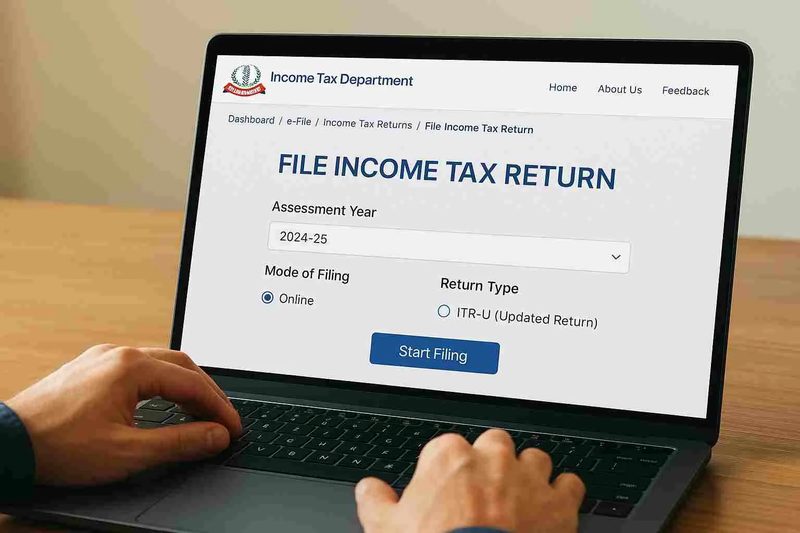
From the portal dashboard, go to e-File, select Income Tax Return, choose the assessment year — for income earned in FY 2025-26, that is AY 2026-27 — and pick online filing. Much of the return arrives pre-filled from your Form 16, 26AS and AIS data; verify every figure rather than trusting it blindly, because deductor errors do occur. Fill in exempt income, deductions under Chapter VI-A (80C, 80D and friends) and your tax regime choice — the new regime is the default, so actively select the old regime if your deductions justify it. The portal computes your liability live: tax due means you pay self-assessment tax through the e-pay facility before submitting; a refund means you double-check bank pre-validation. Submit, and the return generates an acknowledgement, ITR-V.
- Register and link: PAN, Aadhaar-linked mobile, pre-validated bank account.
- Reconcile first: match Form 16, 26AS and AIS before touching the return.
- Pick the right form: ITR-1 for simple salaried; ITR-2 with capital gains.
- Verify within 30 days: e-verify via Aadhaar OTP — unverified returns are not processed.
The crucial last step: verification
Filing without verification is like posting a letter without an address — the return is not considered filed until verified, and the deadline is 30 days from submission. E-verification takes a minute: Aadhaar OTP is the simplest, with net-banking, demat and bank-account EVC as alternatives. Only after verification does processing begin, and only then does the refund clock start. Track status under e-File services; straightforward returns are typically processed within weeks, with refunds credited directly to your validated account. If you receive a notice under Section 143(1) with adjustments, read it carefully before panicking — most are arithmetic corrections you can accept or contest online.
FAQs
What is the due date for individuals? July 31 of the assessment year for most individuals not requiring audit — so July 31, 2026 for FY 2025-26 income.
What if I miss the deadline? You can file a belated return by December 31 with a late fee up to 5,000 rupees, but you lose the right to carry forward most losses.
Do I need a CA for a simple return? No — a salaried return with Form 16 is genuinely DIY-able. Engage one when you have business income, capital gains complexity or foreign assets.
Your first ITR is mostly data entry wrapped around documents you already have. Reconcile, choose the right form, file, verify — and the rite of passage becomes a routine you will repeat every July without a second thought.
Compiled by the Khabar 24h Editorial Desk from publicly available sources.

Khabar 24h Editorial Desk — our explainers are prepared by the Khabar 24h editorial team using AI-assisted research tools, and every piece is reviewed by a human editor before publishing. We do not claim original reporting: our work is turning complex topics into simple, accurate summaries. Spotted an error? Write to contact@khabar24h.com — our corrections policy aims for same-day review.
More from this author →