India-Canada Team Maps Distant Hydrogen Glow in Universe First
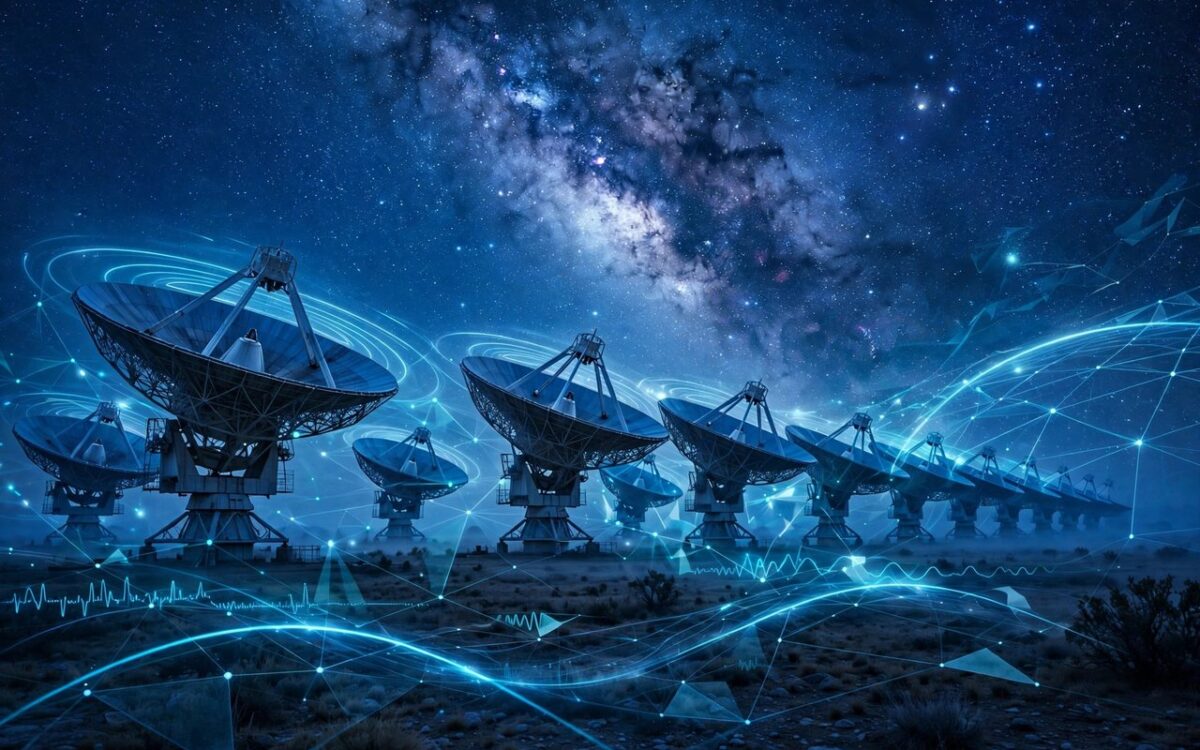
The Canadian Hydrogen Intensity Mapping Experiment (CHIME) telescope has made its first standalone detection of hydrogen’s faint radio glow from when the universe was about five billion years old.
The result, published in The Astrophysical Journal, marks a milestone: CHIME proved it can trace the ancient universe using purely its own observational data, without relying on external galaxy surveys.
The study included collaborators from India’s Raman Research Institute, an autonomous institute of the Department of Science and Technology.
Hydrogen is the most common element in the universe and the raw material from which stars form. Its faint radio emission acts like a cosmic tracer, revealing how matter is distributed across space, said co-author Dr Arnab Chakraborty of the University of Toronto.
The breakthrough offers a cheaper, faster path to study cosmic expansion and dark energy, the mysterious force thought to be driving the universe to expand faster over time.
The team spent more than two years separating the extremely faint signal from background noise that can be up to 10,000 times stronger.

Khabar 24h Editorial Desk — our explainers are prepared by the Khabar 24h editorial team using AI-assisted research tools, and every piece is reviewed by a human editor before publishing. We do not claim original reporting: our work is turning complex topics into simple, accurate summaries. Spotted an error? Write to contact@khabar24h.com — our corrections policy aims for same-day review.
More from this author →
Leave a Reply