How Japan’s Bullet Trains Work: The Shinkansen System Explained
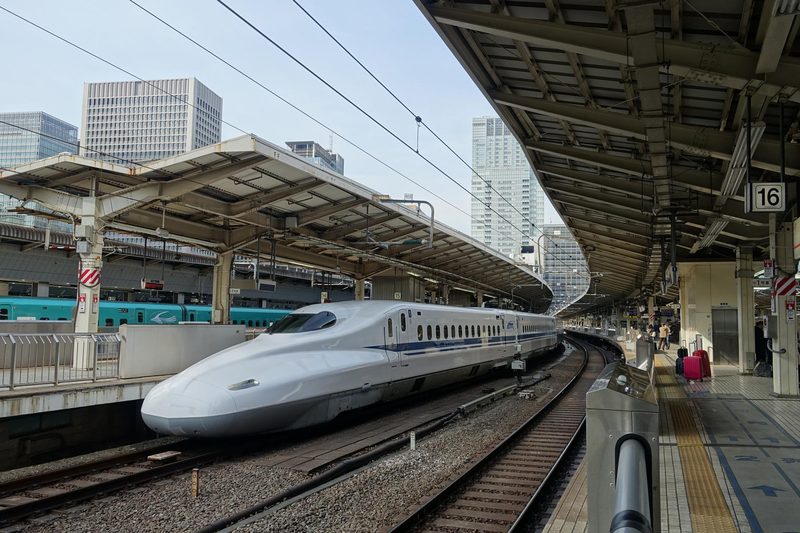
In 1964, as Tokyo hosted the Olympics, Japan unveiled a machine that redefined travel: the Shinkansen, the world’s first high-speed railway, running at 210 km/h between Tokyo and Osaka. Six decades later the network spans nearly 3,000 kilometres, carries over a billion passengers a year, and has never had a single passenger fatality from derailment or collision. Average annual delay: under a minute. How does the bullet train work, and what makes it the marvel it is?
The dedicated track: the real secret
The Shinkansen’s first secret is not the train but the track. Unlike high-speed services elsewhere that share lines with freight and local trains, Shinkansen lines are dedicated, standard-gauge, sealed corridors with no level crossings, gentle curves and generous tunnels. This isolation eliminates the conflicts that cause delays and accidents elsewhere. Building it was enormously expensive, and remains so, but it is why the system runs like clockwork: nothing gets in the way, ever.
The trains themselves
Shinkansen trainsets are engineering showcases: long noses, some stretching 15 metres, to slip through tunnels without sonic booms; active tilt and suspension for curves; lightweight aluminium bodies; and distributed traction, with motors across many cars rather than one locomotive, giving blistering acceleration. The latest N700S series hits 300 km/h in service, with earthquake detection that can brake automatically. Interiors are famously quiet, clean and spacious, with seats that always face forward thanks to rotating seat backs at termini.
Operations: choreography at 300 km/h
The timetable is the true wonder. On the Tokaido line, trains depart Tokyo every few minutes at peak, each timed to the second, and the famed seven-minute turnaround, the Shinkansen theatre of cleaners storming aboard, is studied by railway managers worldwide. Centralised traffic control, automatic train control and rigorous maintenance, tracks inspected nightly by dedicated Doctor Yellow test trains, keep the system safe. Punctuality is cultural: a delay of even a minute prompts apology, because the entire network’s connections depend on precision.
Safety: the zero-fatality record
No passenger has ever died in a Shinkansen derailment or collision in 60 years of operation, an unmatched record. It rests on layers: dedicated tracks, automatic braking, earthquake early-warning that stops trains before shaking arrives, as in 2011, and a safety culture where any anomaly halts operations. Typhoons and snow are managed with equal seriousness; services are suspended rather than risked. The record is not luck but design, maintained at enormous ongoing cost.
Economics: trains that built a nation
The Shinkansen reshaped Japan’s geography, turning distant cities into commuter territory and spreading prosperity along its corridors. It was also ruinously expensive: the debt from later lines helped sink Japanese National Railways, privatised in 1987. Today’s JR companies run the profitable core lines handsomely while rural extensions struggle. Abroad, Japan exports the technology to Taiwan, and competes with French, German and Chinese rivals for contracts from Texas to India. High-speed rail is nation-building you can ride.
The global high-speed race
Japan invented high-speed rail, but China has since built the world’s largest network, over 40,000 kilometres, in barely 15 years. Europe’s TGV, ICE and AVE systems offer their own models, often cheaper by sharing tracks. New frontiers include maglev: Japan’s Chuo Shinkansen, using magnetic levitation at 500 km/h, is under construction despite cost overruns. The bullet train’s children now circle the globe, but the original remains the benchmark for doing it safely, punctually and profitably.
The Shinkansen’s cultural footprint
The bullet train reshaped Japanese life beyond transport. Ekiben boxed lunches turned stations into culinary destinations; the view of Mount Fuji from the right-hand window became a national ritual. Business culture adapted to day trips that once required overnight stays, knitting the Pacific coast into a single economic zone. The Shinkansen even entered the language: shinkansen-like speed is shorthand for progress. Few machines have so thoroughly become part of a nation’s identity.
FAQs
How fast do bullet trains go? In commercial service up to 320 km/h on the fastest lines; test runs have exceeded 400 km/h, and maglev prototypes 500 km/h.
Has a Shinkansen ever crashed fatally? No passenger has ever died from a derailment or collision in the system’s 60-year history.
Why are Japanese trains so punctual? Dedicated tracks, precise timetabling, rigorous maintenance and a culture where delays are treated as serious failures.
The Shinkansen is more than transport; it is a national philosophy made steel, the belief that with enough care, complexity can run perfectly. Sixty years on, the world is still trying to catch the train Japan built.
Source: Japan Times

Khabar 24h Editorial Desk — our explainers are prepared by the Khabar 24h editorial team using AI-assisted research tools, and every piece is reviewed by a human editor before publishing. We do not claim original reporting: our work is turning complex topics into simple, accurate summaries. Spotted an error? Write to contact@khabar24h.com — our corrections policy aims for same-day review.
More from this author →