Machine Learning vs Deep Learning: What Is the Difference?
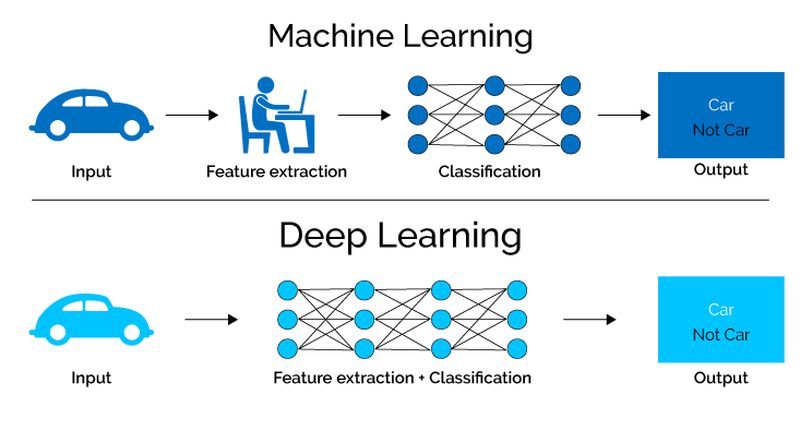
Machine learning and deep learning appear in almost every discussion of artificial intelligence, and they are often used as if they meant the same thing. They do not. Deep learning is a specialised branch of machine learning, and the distinction matters: it explains why some AI systems need enormous datasets and supercomputers while others run happily on a laptop. This guide lays out what each term means, how the two approaches differ, and where each one is actually used in the products you touch every day.
What machine learning means
Machine learning is the broad idea that computers can learn patterns from data instead of being explicitly programmed with rules. A traditional program follows instructions a human wrote: if the email contains these words, mark it as spam. A machine learning system instead studies thousands of examples of spam and legitimate mail and works out the distinguishing patterns for itself. The field includes many techniques. Decision trees split data through a series of yes-or-no questions. Random forests combine many such trees for sturdier predictions. Support vector machines draw boundaries between categories. Linear regression fits trends through numbers. What these methods share is a reliance on features, the measurable attributes of the data, which engineers often select and craft by hand. They work well on structured problems with modest amounts of data, and they remain the workhorses of countless business applications.
What deep learning adds
Deep learning is machine learning done with artificial neural networks that have many layers, hence deep. A neural network is loosely inspired by the brain: layers of simple computational units, called neurons, pass signals forward, each connection carrying a weight that training adjusts. The first layers might detect edges in an image, middle layers assemble edges into shapes, and deeper layers recognise faces or objects. The crucial difference from classical machine learning is that deep networks learn their own features. Instead of an engineer deciding which measurements matter, the network discovers useful representations by itself during training, given enough data. This automatic feature learning is what let deep learning conquer problems, like image recognition and speech transcription, where hand-crafted features had hit a wall.
The practical differences that matter
The two approaches diverge sharply in what they demand and where they shine.
- Data appetite: classical methods can work with hundreds or thousands of examples; deep learning typically needs tens of thousands to millions before it pulls ahead.
- Compute cost: a decision tree trains in seconds on a laptop; a large neural network may need weeks on specialised graphics processors.
- Interpretability: it is usually possible to inspect why a decision tree made a call; deep networks are famously opaque black boxes.
- Feature engineering: classical ML often needs careful human-crafted features; deep learning learns them automatically.
- Performance ceiling: on complex, high-dimensional data like images, audio and language, deep learning wins decisively; on small tabular datasets, classical methods frequently match or beat it.
In short, deep learning trades data, compute and transparency for the ability to solve harder perceptual problems.
Where you meet each one every day
Both are woven into daily life, often invisibly. When your bank flags a suspicious transaction, that is frequently classical machine learning, random forests or gradient-boosted trees working on structured transaction data. When your phone unlocks by recognising your face, transcribes your voice to text, or translates a sign through the camera, that is deep learning, convolutional and transformer networks chewing through pixels and audio. Recommendation engines often blend the two. Chatbots like ChatGPT and image generators are deep learning at its largest and most expensive extreme. The spam filter in your inbox might be either, depending on its age.
How the two relate to AI as a whole
It helps to picture concentric circles. Artificial intelligence is the outermost ring: any technique that lets machines perform tasks requiring intelligence. Machine learning sits inside it: AI that learns from data rather than rules. Deep learning sits inside that: machine learning with multi-layered neural networks. Generative AI, the current wave of chatbots and image generators, sits inside deep learning. Every deep learning system is machine learning, but most machine learning in production today is not deep learning. Knowing which ring a product lives in tells you a lot about what it needs, what it costs and what it can be trusted with.
FAQs
Is deep learning always better? No. On small, structured datasets, classical methods are often faster, cheaper, more interpretable and just as accurate. Deep learning earns its keep on complex data like images, speech and language.
Do I need a supercomputer for machine learning? For classical methods, no, a laptop is plenty. For training large deep networks from scratch, you need serious GPU hardware or cloud computing; using a pre-trained model, though, is cheap.
Will deep learning replace classical machine learning? Unlikely. The two solve different problems, and the simpler tool remains the right tool for a huge number of everyday prediction tasks.
The next time a product claims to be powered by AI, you now have a sharper question to ask: is this classical machine learning on a tidy dataset, or deep learning on a mountain of data? The answer tells you how much to trust its confidence, how much data it needed to get there, and whether a simpler approach might have done the job just as well.
Compiled by the Khabar 24h Editorial Desk from publicly available sources.

Khabar 24h Editorial Desk — our explainers are prepared by the Khabar 24h editorial team using AI-assisted research tools, and every piece is reviewed by a human editor before publishing. We do not claim original reporting: our work is turning complex topics into simple, accurate summaries. Spotted an error? Write to contact@khabar24h.com — our corrections policy aims for same-day review.
More from this author →