Germany’s Apprenticeship System Explained: How It Builds a Skilled Workforce
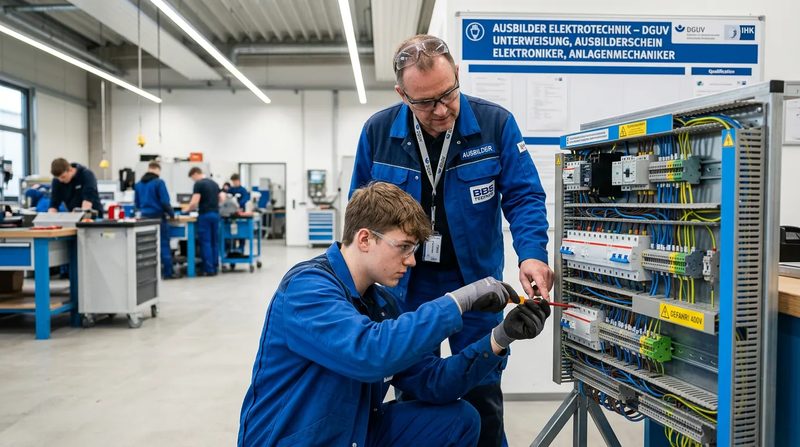
While much of the world debates university degrees, Germany quietly runs the most admired vocational training system on Earth. Around half of each cohort enters the dual system, splitting time between classroom and company, emerging as certified Mechatroniker, bakers, bankers or IT specialists. The result: youth unemployment far below European averages, a manufacturing sector with unmatched skilled labour, and a social prestige for trades that other countries can only envy. How does the system work, and can it be copied?
The dual system: how it works
The dual system pairs apprentices with employers for two to three and a half years. Trainees spend three or four days a week working in a company, earning a training wage, and one or two days at a vocational school learning theory. Some 330 recognised occupations have standardised curricula, from industrial mechanics to office clerks. At the end, apprentices sit standardised exams set with industry chambers, and the certificate is recognised nationwide. Companies invest because they are training their future workforce; apprentices commit because the qualification is a genuine passport.
Why employers play along
The system’s genius is aligning incentives. German firms, from giants like Siemens and BMW to the Mittelstand of family-owned manufacturers, train far more apprentices than they need, accepting the cost because trained workers are productive, loyal and exactly matched to their needs. Chambers of commerce police quality, and unions sit on the boards that design curricula, so training reflects real workplace demands. Poaching is restrained by the shared understanding that everyone trains. It is a collective bargain no single company could sustain alone.
The school-to-work pipeline
German schooling streams pupils early: after primary school, students enter Gymnasium (academic), Realschule or Hauptschule tracks, with the latter two feeding apprenticeships. Critics call early tracking socially divisive, and it is true that immigrant and working-class children cluster in lower tracks. But the system offers permeability: apprentices can add qualifications, attend master schools, and even progress to university. The Meister, master craftsman, title still commands respect, and a master baker or electrician can earn more than many graduates.
What the system delivers
The payoff is visible in the data. German youth unemployment has long been among Europe’s lowest, even during crises that devastated young workers in Spain or Greece. Employers report fewer skills gaps, and German manufacturing’s quality edge rests substantially on this pipeline of practical skill. Socially, the system gives non-academic teenagers a respected path to adulthood, wages and identity, avoiding the graduate-unemployment trap that plagues degree-inflated economies. Dignity of labour is not a slogan here; it is institutionalised.
The strains and the critics
The model faces pressure. Digitalisation is transforming occupations faster than curricula update; some traditional apprenticeships attract too few applicants while IT roles go unfilled. Demographic decline shrinks the applicant pool, and many firms complain school-leavers lack basic skills. Academisation pulls more youths toward university, and the early tracking system perpetuates inequality. Germany is responding with modernised training regulations, better career guidance and efforts to open apprenticeships to refugees and immigrants.
Can the world copy Germany?
Everyone wants the dual system; few replicate it. Britain, the US and others have launched apprenticeship drives with mixed results, because the model needs employer coordination, union involvement, standardised certification and cultural respect for trades, none of which can be legislated overnight. Where elements transfer, work-based learning, employer-designed standards, they help. Germany’s lesson may be less a blueprint than a principle: treat vocational training as a first-class route, invest in it collectively, and the skills will follow.
FAQs
Do apprentices get paid in Germany? Yes, a monthly training allowance that rises each year, typically from several hundred to over a thousand euros.
Can apprentices go to university later? Yes, through further qualifications like the Meister or Fachabitur, the system is designed to be permeable.
Why is German youth unemployment so low? Largely because the dual system moves teenagers directly into structured training and employment instead of leaving them to navigate the job market alone.
Germany’s apprenticeship system is a quiet triumph of coordination over markets: companies, unions, schools and the state building skilled workers together. In an age anxious about the future of work, it remains the gold standard for turning teenagers into professionals.
Source: Deutsche Welle

Khabar 24h Editorial Desk — our explainers are prepared by the Khabar 24h editorial team using AI-assisted research tools, and every piece is reviewed by a human editor before publishing. We do not claim original reporting: our work is turning complex topics into simple, accurate summaries. Spotted an error? Write to contact@khabar24h.com — our corrections policy aims for same-day review.
More from this author →