Confucianism Explained: The Philosophy That Shaped East Asia
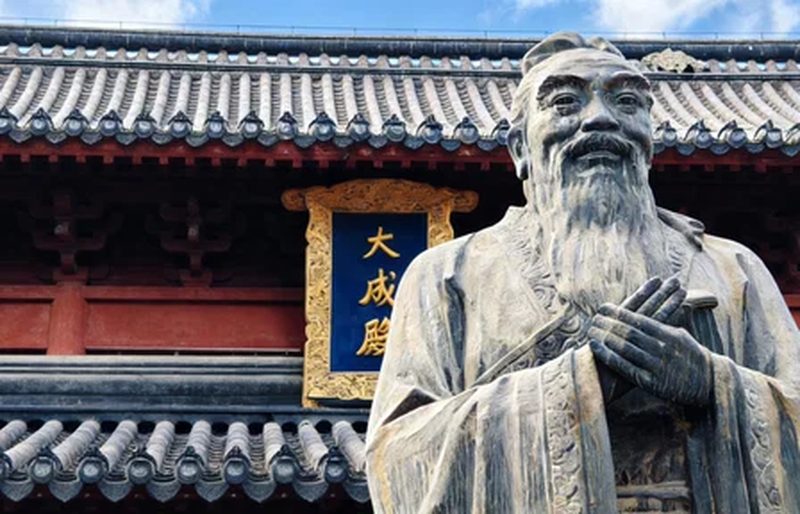
For two millennia, the ideas of a Chinese teacher who died in 479 BCE governed the world’s largest civilisation. Confucianism shaped China’s government, family life and education, spread to Korea, Japan and Vietnam, and still colours how hundreds of millions think about duty, learning and authority. It is less a religion than a complete social philosophy, a manual for becoming a good person and running a good state. Its modern revival, from Beijing to boardrooms, makes it newly worth understanding.
Confucius and his world
Confucius, Kongzi, lived during China’s chaotic Spring and Autumn period, an age of warring states and collapsing order. A teacher and briefly a minister, he wandered between courts offering rulers a programme for restoring harmony, with limited success in his lifetime. His disciples recorded his sayings in the Analects, one of the most influential books ever written: short, gnomic, endlessly quotable. After his death his ideas were systematised by followers like Mencius and Xunzi, and under the Han dynasty Confucianism became China’s state orthodoxy, a position it held, with interruptions, for 2,000 years.
The core virtues: ren, li and yi
Confucian ethics centre on ren, humaneness or benevolence, the supreme virtue of caring for others, famously expressed as the negative golden rule: do not do to others what you do not want done to yourself. Li means ritual propriety, the codes of respectful conduct that make social life graceful, from mourning rites to table manners. Yi is righteousness, doing right because it is right. Together with wisdom and trustworthiness they form the gentleman’s, the junzi’s, character: the ideal of the cultivated person that Confucian education aimed to produce.
Family as the model of society
Confucius saw society as an extension of family. The Five Relationships, ruler-subject, parent-child, husband-wife, elder-younger sibling, friend-friend, each carry mutual duties: the superior owes care and moral example, the inferior owes respect and obedience. Filial piety, devotion to parents and ancestors, became the supreme virtue, shaping everything from living arrangements to ancestor worship. Critics have long charged that this hierarchy entrenched patriarchy and obedience; defenders reply that the duties run both ways, and a ruler who fails his people forfeits legitimacy.
Government by virtue
Confucian political theory is striking: the state should be run not by laws and punishments but by moral example. A virtuous ruler inspires virtuous subjects; good government flows from good character. This justified rule by educated scholar-officials, selected through gruelling civil service examinations on the Confucian classics, the world’s first meritocracy, centuries before Europe. The system produced extraordinary administrative continuity, and also rigidity: when the exams rewarded memorisation over innovation, critics blamed Confucianism for China’s later stagnation.
Decline, attack and revival
The 20th century was brutal to Confucius. Reformers blamed his teachings for China’s weakness; the Communist revolution denounced Confucianism as feudal poison, and Red Guards smashed his temples during the Cultural Revolution. Then came the reversal: as China rose, the state rehabilitated Confucius as a symbol of cultural pride, opening Confucius Institutes worldwide. East Asia’s economic miracle was even credited to Confucian values, respect for education, thrift, discipline. Whether that credit is deserved is debated, but the Master’s return from disgrace is one of modern history’s great ironies.
Confucianism beyond China
Korea embraced Confucianism perhaps most thoroughly, and its traces remain in education obsession, corporate hierarchy and family ritual. Japan blended it with native traditions, producing the samurai ethic and the salaryman culture. Vietnam’s mandarin system was Confucian to the core. Across the region, the shared inheritance includes reverence for learning, respect for elders, and the belief that society works when everyone honours their roles. Modern East Asia, for all its neon modernity, still runs partly on 2,500-year-old software.
FAQs
Is Confucianism a religion? It is usually classed as a philosophy or ethical system; it has no god or afterlife doctrine, though it includes rituals like ancestor veneration.
What is the golden rule in Confucianism? Do not impose on others what you yourself do not desire, stated by Confucius five centuries before Christianity.
Why do East Asian students study so hard? Scholars trace the region’s education obsession partly to Confucianism’s reverence for learning and its examination tradition.
Confucius never claimed divinity, performed no miracles and founded no church. He simply taught that human beings can perfect themselves through learning, ritual and care for others, and that a society of such people would be harmonious. Twenty-five centuries later, half the world is still running the experiment.
Source: Stanford Encyclopedia of Philosophy

Khabar 24h Editorial Desk — our explainers are prepared by the Khabar 24h editorial team using AI-assisted research tools, and every piece is reviewed by a human editor before publishing. We do not claim original reporting: our work is turning complex topics into simple, accurate summaries. Spotted an error? Write to contact@khabar24h.com — our corrections policy aims for same-day review.
More from this author →