The Sahara Desert Explained: How the World’s Largest Hot Desert Is Growing
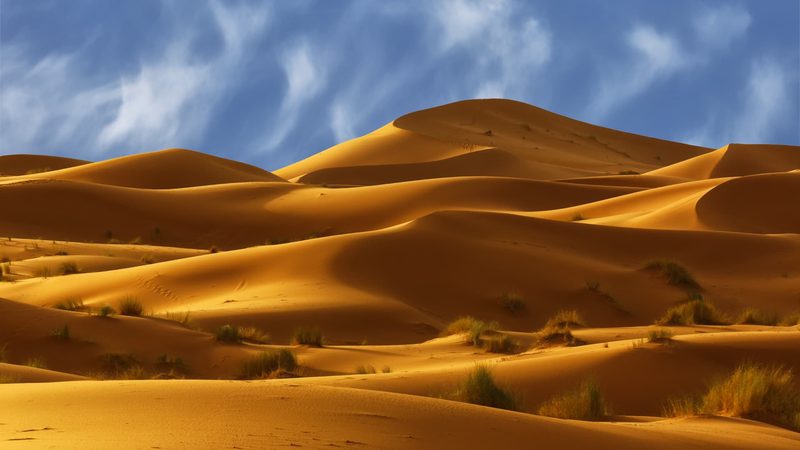
The Sahara is the largest hot desert on earth: 9 million square kilometres of sand, rock and extremes, spanning eleven countries from the Atlantic to the Red Sea. It is also growing, with desertification swallowing farmland and pastures at its southern edge, fuelling conflict, migration and hunger across the Sahel. This explainer shows how the desert expands, what drives it, and the audacious plan to hold it back.
How the Sahara grows
Desertification is not dunes marching forward like an army but land degrading in place: overgrazing, deforestation, poor farming and drought strip soil of vegetation until it cannot recover. Studies suggest the Sahara has expanded by about 10 per cent in a century, with the Sahel, the semi-arid belt to its south, bearing the brunt. Climate change intensifies the cycle: hotter temperatures, erratic rains and fiercer droughts. Human pressure multiplies it: the Sahel’s population is booming, demanding more food, fuelwood and pasture from fragile land.
What desertification costs
The price is measured in hunger and conflict. Degraded land yields less food for more people; herders and farmers clash over shrinking resources, violence that jihadist groups exploit across Mali, Burkina Faso and Niger. Desertification drives migration, within countries and toward Europe, as livelihoods collapse. Dust storms from the Sahara carry health costs across continents and even fertilise the Amazon, a reminder that the desert’s reach is global. The UN estimates land degradation costs the world trillions yearly in lost productivity.
The Great Green Wall
Africa’s answer is the Great Green Wall: an 8,000-kilometre mosaic of restored land across the Sahel, launched by the African Union in 2007. The vision evolved from a wall of trees to a patchwork of agroforestry, water harvesting and sustainable farming. Progress is real but slow: millions of hectares restored, millions of jobs promised, but funding falls far short of the tens of billions needed, and insecurity in the central Sahel stalls work. Where it advances, in Senegal, Ethiopia and Niger’s farmer-managed regreening, degraded land blooms again, proof that desertification is reversible.
- The Sahara covers about 9 million sq km across 11 countries.
- It has expanded roughly 10% over the past century.
- The Great Green Wall aims to restore 100 million hectares by 2030.
- Land degradation costs the global economy trillions of dollars yearly.
Can deserts be reversed?
Yes, and the techniques are ancient and proven: planting drought-tolerant trees, half-moon water catchments, zai pits that concentrate nutrients, and letting farmers manage natural regrowth. Niger’s farmers have regreened millions of hectares simply by protecting sprouting trees. The barriers are not technical but political: land tenure, funding, conflict and governance. Israel’s desert agriculture and China’s Loess Plateau restoration show what sustained investment achieves. The Sahara will not shrink, but its edges can be held, and its victims can be given alternatives to flight.
The bigger picture
The Sahara’s growth is a local expression of a global crisis: a third of Earth’s land is degraded, and deserts expand on every continent. Fighting desertification is climate action, food security and conflict prevention in one. The Great Green Wall is the world’s most ambitious ecological project; its success or failure will signal whether humanity can repair the land it depends on. The desert teaches an old lesson: civilisations are built on soil, and soil, once lost, is brutally hard to regain.
FAQs
Is the Sahara really growing? Its arid zone has expanded about 10% in a century, mainly through degradation of semi-arid lands at its southern edge.
What is the Great Green Wall? An African Union initiative to restore 100 million hectares across the Sahel through trees, sustainable farming and water management.
Can desertification be reversed? Yes: proven techniques from farmer-managed regreening to water harvesting have restored millions of hectares.
The Sahara is vast, ancient and indifferent, but its expansion is humanity’s doing, and therefore humanity’s to stop. In the Sahel, the fight against the desert is the fight for the future, waged one tree, one field, one village at a time.
The desert’s advance is not inevitable. Niger’s farmers have regreened millions of hectares by protecting natural regrowth; Ethiopia’s restoration programmes show state action works. What the Sahel needs is scale: funding, land rights and peace. The Sahara will remain vast and formidable, but its edges are negotiable, and the negotiation is winnable.
Compiled by the Khabar 24h Editorial Desk from publicly available sources.

Khabar 24h Editorial Desk — our explainers are prepared by the Khabar 24h editorial team using AI-assisted research tools, and every piece is reviewed by a human editor before publishing. We do not claim original reporting: our work is turning complex topics into simple, accurate summaries. Spotted an error? Write to contact@khabar24h.com — our corrections policy aims for same-day review.
More from this author →