The Arctic Explained: Melting Ice, New Shipping Routes and Great-Power Rivalry
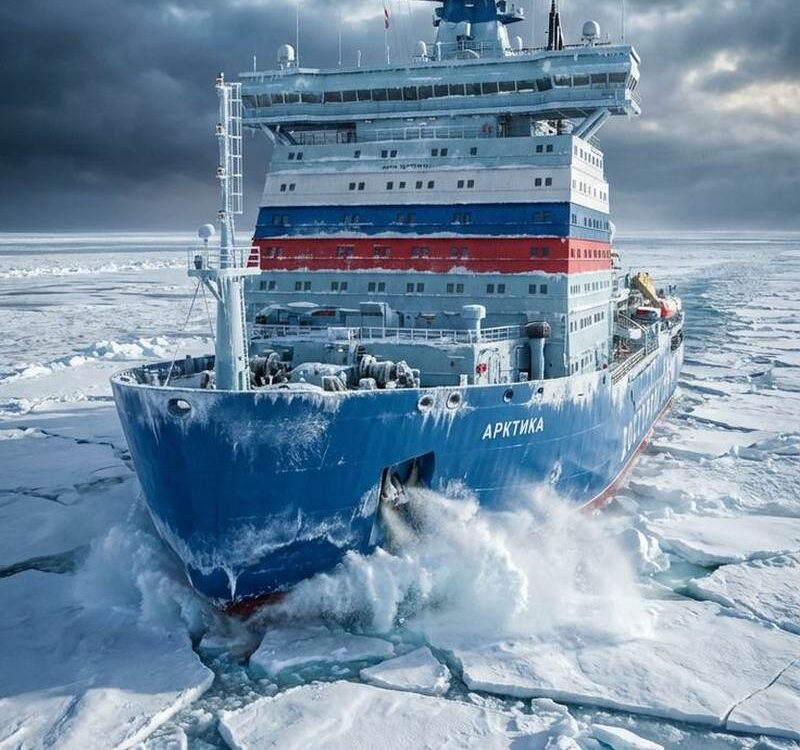
The Arctic is warming nearly four times faster than the global average, and the transformation is redrawing maps, economies and military plans. Melting sea ice is opening shipping shortcuts between Asia and Europe, exposing vast oil, gas and mineral reserves, and turning a frozen periphery into a zone of great-power rivalry. Russia is militarising, China declares itself a near-Arctic state, and NATO is waking up. This explainer covers the melting ice, the new routes and the race for the North.
What is happening to the ice
Arctic sea ice is collapsing: summer extent has shrunk by about half since satellite records began, and the oldest, thickest ice is mostly gone. Scientists expect ice-free Septembers within decades, possibly sooner. Greenland’s ice sheet is shedding hundreds of billions of tonnes yearly. Permafrost is thawing, buckling infrastructure and releasing methane, a potent greenhouse gas. The warming is self-reinforcing: dark ocean absorbs more heat than reflective ice, the albedo feedback that makes the Arctic the planet’s early-warning system. What happens in the Arctic does not stay in the Arctic: it disrupts weather patterns worldwide.
The new shipping routes
Retreating ice opens three coveted passages. Russia’s Northern Sea Route slashes Asia-Europe voyages by up to 40 per cent; Moscow is investing in icebreakers and ports to control it, and demands foreign ships seek permission. Canada’s Northwest Passage threads its archipelago, a sovereignty dispute with Washington, which calls it international waters. The transpolar route, straight over the North Pole, awaits deeper melt. Traffic is growing but remains modest: ice, darkness, poor charts and high insurance keep the Arctic a niche corridor, though LNG tankers and cruise ships multiply yearly.
The resource prize
The Arctic is estimated to hold vast undiscovered oil and gas, plus minerals critical for batteries and electronics. Russia is already drilling; Norway debates its northern fields; Greenland’s minerals draw global suitors. But extraction is brutally expensive and environmentally perilous, and the energy transition clouds oil’s future. Fishing is the more immediate prize: warming waters push stocks north, creating management disputes. The resources are real but often uneconomic, which is why the military race, not the mining race, dominates headlines.
- The Arctic is warming nearly 4x faster than the global average.
- Summer sea ice extent has roughly halved since 1979.
- Russia operates the world’s largest icebreaker fleet by far.
- Eight nations form the Arctic Council; China is an observer state.
The great-power rivalry
Russia sees the Arctic as its strategic bastion: reopened Soviet bases, new airfields, and the Northern Fleet’s nuclear submarines make it the dominant military power there. China, calling itself a near-Arctic state, invests in Russian LNG, research stations and shipping, eyeing a Polar Silk Road. The US, long inattentive, is rebuilding: new icebreakers, Greenland’s upgraded Thule base, and NATO’s Nordic expansion after Finland and Sweden joined. The Arctic Council, the region’s governance forum, froze cooperation with Russia after Ukraine, fracturing the institutions that managed the North peacefully.
The people of the North
Four million people live in the Arctic, including indigenous nations like the Inuit, Sami and Chukchi, whose cultures are built on ice and animals now in flux. Thawing ground destroys homes and heritage sites; changing ice endangers hunting; but development also brings jobs and revenue. Indigenous groups demand seats at every table, and their knowledge is increasingly recognised as essential science. The Arctic’s future will be decided in Moscow, Washington and Beijing, but it will be lived in Utqiagvik, Nuuk and Tromso.
FAQs
Who owns the Arctic? Eight Arctic states control territory and waters; the central Arctic Ocean is international, with seabed claims under UN review.
Is the Northern Sea Route open? Seasonally, with Russian icebreaker escort; it cuts Asia-Europe distance dramatically but remains costly and icy.
Why is Russia so active there? The Arctic holds its nuclear deterrent bastion, vast resources, and the Northern Sea Route it seeks to control.
The Arctic was once a frozen desert at the edge of strategy; it is becoming a central theatre of climate change and great-power competition. The ice is melting, the ships are coming, and the rules for the new North are being written in real time.
The Arctic’s transformation is the century’s great geographical event: a frozen ocean becoming a navigable sea, a periphery becoming a prize. Whether it becomes a zone of cooperation or conflict depends on choices made in distant capitals, but its 4 million residents will live with the consequences first.
Compiled by the Khabar 24h Editorial Desk from publicly available sources.

Khabar 24h Editorial Desk — our explainers are prepared by the Khabar 24h editorial team using AI-assisted research tools, and every piece is reviewed by a human editor before publishing. We do not claim original reporting: our work is turning complex topics into simple, accurate summaries. Spotted an error? Write to contact@khabar24h.com — our corrections policy aims for same-day review.
More from this author →