The Amazon Rainforest Explained: Why the World’s Largest Forest Matters to Everyone
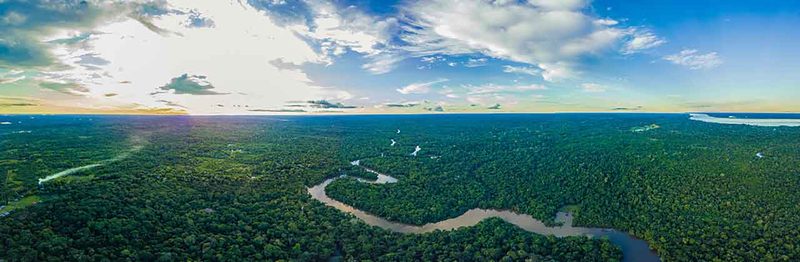
The Amazon is the world’s largest rainforest and one of its most important life-support systems: 60 per cent of it in Brazil, sprawling across nine countries, holding a tenth of all known species and storing carbon on a planetary scale. It makes its own weather, influences rainfall as far as Argentina, and has been called the lungs of the Earth. It is also being destroyed at an alarming rate. This explainer shows why the Amazon matters to everyone and what is killing it.
Why the forest matters
The Amazon’s importance is threefold. Ecologically, it is the most biodiverse place on earth: millions of species, many undiscovered, in a forest that took millions of years to evolve. Climatically, it stores 100 billion tonnes of carbon and pumps moisture into the atmosphere through flying rivers, airborne water vapour that waters South America’s breadbaskets. Economically, it sustains 30 million people, including hundreds of indigenous nations, and provides rainfall for agriculture worth billions. Lose the Amazon and the world loses a species library, a climate stabiliser and a rainfall engine at once.
What is destroying it
Deforestation is driven by a ruthless economics: cattle ranching accounts for most clearing, followed by soy farming, logging, mining and infrastructure. Brazil’s arc of deforestation advances along new roads; illegal gold mining poisons rivers with mercury; land-grabbers clear forest to claim title. Politics accelerates the cycle: Jair Bolsonaro’s presidency gutted enforcement and deforestation surged, while Luiz Inacio Lula da Silva’s return brought pledges to end it, with mixed results. The underlying force is demand: the world wants cheap beef, soy and gold, and the forest pays.
The tipping point warning
Scientists warn the Amazon is nearing a tipping point where deforestation and climate change turn rainforest into savanna. Models suggest losing 20-25 per cent of the forest could trigger dieback; some regions are already there. A savanna Amazon would release its stored carbon, accelerating global warming, and collapse the rainfall systems southern Brazil’s farms depend on. Parts of the southeastern Amazon already emit more carbon than they absorb. The tipping point is not a distant theory but a measurable approach, and crossing it would be irreversible on human timescales.
- The Amazon spans 9 countries; about 60% lies in Brazil.
- It holds roughly 10% of the world’s known species.
- An estimated 17-20% of the original forest has been lost.
- Scientists warn of a tipping point at 20-25% deforestation.
Who is fighting to save it
The forest’s defenders are its indigenous peoples, who protect lands with far lower deforestation rates than surrounding areas, plus a coalition of scientists, prosecutors, journalists and international donors. Norway and Germany’s Amazon Fund pays Brazil for verified results. Satellite monitoring now exposes illegal clearing in near real-time. Market pressure works too: soy and beef moratoriums, where traders refuse deforestation-linked products, have slowed clearing in key areas. But defenders are murdered with impunity: land conflicts kill activists every year, and enforcement remains outgunned.
Can the Amazon be saved?
The technical solutions exist: enforce the law, pay for standing forest, title indigenous lands, and shift agriculture to already-cleared areas. Brazil has shown deforestation can fall fast when governments act, as it did in the 2000s and again after 2023. The obstacles are political and economic: the farm lobby’s power, the poverty that drives clearing, and a world unwilling to pay what conservation costs. The 2030 zero-deforestation pledges will be the test. The Amazon’s fate will be decided less in the forest than in Brasilia’s congress, Beijing’s commodity markets and the choices of consumers worldwide.
FAQs
How much of the Amazon is gone? About 17-20 per cent of the original forest has been cleared, mostly for cattle and soy.
What is the tipping point? The threshold, estimated at 20-25% loss, beyond which the rainforest could irreversibly degrade into savanna.
Who owns the Amazon? Nine countries share it, with Brazil holding 60%; indigenous territories cover large areas and are among the best-protected lands.
The Amazon is the planet’s greatest ecological treasure and its most urgent rescue mission. It survived ice ages and empires; whether it survives the 21st century depends on decisions being made right now, in capitals far from its canopy.
The decisions made in the next few years, in Brasilia, in commodity markets, in consumer choices worldwide, will determine whether the world’s greatest rainforest survives the century.
Compiled by the Khabar 24h Editorial Desk from publicly available sources.

Khabar 24h Editorial Desk — our explainers are prepared by the Khabar 24h editorial team using AI-assisted research tools, and every piece is reviewed by a human editor before publishing. We do not claim original reporting: our work is turning complex topics into simple, accurate summaries. Spotted an error? Write to contact@khabar24h.com — our corrections policy aims for same-day review.
More from this author →