How AI Voice Cloning Works: The Technology Behind Synthetic Speech
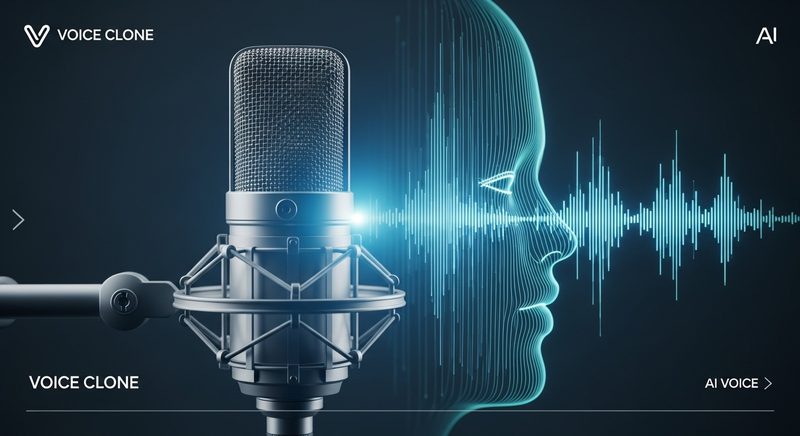
A few seconds of someone’s voice is now enough for AI to speak any sentence in a near-perfect imitation of them. Voice cloning powers audiobooks narrated by authors long gone, personalised assistants that sound like family members, and, more darkly, convincing phone scams. The technology behind synthetic speech has advanced from robotic monotone to uncanny realism in less than a decade. This guide explains how AI voice cloning actually works, what makes a clone convincing, and where the line between useful and dangerous lies.
From text to speech: the two-step pipeline
Modern voice cloning systems work in two stages. First, a speaker encoder listens to a short sample of the target voice, sometimes as little as three seconds, and distils it into a speaker embedding: a compact mathematical signature capturing the qualities that make that voice distinctive, its pitch range, timbre, rhythm and accent. Second, a synthesis model takes the text you want spoken plus that embedding and generates the audio waveform, shaping every phoneme to match the target voice’s characteristics. Early systems needed hours of recordings and produced flat, robotic output. Today’s models learn the speaker’s identity from tiny samples and generate speech with natural pauses, emphasis and emotion, because they were trained on hundreds of thousands of hours of diverse human speech.
What makes a clone convincing
Several ingredients separate a rough imitation from an uncanny one.
- Prosody modelling: capturing not just how a voice sounds but how its owner speaks, the rise and fall of sentences, the pauses, the energy.
- Large training corpora: models trained on vast, multilingual speech datasets generalise better to new voices and accents.
- Neural vocoders: the component that turns abstract representations into actual sound waves has become dramatically more natural.
- Emotion control: leading systems can now render the same sentence as whispered, cheerful or urgent on demand.
- Noise robustness: good encoders extract a clean voice signature even from imperfect phone-quality samples.
Together these advances mean the gap between a clone and the real voice is now smaller than the gap between two recordings of the same person on different days.
The legitimate uses growing fast
Voice cloning is not only a scammer’s tool. Film studios use it to fix dialogue without costly reshoots. Audiobook publishers produce narrations in the author’s own voice at a fraction of traditional studio cost. People losing their speech to illness bank their voices while they still can, then speak through the clone. Video creators localise content into dozens of languages while keeping the original speaker’s voice. Accessibility tools give non-speaking users a natural voice of their own choosing. In each case the technology restores or extends human expression rather than faking it, and consent is the bright line that separates these uses from abuse.
The dark side: scams and fraud
The same capability enables convincing fraud. Criminals scrape a few seconds of voice from social media videos, clone it, and call relatives with urgent pleas for money, the grandparent scam supercharged by AI. Fake audio of executives has been used to authorise fraudulent transfers. Fabricated clips of politicians saying things they never said circulate as disinformation. The defence is partly technical: researchers are building audio watermarking and deepfake detectors, though detection remains an arms race. It is partly procedural: families and companies are adopting code words and callback verification for urgent requests. And it is partly legal: several countries have begun criminalising non-consensual voice cloning. The uncomfortable truth is that you can no longer trust a familiar voice on the phone as proof of identity.
How the technology keeps improving
The frontier is moving toward zero-shot multilingual cloning, where a model clones a voice it has never heard speaking a language it barely trained on, and toward real-time voice conversion for live calls. Researchers are also working on consent infrastructure: systems that only clone voices with cryptographic proof of permission, and inaudible watermarks embedded in synthetic audio so detectors can flag it later. The trajectory mirrors every dual-use technology: capability races ahead while safeguards scramble to catch up. For now, the practical advice is simple: enjoy the legitimate wonders, verify urgent voice requests through a second channel, and remember that hearing is no longer believing.
FAQs
How much audio is needed to clone a voice? Modern systems need as little as three to ten seconds for a recognisable clone, though a minute or more of clean audio produces markedly better quality.
Is voice cloning legal? Cloning your own voice or someone else’s with consent is generally legal. Non-consensual cloning for fraud or impersonation is illegal in most jurisdictions, and specific deepfake laws are spreading.
Can detectors reliably spot cloned audio? Not reliably. Detectors work against known generation methods but struggle with new ones, so technical detection should never be your only defence.
AI voice cloning compresses a lifetime of vocal identity into seconds of audio and a few billion parameters. It is a marvel of engineering that restores voices to those who lost them and a weapon that puts words in anyone’s mouth. Which of those futures dominates depends less on the technology than on the norms, laws and habits we build around it now.
Compiled by the Khabar 24h Editorial Desk from publicly available sources.

Khabar 24h Editorial Desk — our explainers are prepared by the Khabar 24h editorial team using AI-assisted research tools, and every piece is reviewed by a human editor before publishing. We do not claim original reporting: our work is turning complex topics into simple, accurate summaries. Spotted an error? Write to contact@khabar24h.com — our corrections policy aims for same-day review.
More from this author →