The Silk Road Explained: How Ancient Trade Connected East and West
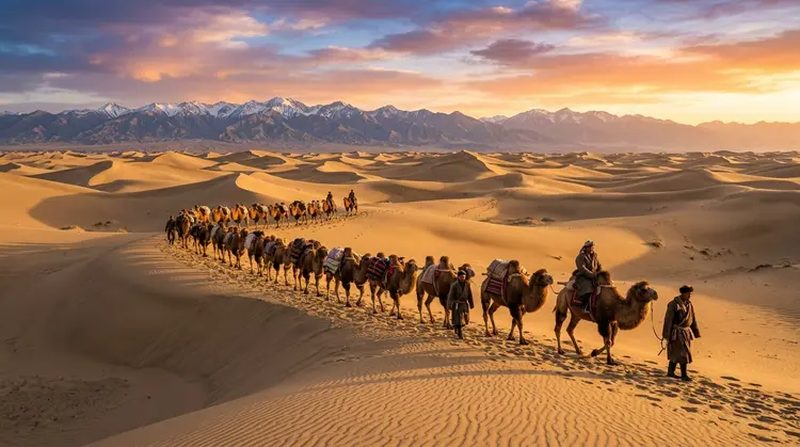
For some 1,500 years, caravans crossed the deserts and mountains of Asia along a network of routes carrying silk west and gold, glass and ideas east. The Silk Road was history’s first great information highway: along it travelled Buddhism to China, paper to the West, and technologies that would remake civilisations. It was never a single road, and silk was only part of the cargo. This is how the ancient world’s globalisation worked.
What the Silk Road actually was
The Silk Road was a shifting web of trade routes linking Chang’an (Xi’an) in China to the Mediterranean, some 7,000 miles, crossing deserts like the Taklamakan, mountain passes like the Pamirs, and oasis cities like Samarkand, Kashgar and Bukhara. Named by a 19th-century German geographer, it was less a road than a relay: few merchants travelled the whole distance, goods passed hand to hand through chains of middlemen. It flourished when strong empires, Han China, Rome, the Mongols, secured the routes, and withered when they didn’t.
More than silk: what travelled the road
Silk gave the road its name and China its fortune, light, precious, and desperately wanted by Roman elites. Westbound went porcelain, tea, paper and gunpowder’s ancestors; eastbound came horses, prized by Chinese armies, glassware, gold, silver and wool. But the most consequential cargo was intangible: Buddhism travelled from India to China and Japan along these routes, carried by missionaries and translated scriptures. Islam, Nestorian Christianity and Manichaeism spread the same way. Technologies, papermaking, printing, the stirrup, moved along caravan tracks and changed history.
The oasis cities: globalisation’s first hubs
The road’s beating heart was its oasis cities, cosmopolitan bazaars where Chinese, Persian, Indian, Arab and steppe peoples mixed. Samarkand grew rich on paper mills and became a centre of Islamic scholarship; Dunhuang’s Mogao Caves preserve a millennium of Buddhist art funded by merchant donations; Chang’an was the world’s largest city, with foreign quarters, exotic foods and imported religions. These cities were the ancient equivalent of global financial centres, living off the flows between empires.
Danger, bandits and the cost of trade
The romance obscures the risk. Caravans faced bandits, corrupt officials, waterless deserts where the Taklamakan’s name allegedly means go in and you won’t come out, and passes where altitude and cold killed men and beasts. Protection cost money: empires garrisoned the routes, merchants hired guards, and cities taxed every bale. The rewards justified it: markups of hundreds of per cent made fortunes. The Silk Road was high-risk, high-return venture capitalism with camels.
Why the Silk Road declined
The road faded when its conditions vanished. The Mongol peace that made the 13th century its golden age collapsed with the empire; the Black Death, which likely travelled these same routes, devastated the cities; and in the 1400s, European ships found sea routes to Asia, undercutting the overland trade. The ocean killed the caravan. Central Asia’s oasis cities shrank into obscurity for centuries, until archaeologists and modern geopolitics rediscovered them.
The Silk Road’s modern ghost
Today the Silk Road is back as metaphor and policy. China’s Belt and Road Initiative explicitly invokes it, building railways, ports and pipelines across the same corridors. The China-Europe freight trains now rumble through Kazakhstan and Poland on schedules the camel caravans would envy. Historians debate whether the romance obscures a thinner reality, but the underlying truth stands: for 1,500 years, Asia was connected, and the connectedness shaped everything from religion to technology. Globalisation is older than we think.
What the Silk Road teaches today
The Silk Road’s deepest lesson is that prosperity follows connection. The oasis cities thrived not by producing everything but by sitting on the flows between producers. Modern logistics hubs, from Dubai to Singapore, play the same role. And the road warns against fragility: when the Mongol peace broke, the whole network withered. Connection is powerful, but it needs guardians.
FAQs
Was the Silk Road one road? No, it was a network of shifting overland and maritime routes connecting East Asia to the Mediterranean and beyond.
What ended the Silk Road? The collapse of the Mongol peace, the plague, and above all the European discovery of cheaper sea routes to Asia in the 1400s.
Did Marco Polo travel the Silk Road? According to his famous account, yes, reaching the Mongol court in the late 1200s, though scholars still debate details of his story.
The Silk Road reminds us that civilisations were never isolated: they were always trading, borrowing and arguing across the desert. The caravans are gone, but the connections they forged, faiths, foods, ideas, are still with us.
Compiled by the Khabar 24h Editorial Desk from publicly available sources.

Khabar 24h Editorial Desk — our explainers are prepared by the Khabar 24h editorial team using AI-assisted research tools, and every piece is reviewed by a human editor before publishing. We do not claim original reporting: our work is turning complex topics into simple, accurate summaries. Spotted an error? Write to contact@khabar24h.com — our corrections policy aims for same-day review.
More from this author →