What Is a Large Language Model? How AI Predicts Its Next Word
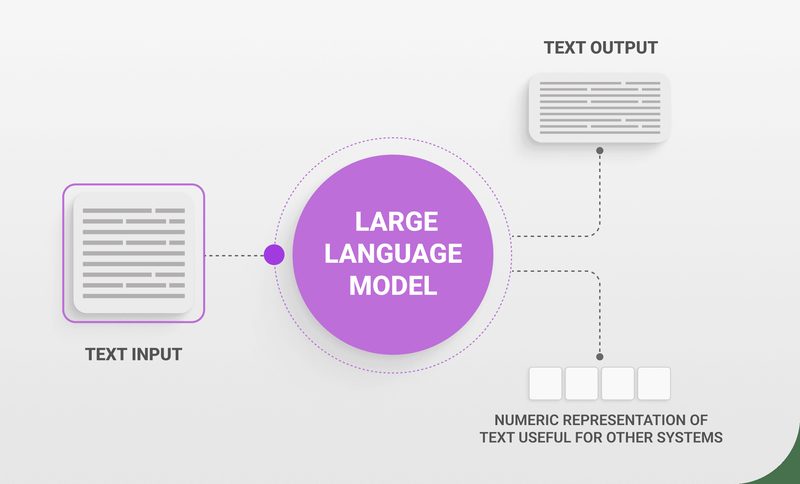
When you ask a chatbot a question and watch the answer stream out word by word, it can feel like watching a mind at work. In reality, a large language model is doing something far simpler and far stranger: it is predicting the next word, then the next, then the next, thousands of times, until a full answer exists. This single mechanism, repeated at enormous scale, is the engine behind ChatGPT, Gemini, Claude and every other modern chatbot. Here is how it works, what the jargon means, and why such a simple trick produces such remarkable results.
What a large language model actually is
A large language model is a computer program with a very large number of adjustable settings, called parameters, that has been trained on a very large amount of text. The word large refers to both: modern models have tens or hundreds of billions of parameters and have read trillions of words during training, drawn from books, encyclopaedias, websites, forums and code repositories. The parameters are numbers that the training process adjusts, little by little, so the model gets better at its one job: given some text, guess what comes next. After enough training, those billions of numbers encode a rich statistical picture of how language works, and of the facts, reasoning patterns and styles embedded in the text it read.
How next-word prediction works in practice
Behind the scenes, the model does not work with whole words but with tokens, chunks of text that can be whole words, parts of words or punctuation marks. When you type a prompt, the model converts it into tokens and, for each position, assigns a probability to every token in its vocabulary for what should come next. It then picks one, usually sampling from the most likely candidates rather than always taking the top choice, which is why asking the same question twice can give slightly different answers. The chosen token is appended to the sequence, and the process repeats. This is why answers stream out one word at a time: the model is genuinely generating the text incrementally, with each new token conditioned on everything that came before it. There is no hidden script or database of answers; the response is composed fresh on every run.
What happens inside the transformer
Almost every modern language model uses an architecture called the transformer. Its key innovation is a mechanism called attention, which lets the model weigh the relevance of every earlier word when predicting the next one. In the sentence about a bank, attention helps the model decide whether bank means a river bank or a financial institution by attending to surrounding words like water or money. A transformer stacks many layers of attention and other computations, dozens or even over a hundred layers deep, so that early layers pick up grammar and local structure while deeper layers track topics, arguments and long-range references across thousands of words. Training adjusts billions of parameters across these layers using a simple feedback signal: how wrong was the prediction. Repeated trillions of times, this optimisation sculpts the model into a fluent language machine.
Why scale changed everything
Researchers discovered something unexpected as they made models bigger: capabilities appeared that were not explicitly programmed. Small models could complete sentences; much larger ones could suddenly summarise documents, translate languages, write code and follow complex instructions. This phenomenon, called emergence, is why the field moved so fast in the 2020s. More parameters, more training data and more computing power kept unlocking new abilities, and the companies building the frontier models, OpenAI, Google, Anthropic and others, poured ever-larger supercomputers into training runs that cost tens or hundreds of millions of dollars. Scale does not guarantee truthfulness or common sense, but it has repeatedly been the difference between a toy and a tool.
What prediction cannot do
The mechanism has built-in limits worth knowing.
- It optimises for plausibility, not truth, so confident-sounding falsehoods, called hallucinations, are always possible.
- It cannot verify facts against the real world unless given tools such as web search or calculators.
- It has a fixed context window, so very long conversations can push earlier details out of its working memory.
- It reflects the biases and errors present in its training data, because that is all it ever learned from.
These are not bugs that a quick patch will fix; they are consequences of how the technology works.
FAQs
Does the model understand what it is saying? It has no consciousness or lived experience. It manipulates language with extraordinary statistical skill, which produces behaviour that looks like understanding without the inner life that the word implies for humans.
Why do answers differ each time I ask? Because the model samples from probable next words rather than always picking the single most likely one. That randomness is also what lets it be creative.
What is a token? A chunk of text the model processes as one unit, roughly three-quarters of an English word on average. Context windows are measured in tokens, not words.
A large language model is, at bottom, an extremely sophisticated autocomplete, trained on a library larger than any human could read in a thousand lifetimes. That such a simple objective, predict the next word, could give rise to machines that explain physics, write software and argue philosophy is one of the most surprising discoveries in the history of computing. Knowing the mechanism does not make the results less impressive; it makes them more useful, because you know exactly where to trust them and where to check.
Compiled by the Khabar 24h Editorial Desk from publicly available sources.

Khabar 24h Editorial Desk — our explainers are prepared by the Khabar 24h editorial team using AI-assisted research tools, and every piece is reviewed by a human editor before publishing. We do not claim original reporting: our work is turning complex topics into simple, accurate summaries. Spotted an error? Write to contact@khabar24h.com — our corrections policy aims for same-day review.
More from this author →