Penalty Corners in Hockey Explained: Techniques and Defensive Strategies
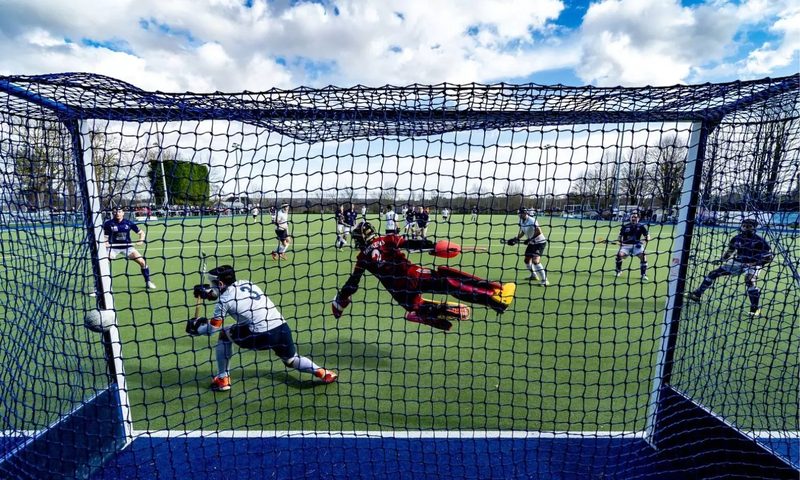
In field hockey, no passage of play is more choreographed, more explosive or more decisive than the penalty corner. Awarded for defensive fouls in the shooting circle, it gives the attacking team a rehearsed, high-percentage scoring chance: a push-out, a stop, and a shot that can exceed 100 kph. Entire matches turn on penalty-corner execution and defence, and specialists who master the drag-flick become their teams’ most valuable players. This guide explains the techniques of the penalty corner and the strategies defences use to stop it.
How the penalty corner works
The routine begins with the ball placed on the backline, at least ten metres from the goalpost. An attacker pushes the ball out to a teammate waiting at the top of the circle, who stops it dead, and the shot follows: either a direct hit, which must not rise dangerously above the backboard on the first shot, or the more lethal drag-flick. Five defenders, including the goalkeeper, may defend from behind the goal line, while the rest of the defending team waits beyond the halfway line. The attackers position themselves around the circle for deflections and rebounds. The whole sequence unfolds in about three seconds, a blur of coordinated movement that teams rehearse hundreds of times. Variations abound: slip passes to the injector, disguised shots, and deflections off cleverly positioned forwards.
The drag-flick: hockey’s deadliest skill
The drag-flick is the penalty corner’s ultimate weapon. Unlike a hit, the drag-flicker slings the ball along the ground with a whipping motion, generating extraordinary speed while keeping it legal, the ball may be raised since it is flicked rather than hit. The technique is biomechanically complex: a low, coiled stance, a long drag across the body, and a violent release that sends the ball arrowing into the corners at speeds that give goalkeepers fractions of a second to react. Mastering it takes years, and the world’s best drag-flickers are among hockey’s highest-paid players, capable of deciding tournaments single-handedly. They aim for the top corners, the goalkeeper’s weakest zones, and disguise their intentions until the last instant. A team with an elite flicker converts a far higher percentage of corners, which is why the specialist is the first name on every team sheet.
Defensive strategies: stopping the unstoppable
Defending penalty corners is organised desperation. The first runner charges the flicker, trying to close the distance before the shot is released, a courageous role that demands sprint speed and disregard for personal safety. The remaining defenders position themselves on the goal line to cover the angles, with the goalkeeper reading the flicker’s body shape. Teams use video analysis to study opponents’ routines: where the flicker aims, which variations they favour, how the injector moves. Defensive innovations include the rushing goalkeeper, protective equipment allowing braver positioning, and tactical fouling discipline to avoid conceding corners in the first place. Some teams now employ specialist corner-defence coaches. The duel between the flicker and the first runner, three seconds of explosive action, is hockey’s purest contest of skill versus courage.
Why corners decide tournaments
At the elite level, where open-play goals are hard to come by against organised defences, penalty corners are the great differentiator. Statistics show that a large share of goals in major tournaments comes from corners, and knockout matches are routinely decided by corner execution. This is why teams invest so heavily in flickers and routines, and why umpiring interpretations around circle fouls are so consequential. The penalty corner compresses hockey’s essence into three seconds: precision, power, courage and rehearsal. Master it, and you master the modern game.
- Penalty corners: push-out, stop, and shot within about three seconds.
- The drag-flick is the premium weapon, with shots exceeding 100 kph.
- Five defenders may defend from the goal line; the first runner charges the flicker.
- A large share of elite goals comes from penalty corners, especially in knockouts.
FAQs
What is a drag-flick? A flicking technique that slings the ball at extreme speed while keeping it legal, the most potent penalty-corner weapon.
Can the first shot be raised? A direct hit must not rise dangerously; flicks and deflections may be raised within the rules.
Why is the first runner so important? By charging down the flicker, the runner reduces the shooting angle and time, the defence’s best weapon against an elite flick.
The penalty corner is hockey in miniature: three seconds where preparation meets pressure and matches are won. No team conquers the modern game without mastering it.
Compiled by the Khabar 24h Editorial Desk from publicly available sources.

Khabar 24h Editorial Desk — our explainers are prepared by the Khabar 24h editorial team using AI-assisted research tools, and every piece is reviewed by a human editor before publishing. We do not claim original reporting: our work is turning complex topics into simple, accurate summaries. Spotted an error? Write to contact@khabar24h.com — our corrections policy aims for same-day review.
More from this author →