Kolkata Derby Explained: Mohun Bagan vs East Bengal Rivalry History
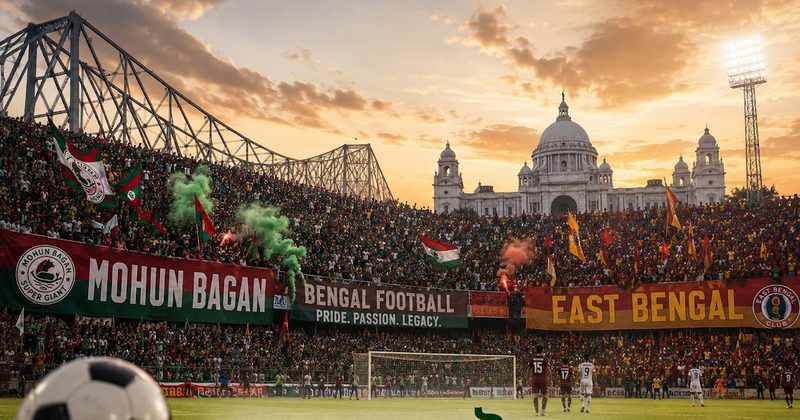
There are derbies, and then there is the Kolkata Derby: Mohun Bagan versus East Bengal, a rivalry so intense that it has defined the sporting culture of a city for over a century. Played before crowds that turn Kolkata’s great stadiums into cauldrons of noise and colour, it is routinely described as Asia’s greatest football rivalry and one of the most passionate in world football. The fixture carries the weight of history, identity and migration, making it about far more than three points. This guide explains the derby’s origins, its culture and its legendary moments.
Origins: a rivalry born of identity
The rivalry’s roots lie in the partition of Bengal and the migrations it caused. Mohun Bagan, founded in 1889, became associated with the established residents of West Bengal, while East Bengal, founded in 1920, became the club of the migrants from the east, the Bangals, who had crossed over amid upheaval. Football became the arena where these identities clashed and asserted themselves: to support East Bengal was to honour roots left behind; to support Mohun Bagan was to defend the honour of the homeland. This origin gives the derby a charge that sporting rivalries rarely possess, a sense that the match is about who you are, not just who you support. The clubs’ early encounters, played in the Calcutta Football League, drew enormous crowds and established a template of passion that has never dimmed.
The derby experience: passion and spectacle
Attending a Kolkata Derby is an assault on the senses. Tens of thousands of supporters fill the Salt Lake Stadium, divided into seas of maroon-and-green and red-and-gold, with tifos, banners, drums and chants that never stop. The noise is physical, the tension unbearable, and the players describe an atmosphere unlike anything else in Asian football. The rivalry extends beyond the stadium: the city divides, workplaces and families split, and the build-up dominates local media for weeks. It has also had its dark side, with crowd trouble marring some editions, but the overwhelming character is one of passionate, creative support. For neutrals, it is a bucket-list fixture; for Kolkatans, it is the emotional centre of the sporting year.
Great matches and legendary moments
A century of derbies has produced a folklore of unforgettable matches. There have been title deciders, cup finals and comebacks that are still argued about in the city’s coffee houses. Legendary players on both sides, from the greats of the mid-20th century to modern stars, built their reputations in this fixture, understanding that a derby hero is remembered forever. The matches have often mirrored the broader story of Indian football: the eras of dominance shifting between the clubs, the tactical battles between iconic coaches, and the individual brilliance that decides tight games. In recent years the derby has moved onto the national stage of the ISL, with both clubs’ modern avatars carrying the ancient rivalry into the franchise era, proving that some passions cannot be rebranded.
The derby in the modern era
The rivalry’s transition into the ISL era raised questions: could a century-old hatred survive corporate rebranding and new club structures? The answer has been emphatically yes. The derbies remain the league’s biggest fixtures, drawing its largest crowds and television audiences, and the old identities have proven remarkably resilient. Both clubs have invested in modern infrastructure while preserving their heritage, and the fixture continues to produce the intensity that made it famous. As Indian football evolves, the Kolkata Derby stands as proof that the game’s deepest roots still nourish its present: a reminder that football is, at its core, about belonging.
- Mohun Bagan (1889) vs East Bengal (1920): over a century of rivalry.
- Rooted in the identities of West Bengal’s residents and migrants from the east.
- Played at the Salt Lake Stadium before crowds among Asia’s largest.
- Now contested in the ISL era, still the league’s marquee fixture.
FAQs
Why is it called the Kolkata Derby? It is the derby of Kolkata (formerly Calcutta), contested by the city’s two historic giants.
Which club has won more derbies? The head-to-head has swung back and forth across the decades, with both clubs enjoying eras of dominance.
Is it really Asia’s biggest derby? By attendance, atmosphere and historical depth, it is widely regarded as the continent’s fiercest club rivalry.
The Kolkata Derby is more than a football match: it is a city’s memory, identity and passion, played out in ninety minutes. Long may it rage.
Compiled by the Khabar 24h Editorial Desk from publicly available sources.

Khabar 24h Editorial Desk — our explainers are prepared by the Khabar 24h editorial team using AI-assisted research tools, and every piece is reviewed by a human editor before publishing. We do not claim original reporting: our work is turning complex topics into simple, accurate summaries. Spotted an error? Write to contact@khabar24h.com — our corrections policy aims for same-day review.
More from this author →