Pain: Why It Hurts and How Your Body Signals Danger
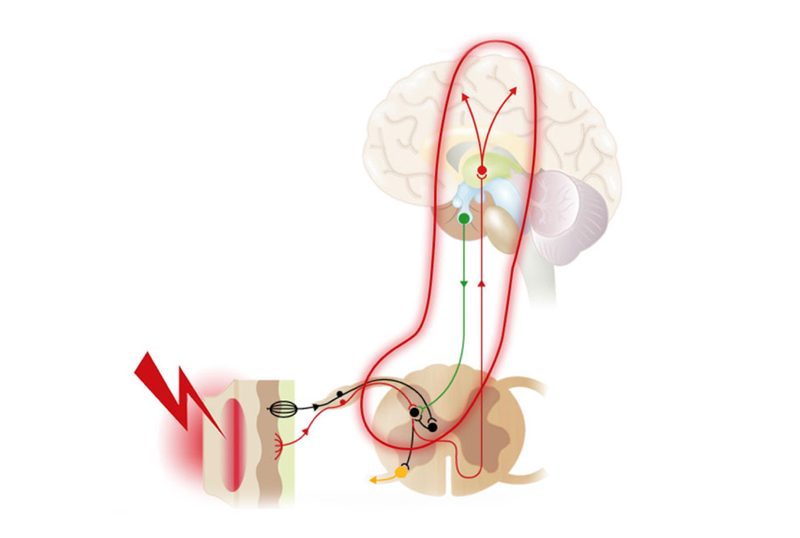
Pain is the most common reason people seek medical care, and the most paradoxical of sensations. It feels like it lives in the injured body part, but pain is constructed entirely in the brain; no brain activity, no pain, which is why general anaesthesia works. It is both a simple alarm, pull your hand from the flame, and one of the deepest mysteries in neuroscience, as the same injury can agony one person and barely register in another. Chronic pain afflicts roughly one in five adults worldwide, costs economies billions, and drove the opioid crisis that has killed hundreds of thousands. Understanding pain means understanding a signalling system that is part telephone wire, part smoke detector, and part story the brain tells about the body. Here is how it works, and why it sometimes goes wrong.
How the alarm is wired
Pain begins with nociceptors, specialised nerve endings that detect threatening stimuli: extreme heat or cold, crushing pressure, and chemicals released by damaged tissue like prostaglandins and bradykinin. When triggered, they fire electrical signals along two types of fibres: fast A-delta fibres carrying the sharp, immediate first pain, and slow C fibres carrying the dull, throbbing second pain that follows. The signals travel up the spinal cord to the brain, but the spinal cord is not a passive cable: its dorsal horn contains gate-like circuits that can amplify or suppress incoming signals, which is why rubbing a bumped elbow genuinely reduces pain and why a soldier may not notice a wound until the battle ends. In the brain, there is no single pain centre; instead, a network spanning sensory, emotional and cognitive regions constructs the experience, which is why anxiety, attention and expectation so powerfully modulate pain. Placebos can relieve pain measurably by triggering the brain’s own opioid systems, and nocebos, expecting pain, can worsen it. Pain is not a readout of tissue damage; it is the brain’s best guess about danger.
Why pain varies so wildly
The same paper cut ruins one person’s morning and is forgotten by another, and the variation is not weakness but biology. Genetics sets baseline sensitivity: variants in genes like COMT and SCN9A, which encodes a sodium channel in pain nerves, create dramatically different pain thresholds, and rare mutations can even eliminate pain entirely, a dangerous condition whose sufferers die young from unnoticed injuries. Sex hormones modulate pain, with sensitivity fluctuating across menstrual cycles. Past experience rewires the system: repeated pain can sensitise nerves, while cultural attitudes shape expression and even perception. Perhaps most fascinating is the brain’s top-down control: elite athletes, meditators and soldiers under fire all demonstrate the system’s ability to suppress pain when the brain deems other priorities more important. This variability is why pain cannot be objectively measured like blood pressure; the 1-to-10 scale, crude as it is, remains the clinical standard because pain is inherently subjective. It also explains why dismissing someone’s pain as exaggerated is scientifically illiterate: their nervous system may genuinely be sounding a louder alarm.
When the alarm won’t switch off
Chronic pain, defined as pain persisting beyond three months, is pain as disease rather than symptom. After nerves are damaged or inflammation persists, the nervous system can become sensitised: spinal circuits amplify signals, the brain’s pain networks rewire, and pain continues long after tissues have healed. Neuropathic pain from diabetes, shingles or spinal injury produces burning, electric-shock sensations from damaged nerves themselves. Phantom limb pain, felt in amputated limbs, shows the brain generating pain from its body map alone. Chronic pain rewires lives: it disrupts sleep, breeds depression and anxiety, destroys livelihoods, and in India, where pain clinics are few and palliative care reaches a tiny fraction of those in need, millions suffer without adequate treatment. The opioid crisis taught a brutal lesson about treating chronic pain with addictive drugs: America’s overprescription epidemic killed over half a million people, showing that dulling the alarm without addressing its causes is catastrophic. Modern pain medicine increasingly combines physiotherapy, psychological therapies, nerve-targeted drugs and procedures, treating the person rather than just blocking the signal.
- About one in five adults worldwide lives with chronic pain.
- Fast A-delta fibres carry sharp first pain; slow C fibres carry dull second pain.
- Placebos relieve pain by activating the brain’s own opioid systems.
- Rare SCN9A mutations can eliminate pain perception entirely, a dangerous condition.
- The opioid overdose crisis has killed over half a million people in the United States.
How pain relief actually works
Every analgesic exploits the signalling chain. Paracetamol’s exact mechanism remains debated but involves the brain’s pain processing; NSAIDs like ibuprofen block prostaglandin production at the injury site, quieting nociceptors; local anaesthetics like lidocaine block sodium channels to silence nerve conduction entirely; opioids mimic the brain’s endorphins at mu receptors, powerfully suppressing pain perception but also depressing breathing and causing euphoria, hence addiction. Non-drug approaches work through the same circuitry: exercise releases endorphins, cognitive-behavioural therapy retrains pain catastrophising, mindfulness meditation measurably reduces pain-related brain activity, and TENS devices scramble signals at the spinal gate. The future includes drugs targeting specific pain channels like Nav1.7, gene therapies, and brain-computer interfaces for intractable pain. India’s challenge is access: morphine for cancer pain remains scandalously hard to obtain despite simplified regulations, and most chronic pain sufferers never see a specialist. Pain is universal; relief should not be a privilege.
FAQs
Why does pain throb? The throbbing synchronises with your pulse because each heartbeat sends a pressure wave through inflamed tissue, rhythmically stimulating sensitised nociceptors.
Is pain all in your head? All pain is constructed by the brain, but that does not make it imaginary; the brain’s danger assessment is a real biological process responding to real signals.
Pain is the body’s most insistent teacher: a signal evolved to protect, constructed by the brain, and devastating when broken. Understanding it is the first step toward mastering it.
Compiled by the Khabar 24h Editorial Desk from publicly available sources.

Khabar 24h Editorial Desk — our explainers are prepared by the Khabar 24h editorial team using AI-assisted research tools, and every piece is reviewed by a human editor before publishing. We do not claim original reporting: our work is turning complex topics into simple, accurate summaries. Spotted an error? Write to contact@khabar24h.com — our corrections policy aims for same-day review.
More from this author →