How GPS Satellites Prove Einstein’s Relativity Every Day
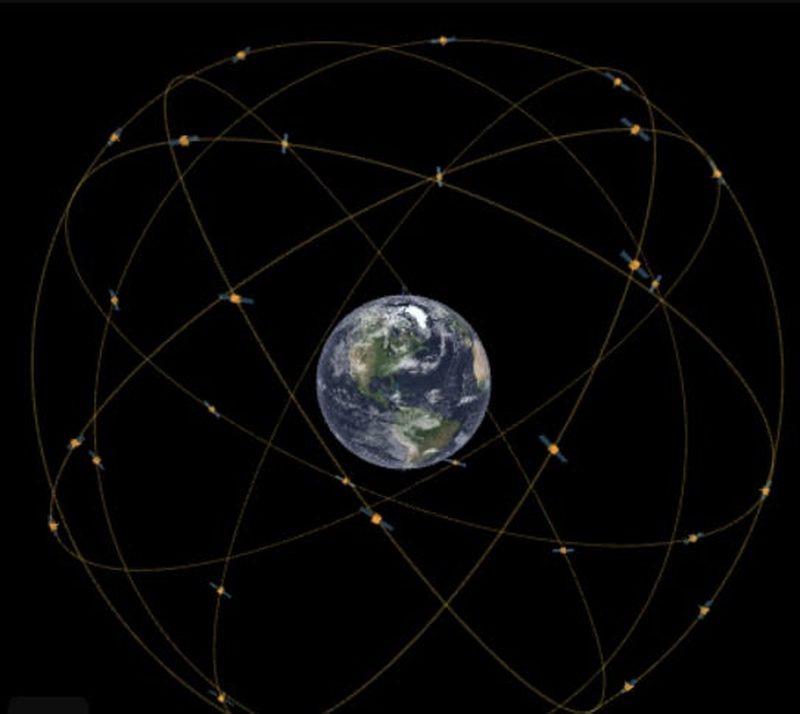
Every time your phone pinpoints your location to within a few metres, it is quietly confirming one of the strangest predictions in science. The Global Positioning System depends on a constellation of satellites orbiting 20,200 kilometres above Earth, each carrying atomic clocks that must stay synchronised to within billionths of a second. According to Einstein’s theories of relativity, those orbiting clocks tick at different rates from identical clocks on the ground, for two separate reasons that push in opposite directions. If engineers ignored relativity, GPS position errors would accumulate at roughly 10 kilometres per day, rendering the system useless within hours. Instead, the satellites are programmed with a relativistic correction before they ever leave the factory, and your navigation app works. GPS is the most widespread daily proof that Einstein was right.
How GPS actually finds you
Each GPS satellite continuously broadcasts the exact time from its onboard atomic clock, along with its orbital position. Your receiver picks up these signals from at least four satellites and measures how long each signal took to arrive; since radio waves travel at the speed of light, each time delay translates directly into a distance. Intersecting the distance spheres from four satellites pinpoints your three-dimensional position and corrects your receiver’s own clock error. The entire scheme hinges on timing precision: light travels about 30 centimetres in a nanosecond, so a clock error of just one microsecond, a millionth of a second, translates into a 300-metre position error. The satellites’ atomic clocks are stable to a few nanoseconds per day, and ground stations monitor them constantly, uploading corrections. It is a system built on the assumption that time can be measured and shared with extraordinary fidelity across a continent-sized volume of space.
Special relativity: moving clocks run slow
Einstein’s special relativity, from 1905, predicts that a moving clock ticks more slowly than a stationary one, an effect called time dilation. GPS satellites race around Earth at about 3.9 kilometres per second, fast enough for the effect to matter. From the perspective of clocks on the ground, each satellite’s atomic clock loses about 7 microseconds per day due to its orbital velocity. Seven millionths of a second sounds negligible, but at the speed of light it corresponds to a ranging error of more than 2 kilometres per day. The effect has been verified directly: in the famous Hafele-Keating experiment of 1971, atomic clocks flown around the world on airliners came back measurably out of sync with clocks left on the ground, exactly as relativity predicted. Every satellite navigation system, from America’s GPS to Europe’s Galileo and India’s NavIC, must account for the fact that motion itself slows time.
General relativity: gravity also changes time
Einstein’s general relativity, from 1915, adds a second, larger effect in the opposite direction. Gravity slows time: the deeper you are in a gravitational field, the more slowly your clock ticks relative to one higher up. GPS satellites orbit far above most of Earth’s gravity, so their clocks run faster than ground clocks by about 45 microseconds per day. Subtract the 7-microsecond slowdown from special relativity, and the net effect is that satellite clocks gain roughly 38 microseconds per day relative to the ground. Left uncorrected, that would inject errors of nearly 12 kilometres per day into every position fix. The elegant solution, worked out before the first GPS satellite launched in the 1970s, was to build the correction into the hardware: the satellites’ clocks are manufactured to tick at a slightly slower frequency, 10.23 megahertz adjusted downward, so that once in orbit, relativity brings them into perfect step with ground time. When the system was switched on, the predicted offset appeared exactly as calculated, a triumph of applied Einstein.
- GPS satellites orbit at 20,200 km altitude, circling Earth twice per day at 3.9 km per second.
- Special relativity slows satellite clocks by about 7 microseconds per day due to orbital velocity.
- General relativity speeds them up by about 45 microseconds per day due to weaker gravity.
- The net 38-microsecond daily gain would cause roughly 10 km of position error per day if ignored.
- Satellite clocks are factory-tuned to run slow so relativity brings them into sync in orbit.
Why this matters beyond navigation
GPS has become invisible infrastructure: it timestamps financial trades, synchronises power grids and mobile networks, guides aircraft and tractors, and underpins India’s NavIC system, which provides independent positioning over the subcontinent. All of it rests on relativistic timekeeping. The same physics is now being pushed further: physicists use networks of atomic clocks to hunt for dark matter, test whether fundamental constants vary, and measure Earth’s gravitational field with centimetre precision. Future deep-space navigation will need relativistic corrections far larger than GPS’s, since probes near the Sun or Jupiter experience much stronger gravitational time shifts. There is a quiet poetry in the fact that the most abstract theory of the twentieth century, born from thought experiments about trains and light beams, now lives in every smartphone, silently correcting for the warping of time itself so you can find the nearest petrol pump.
FAQs
Would GPS really fail without relativity? Yes. Uncorrected, the 38-microsecond daily clock drift would accumulate about 10 kilometres of position error per day, making GPS useless for navigation within hours.
Do India’s NavIC satellites need the same correction? Yes. NavIC satellites in geostationary and inclined orbits experience the same relativistic effects, and the system applies equivalent corrections.
Was Einstein involved in GPS design? No, he died in 1955, two decades before the first GPS satellite launched. But the system’s designers used his equations, and early tests confirmed the predicted clock offsets precisely.
Relativity is often presented as remote cosmic philosophy. GPS proves it is also plumbing: bend time by billionths of a second, and the modern world quietly stops knowing where it is.
Source: NASA

Khabar 24h Editorial Desk — our explainers are prepared by the Khabar 24h editorial team using AI-assisted research tools, and every piece is reviewed by a human editor before publishing. We do not claim original reporting: our work is turning complex topics into simple, accurate summaries. Spotted an error? Write to contact@khabar24h.com — our corrections policy aims for same-day review.
More from this author →