The Asiatic Lion of Gir: Anatomy of a Conservation Success
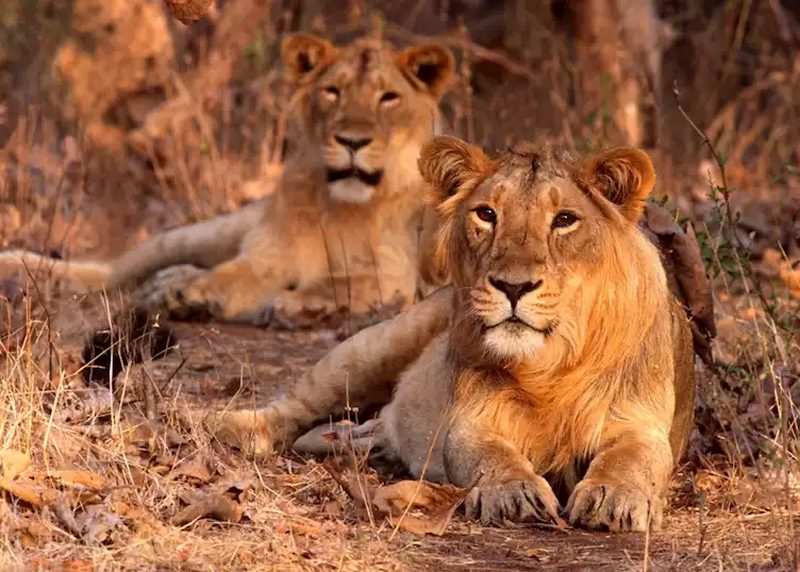
In the dry teak forests of Gujarat’s Saurashtra peninsula lives an animal found nowhere else on Earth in the wild: the Asiatic lion. Every one of the roughly 674 free-ranging Asiatic lions counted in the 2020 census descends from a population that, at the start of the twentieth century, had shrunk to barely a dozen individuals in the forests of Gir. Their recovery is one of the great conservation turnarounds of the modern era, achieved not by a single dramatic intervention but by a century of patient protection, community tolerance and scientific management. The story of the Asiatic lion is also a warning, because almost the entire species still lives in one small landscape, and conservationists argue about how to keep it safe.
How the Asiatic lion differs from its African cousin
The Asiatic lion, scientifically classed as Panthera leo persica, is a distinct subspecies of lion, genetically separate from the lions of Africa. It is slightly smaller, with males typically weighing between 160 and 190 kilograms, and it carries a few telltale features: a prominent fold of skin running along its belly, a sparser and shorter mane that leaves the ears visible, and a larger tail tuft. Prides in Gir tend to be smaller than African ones, usually just two to four females with their cubs, and the males often form loose coalitions of their own rather than staying permanently with a pride. These differences matter because they mean lessons from African lion management do not always transfer. The Asiatic lion evolved in the scrub and dry deciduous forests of the Indian subcontinent, hunting chital, sambar, nilgai and wild pig, and its behaviour is tuned to that landscape, not the open savannah.
A century ago, the species was nearly gone
Two thousand years ago, Asiatic lions ranged from Greece and the Middle East across Persia to eastern India. By the late 1800s, hunting by colonial officers and Indian royalty, combined with the spread of farmland and firearms, had wiped them out almost everywhere. Only the forests of Junagadh state, where the Nawab of Junagadh maintained them as a private hunting reserve, held on. When the first serious estimates were made around 1913, perhaps twenty lions remained. The Nawabs deserve a complicated credit: they preserved the lions so they could hunt them, banning other hunting in the area and thereby keeping a remnant population alive. After Independence, the forest became a sanctuary in 1965 and a national park in 1975, and hunting was outlawed entirely. From that tiny genetic bottleneck, the population began the slow climb to the roughly 400 lions counted in 2010 and 674 in 2020, with lions now spilling beyond the protected area into surrounding farmland and coastal scrub.
How Gir’s lions were actually brought back
The recovery rested on several pillars, and none of them was glamorous. First came habitat protection: grazing restrictions, the relocation of some Maldhari herder settlements from the core area, and a ban on hunting gave the lions and their prey room to recover. Second came prey management, because lions cannot thrive without deer and antelope; protection of the forest brought chital and sambar numbers up with it. Third, and perhaps most important, came tolerance. Lions in Gir regularly kill livestock, and outside the park they now live among farms and villages. A compensation scheme that pays herders promptly for lost cattle, combined with the Maldharis’ traditional reverence for the lion, has kept retaliatory killings rare. Together these unglamorous measures did what no single grand project could: they made it possible for lions and people to share a landscape.
- Legal protection: Gir became a sanctuary in 1965 and a national park in 1975, ending all hunting of lions.
- Habitat and prey: grazing controls and forest protection rebuilt the chital, sambar and nilgai populations lions depend on.
- Community tolerance: prompt compensation for livestock kills kept retaliatory poisoning and spearing rare.
- Disease control: vaccination of dogs and cattle around the park reduced the risk of outbreaks like canine distemper.
- Monitoring: regular censuses and radio-collaring let managers track dispersal, conflict and population health.
Why keeping every lion in one place is a gamble
Here is the uncomfortable part of the success story: almost the entire wild population lives in and around one landscape of a few thousand square kilometres. Conservation biology has a grim rule of thumb that a species confined to a single location is one epidemic, one drought or one disaster away from catastrophe. In 2018, an outbreak of canine distemper virus killed more than two dozen lions in Gir in a matter of weeks, a reminder of how fast disease can move through a dense population. That is why wildlife biologists have argued for decades that a second, geographically separate population should be established, with Kuno in Madhya Pradesh long proposed as the site. The proposal has been tangled in legal and political disputes between Gujarat and the central authorities for years, though lions of the African lineage were eventually introduced to Kuno from Africa, not Gir. Until a second wild home exists, the Asiatic lion remains a conservation success with a single point of failure.
FAQs
How many Asiatic lions are left in the wild? The 2020 census counted 674 lions in and around the Gir landscape in Gujarat, up from about 411 in 2010. There are no other wild populations anywhere in the world.
Are Asiatic lions dangerous to people? Attacks are rare. Gir’s lions live close to villages, and the combination of abundant wild prey, compensation for livestock losses and local tolerance keeps conflict low, though occasional incidents do occur.
Gir’s lions prove that extinction is not inevitable, even from a population of a dozen animals, provided protection is sustained for decades and local people are treated as partners rather than obstacles. The next chapter of the story, whether the species gets the second home its long-term survival demands, is still being written.
Compiled by the Khabar 24h Editorial Desk from publicly available sources.

Khabar 24h Editorial Desk — our explainers are prepared by the Khabar 24h editorial team using AI-assisted research tools, and every piece is reviewed by a human editor before publishing. We do not claim original reporting: our work is turning complex topics into simple, accurate summaries. Spotted an error? Write to contact@khabar24h.com — our corrections policy aims for same-day review.
More from this author →