Aditya-L1: How India Studies the Sun From a Million Miles Away
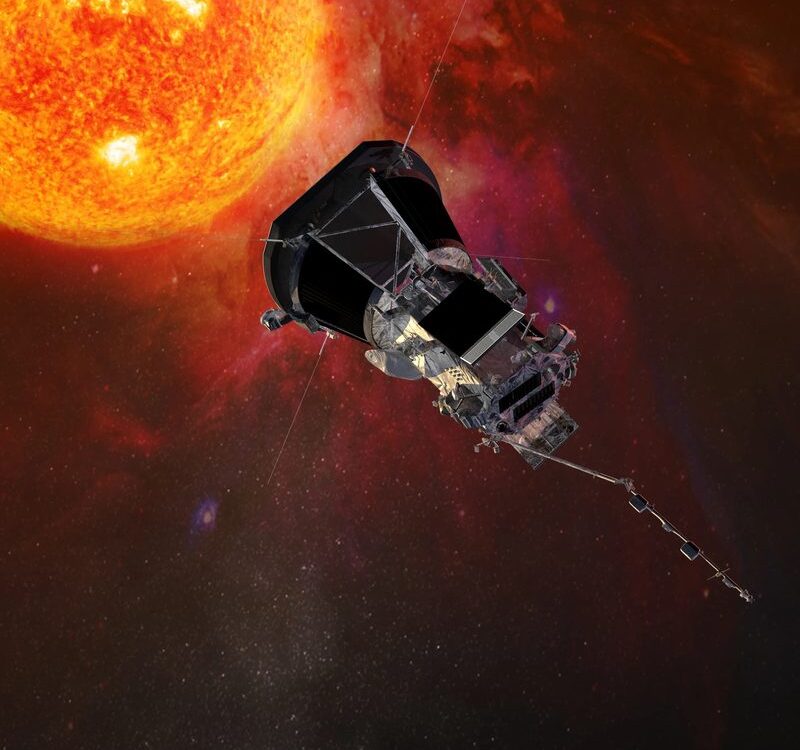
The Sun is the most important object in our sky and one of the hardest to study up close. Its blinding light, violent outbursts and million-degree outer atmosphere shape the space weather that can knock out satellites and power grids on Earth. Aditya-L1, India’s first dedicated solar mission, was built to stare at our star without blinking, from a vantage point 1.5 million kilometres away where it enjoys an uninterrupted view no ground telescope can match. Launched in September 2023, it made India one of the few nations with a permanent eye on the Sun.
Why park at Lagrange point 1
Aditya-L1 does not orbit the Sun directly; it circles a gravitationally special location called the Sun-Earth Lagrange point 1, or L1. This is a spot on the line between the Earth and the Sun where the gravitational pulls of the two bodies, combined with orbital motion, nearly cancel out. A spacecraft placed there stays roughly fixed relative to the Earth-Sun line with minimal fuel. The practical payoff is enormous: from L1, the Sun is visible continuously, with no eclipses and no day-night cycle interrupting observations. The spacecraft loops around the L1 point in a wide halo orbit, stationed about 1.5 million kilometres sunward of Earth.
The seven instruments on board
Aditya-L1 carries seven scientific instruments, four that look directly at the Sun and three that sample the particles and magnetic fields flowing past the spacecraft. The headline instrument is the Visible Emission Line Coronagraph, which creates an artificial eclipse inside the telescope to block the Sun’s dazzling disc and reveal the faint corona, the outer atmosphere that is paradoxically hotter than the surface. The Solar Ultraviolet Imaging Telescope photographs the Sun in ultraviolet wavelengths that never reach the ground, while X-ray spectrometers watch the high-energy tantrums of solar flares. Together, the payload covers the Sun from its visible surface to the solar wind streaming past L1.
The coronal heating mystery
One of the deepest puzzles Aditya-L1 is chasing is deceptively simple: why is the Sun’s outer atmosphere so hot? The visible surface simmers at about 5,500 degrees Celsius, yet the corona above it burns at over a million degrees. Heat is supposed to flow from hot to cold, not the other way around, so something must be pumping energy upward. Leading suspects include nanoflares, tiny magnetic explosions, and waves travelling along magnetic field lines. By watching the corona continuously in multiple wavelengths while simultaneously measuring magnetic fields and particles nearby, Aditya-L1 can catch these heating events in the act.
Space weather: why the Sun’s moods matter
Solar storms are not just pretty auroras. A coronal mass ejection, a billion-tonne cloud of magnetised plasma hurled off the Sun, can slam into Earth’s magnetic field, induce currents in power lines, scramble navigation signals and damage satellites. Because Aditya-L1 sits upstream of Earth in the solar wind, its particle detectors sample these storms before they arrive, giving forecasters precious advance warning. For a country as dependent on satellites and power grids as India, that early-warning capability is a strategic asset as much as a scientific one.
What makes Aditya-L1 different
Several solar observatories already operate, including probes that fly daringly close to the Sun. Aditya-L1’s strength is different: persistence and perspective. Highlights of its approach include:
- Uninterrupted viewing from L1, with no eclipses to break long observations of evolving solar features.
- Coordinated Indian science, with ground observatories observing the same events simultaneously.
- Indigenous coronagraph technology, a technically demanding instrument that few space agencies have successfully flown.
FAQs
How far is Aditya-L1 from Earth? About 1.5 million kilometres, roughly four times the distance to the Moon, at the Sun-Earth Lagrange point 1.
Can it see the Sun during the night? The spacecraft has no night. From L1 the Sun never sets and is never eclipsed by Earth, allowing round-the-clock observation.
What is the mission’s expected lifetime? The nominal mission life is five years, though spacecraft at L1 often operate well beyond their design life if fuel and instruments hold out.
Aditya-L1 is India’s quiet sentinel between Earth and the Sun, watching the star that governs our climate, our technology and our existence. Every flare it records and every gust of solar wind it measures sharpens our understanding of the only star we can study in detail, and the only one that can switch off our civilisation’s electronics.
Source: ISRO

Khabar 24h Editorial Desk — our explainers are prepared by the Khabar 24h editorial team using AI-assisted research tools, and every piece is reviewed by a human editor before publishing. We do not claim original reporting: our work is turning complex topics into simple, accurate summaries. Spotted an error? Write to contact@khabar24h.com — our corrections policy aims for same-day review.
More from this author →