Secularism in India: The Constitutional Promise and the Political Debate
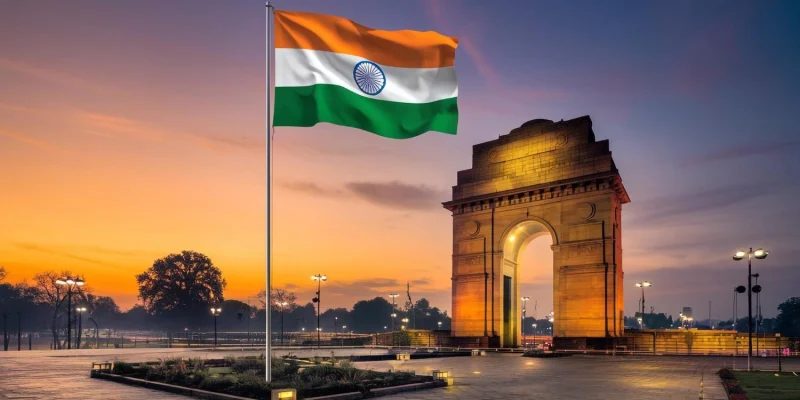
Secularism in India means something distinctive: not the Western wall of separation between church and state, but the state’s equal treatment of all religions — principled distance combined with active engagement. The constitution never defined it until the 42nd Amendment (1976) inserted the word into the Preamble; the Supreme Court later made it part of the basic structure. Yet secularism is also Indian politics’ most contested word — defended as the republic’s soul, attacked as minority appeasement. This is the promise and the debate.
What does Indian secularism mean?
Scholar Rajeev Bhargava’s formulation is canonical: Indian secularism is not separation but principled distance — the state stays equidistant, intervening or abstaining as equality requires. Hence apparent paradoxes: the state manages Hindu temples (through HR&CE departments) while funding Haj subsidies (now ended) and minority institutions; personal laws differ by religion (Hindu code bills, Muslim personal law, no uniform civil code yet); the state bans cow slaughter in most states while protecting religious conversion freedoms. Articles 25-28 guarantee religious freedom subject to public order; Articles 29-30 protect minorities’ cultural and educational rights. The model: equal respect, not equal neglect.
How did the constitutional promise evolve?
The founders debated secularism intensely and chose not to define it — a deliberate ambiguity. Nehru’s state practised secularism as religious neutrality; Indira Gandhi inserted the word into the Preamble during the Emergency, ironically. The Supreme Court gave it teeth: S.R. Bommai (1994) made secularism part of the basic structure, upholding the dismissal of BJP state governments after the Babri demolition; later judgments barred appeals to religion in elections (Abhiram Singh, 2017). The Uniform Civil Code, directed by Article 44, remains the unfulfilled promise — enacted only in Uttarakhand (2024) amid fierce debate.
Why is secularism so contested?
The critique from the right holds that Indian secularism became pseudo-secularism: minority appeasement disguised as neutrality — separate personal laws, Haj subsidies, the Shah Bano reversal (1986) when Rajiv Gandhi overturned a Supreme Court maintenance verdict under clerical pressure. Defenders reply that minority protections are secularism’s essence in a Hindu-majority country, and that the real threat is majoritarianism: lynchings, bulldozer justice, the Citizenship Amendment Act’s religion-based criterion. The Babri Masjid demolition (1992) and Gujarat 2002 remain the debate’s traumatic reference points — moments when the state’s secular promise visibly failed.
Secularism under the BJP
The Modi era reframed the debate: the government claims true secularism — equal treatment without appeasement — citing the end of Haj subsidies, triple-talaq criminalisation (framed as gender justice) and welfare reaching all communities. Critics see majoritarian consolidation: the CAA-NRC combination, anti-conversion laws, the Gyanvapi/Kashi disputes and rhetoric casting Muslims as outsiders. The Supreme Court’s Ayodhya verdict (2019) — granting the disputed site for a Ram temple while calling the demolition illegal — satisfied few legal purists but closed the most explosive dispute.
- The promise: equal citizenship regardless of faith, enforced by courts.
- The practice: personal laws, temple management and minority institutions show the state deeply entangled with religion.
- The debate: appeasement vs majoritarianism — mirror-image accusations about whose secularism is real.
- The test: whether equal treatment survives when majorities feel entitled and minorities feel insecure.
Indian secularism was never the absence of religion from politics — it was the promise that the state belongs to no religion. Keeping that promise, in a polity where faith and identity are inseparable, remains the republic’s hardest balancing act.
The global comparison
India’s model puzzles Western observers: a secular state managing temples, subsidising pilgrimages and adjudicating personal laws by religion. France’s laicite bans religion from public space; America’s separation coexists with deep religiosity; Turkey’s Kemalism imposed secularism from above. India’s distinctiveness lies in managing deep religious diversity through engagement rather than exclusion — a model some scholars propose for plural societies worldwide, and others dismiss as incoherent. The debate matters beyond India: how democracies handle religion is a 21st-century question everywhere.
FAQs
What is the difference between Indian and Western secularism?
Western models separate church and state; India’s practises principled distance — the state engages with all religions while treating them equally.
When was secularism added to the Preamble?
The 42nd Amendment in 1976, during the Emergency, inserted secular (and socialist) into the Preamble’s description of India.
What is the Uniform Civil Code debate?
Article 44 directs the state toward a common civil code replacing religion-based personal laws; supporters see equality, critics see majoritarian imposition.
Compiled by the Khabar 24h Editorial Desk from publicly available sources.

Khabar 24h Editorial Desk — our explainers are prepared by the Khabar 24h editorial team using AI-assisted research tools, and every piece is reviewed by a human editor before publishing. We do not claim original reporting: our work is turning complex topics into simple, accurate summaries. Spotted an error? Write to contact@khabar24h.com — our corrections policy aims for same-day review.
More from this author →