Public Interest Litigation Explained: How PIL Opened India’s Courtroom Doors
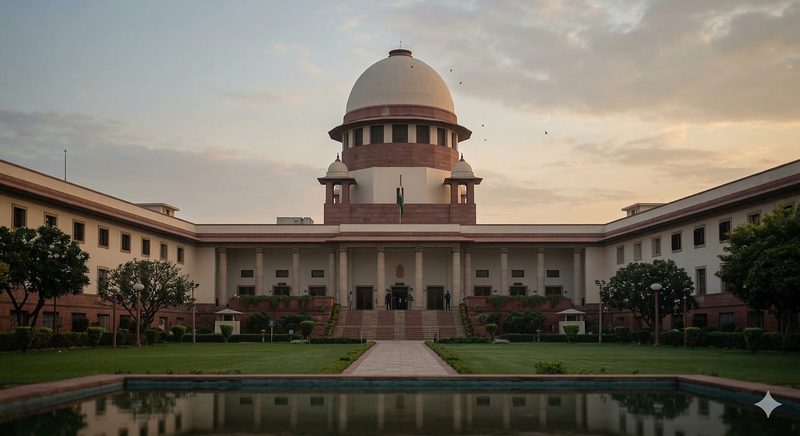
Public Interest Litigation transformed India’s Supreme Court from a distant forum for the wealthy into the world’s most accessible apex court. By relaxing the rule that only an aggrieved person could approach the court, PIL let any citizen — or the court itself, acting on a newspaper report or even a postcard — litigate on behalf of the voiceless: bonded labourers, prisoners, the environment, the homeless. It is arguably India’s greatest judicial innovation — and its most abused.
How did PIL begin?
PIL was born in the early 1980s, in the Court’s post-Emergency reinvention. Justices P.N. Bhagwati and V.R. Krishna Iyer, seeking to atone for the Emergency-era ADM Jabalpur disgrace, discarded the Anglo-Saxon doctrine of locus standi: in S.P. Gupta (1981) and the bonded-labourer cases, they held that any public-spirited citizen could move the court for those too poor or oppressed to do so themselves. The Court accepted letters as writ petitions — epistolary jurisdiction — and appointed commissions to investigate facts. For millions shut out of the legal system, the courthouse door suddenly opened.
What has PIL achieved?
The record of achievement is extraordinary. PIL freed bonded labourers and reformed prison conditions; forced the cleaning of the Ganga and Delhi’s air through the vehicular-pollution cases; won compensation for Bhopal’s victims; protected the Taj Mahal from industrial pollution; mandated sexual-harassment guidelines (Vishaka) and right-to-food programmes; and, through continuing mandamus, kept executive agencies under years of judicial supervision. Environmental jurisprudence — the polluter-pays principle, the precautionary principle, absolute liability — was built almost entirely through PIL. For causes legislatures ignored and administrations buried, PIL became India’s conscience court.
How is PIL misused?
Success bred abuse. Courts now routinely lament PIL’s mutation into private-interest, publicity-interest and political-interest litigation: corporate rivals settling scores, busybodies seeking headlines, political operatives laundering campaigns through writ petitions. Frivolous PILs clog dockets already groaning under 80,000+ pending Supreme Court cases. The Court has responded with costs on frivolous petitioners, stricter screening and insistence on bona fides — but the line between public spirit and publicity stunt remains blurry, and judges’ discretion enormous.
Did PIL make judges too powerful?
PIL’s deepest controversy is institutional. By entertaining governance failures as court cases, the judiciary became India’s default administrator: managing forests, ordering highway liquor bans, overseeing cricket, directing inter-state river disputes. Defenders say courts filled a vacuum left by failed legislatures and executives; critics call it the judiciary’s takeover of democracy, with unelected judges making policy without expertise or accountability. The truth lies in between: PIL corrected genuine state failures, but normalised a judicial supremacy that sits uneasily with democratic theory.
The balance sheet
Four decades on, PIL remains both India’s proudest judicial export and its most debated.
- Access: no apex court in the world is easier for the powerless to reach.
- Rights revolution: the environment, prisoners, women and workers gained protections legislatures never gave.
- Overreach: governance by continuing mandamus substitutes judges for administrators.
- Abuse: publicity-seeking petitions waste scarce judicial time.
- Reform direction: stricter locus filters, costs for frivolity, and judicial restraint in policy domains.
PIL opened the courtroom doors; the ongoing task is ensuring what enters serves the public interest rather than private agendas. The innovation endures because the need endures — India’s marginalised still find in PIL a forum they find nowhere else.
PIL’s global influence
India’s innovation travelled. South Africa’s constitution explicitly embraced public-interest standing; Bangladesh, Pakistan and Nepal developed their own PIL jurisprudence; and the idea influenced environmental and human-rights litigation worldwide. Foreign scholars study the Indian model as proof that apex courts in developing democracies can be engines of social change. The export confirms PIL’s significance: a procedural tweak — who may approach the court — that redrew the relationship between citizens, courts and the state.
FAQs
Who can file a PIL?
Any public-spirited citizen or organisation can, on behalf of those unable to approach the court themselves; courts have even acted on newspaper reports and letters.
What was epistolary jurisdiction?
The practice of treating letters and telegrams as writ petitions, pioneered in the 1980s to give the poorest access to the Supreme Court.
Can PIL be filed for private disputes?
No — courts dismiss petitions serving private, political or publicity interests, sometimes imposing heavy costs on abusive petitioners.
Source: Supreme Court Observer

Khabar 24h Editorial Desk — our explainers are prepared by the Khabar 24h editorial team using AI-assisted research tools, and every piece is reviewed by a human editor before publishing. We do not claim original reporting: our work is turning complex topics into simple, accurate summaries. Spotted an error? Write to contact@khabar24h.com — our corrections policy aims for same-day review.
More from this author →