The Quad Explained: India, the US, Japan, Australia and the Indo-Pacific
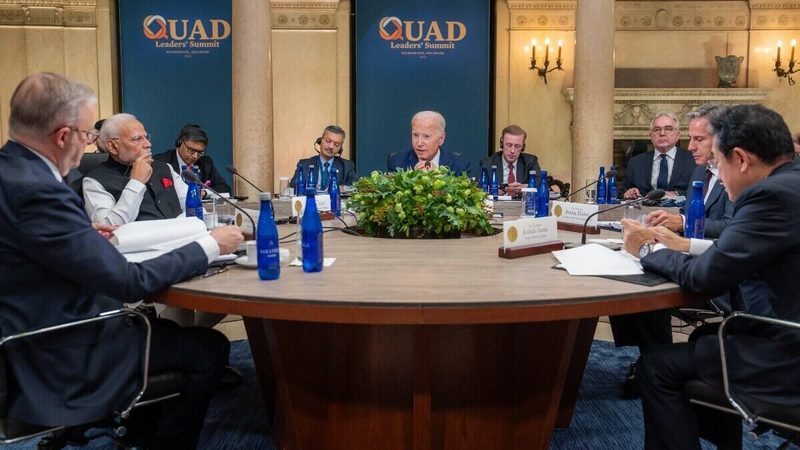
The Quadrilateral Security Dialogue — the Quad — brings together India, the United States, Japan and Australia in the Indo-Pacific’s most prominent strategic grouping. Revived in 2017 after a decade in cold storage, it has evolved from a loose dialogue into a leaders-level summit with working groups on vaccines, critical technology, maritime security and infrastructure. Beijing denounces it as an Asian NATO; members insist it is not a military alliance. The truth lies in between — and in India’s careful balancing act.
What is the Quad and how was it revived?
The Quad’s first incarnation in 2007, championed by Japan’s Shinzo Abe, collapsed within a year as Australia withdrew and members feared provoking China. Its revival began in 2017, driven by a shared assessment that China’s assertiveness — in the South China Sea, along India’s Himalayan border and across the Pacific — required a coordinated democratic response. The upgrade to leaders’ summits from 2021, championed by US President Joe Biden, gave it political weight: the four leaders now meet annually, most recently on the sidelines of the UN General Assembly.
What does the Quad actually do?
The Quad’s agenda is deliberately broad, spanning security and public goods. Its headline initiatives include the Indo-Pacific Partnership for Maritime Domain Awareness, which tracks dark shipping to combat illegal fishing; cooperation on critical and emerging technologies, including 5G and semiconductors; a vaccine partnership born during the pandemic; and infrastructure coordination as an alternative to China’s Belt and Road. The Malabar naval exercise, involving all four navies, is the grouping’s most visible military dimension — though the Quad itself issues no joint defence commitments.
Where does India stand?
India is the Quad’s pivotal and most cautious member. New Delhi values the grouping as a counterweight to China and a source of technology and investment, but it refuses any framing as an alliance: India remains committed to strategic autonomy, continues to buy Russian oil and arms, and participates in BRICS and the Shanghai Cooperation Organisation alongside China and Russia. This multi-alignment frustrates Quad partners who want sharper anti-China positioning, but it is also what makes India valuable — a major power that engages the West without becoming a Western ally.
Why does China oppose it?
Beijing views the Quad as containment by another name — an attempt to encircle China with US-aligned democracies. Chinese diplomats have called it a clique destined to fail, and China pressures regional states, particularly in Southeast Asia and the Pacific Islands, to keep their distance. The members’ response is consistent: the Quad targets no country, any nation sharing its vision of a free and open Indo-Pacific is welcome, and its public-goods agenda benefits the whole region. Whether ASEAN’s smaller states buy that framing determines the Quad’s regional legitimacy.
What next for the Quad?
The grouping’s trajectory points toward deeper institutionalisation without formal alliance.
- Regular summits: annual leaders’ meetings now anchor the calendar, with India due to host.
- Technology focus: semiconductor supply chains and undersea cables are emerging as priority areas.
- Maritime security: coastguard cooperation and domain awareness directly address grey-zone coercion.
- The China question: how explicitly the Quad names China will remain the fault line between Washington’s hawks and New Delhi’s caution.
The Quad is best understood as a strategic hedge: not an alliance, but a signal that four major democracies will coordinate to shape the Indo-Pacific’s rules. Its success will be measured not in communiqués but in whether the region’s smaller states feel they have genuine alternatives.
Quad fatigue and the road ahead
Sceptics warn of Quad fatigue: summits multiply while deliverables stay modest, and members’ China policies diverge — Washington confronts, Tokyo hedges, Canberra wobbles, Delhi balances. Yet the grouping’s very looseness is its strength: it demands little, survives disagreements and keeps four powerful navies talking. The realistic future is not an Asian NATO but a persistent convening power — the Indo-Pacific’s standing committee of concerned democracies.
FAQs
Is the Quad a military alliance like NATO?
No. It has no mutual-defence treaty; it is a strategic dialogue with security cooperation, joint naval exercises and a broad public-goods agenda.
Why did the Quad collapse in 2008?
Australia withdrew under Kevin Rudd amid concerns about provoking China, and the remaining members let the initiative lapse for a decade.
Does India treat the Quad as anti-China?
New Delhi avoids that framing, presenting the Quad as a partnership for a free and open Indo-Pacific while maintaining ties with Russia and China elsewhere.
Source: The Diplomat

Khabar 24h Editorial Desk — our explainers are prepared by the Khabar 24h editorial team using AI-assisted research tools, and every piece is reviewed by a human editor before publishing. We do not claim original reporting: our work is turning complex topics into simple, accurate summaries. Spotted an error? Write to contact@khabar24h.com — our corrections policy aims for same-day review.
More from this author →