How the International Court of Justice Works: The UN’s World Court Explained
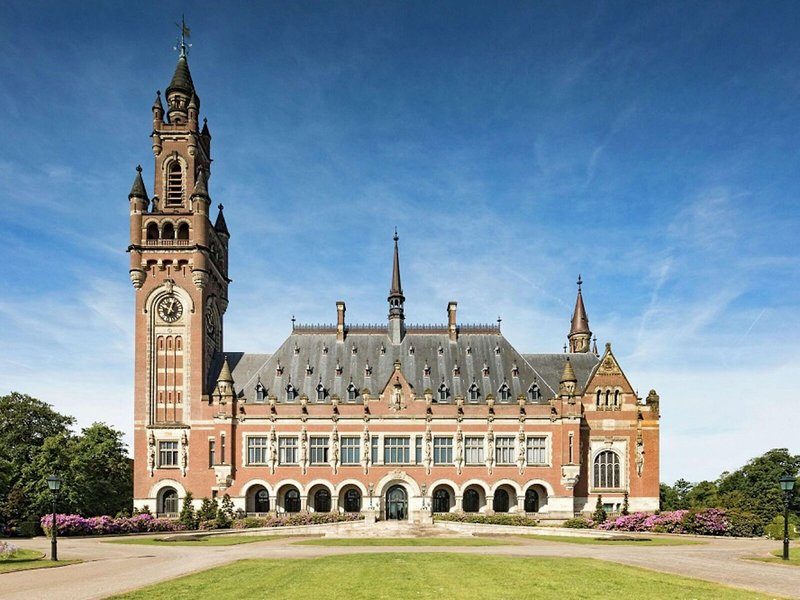
The International Court of Justice, housed in the Peace Palace at The Hague, is the United Nations’ principal judicial organ — the closest thing the world has to a supreme court for disputes between states. Since 1946 it has ruled on border conflicts, maritime boundaries, genocide allegations and the legality of walls and weapons. Yet it has no police force, no power over individuals, and its authority depends entirely on states agreeing to be bound. Here is how the world court actually works.
What does the ICJ do?
The Court has two jobs. In contentious cases, it settles legal disputes between states that accept its jurisdiction — recent headline cases include South Africa’s genocide case against Israel over Gaza, Ukraine’s case against Russia, and the long-running Kulbhushan Jadhav matter between India and Pakistan. In advisory opinions, it answers legal questions referred by UN organs; its 2024 opinion on Israel’s occupation of Palestinian territories and its 2025 climate-change opinion carried enormous moral and political weight even though advisory opinions are not strictly binding.
How is the Court composed?
The ICJ has 15 judges elected for nine-year terms by the UN General Assembly and Security Council voting independently. Seats are distributed by region to reflect the world’s principal legal systems, and no two judges may share a nationality. In practice, the five permanent Security Council members have almost always had a judge on the bench. When a case involves a state with no judge of its nationality, that state may appoint an ad hoc judge — which is how high-profile cases end up with expanded benches and politically charged dissents.
Where does its authority come from?
The Court’s jurisdiction is consensual: it can only hear cases states agree to bring. Around 74 states have accepted compulsory jurisdiction, many with reservations carving out sensitive topics. Judgments in contentious cases are final and binding on the parties, and the UN Charter says Security Council enforcement is available — though a permanent member can veto enforcement against itself, as the United States did after losing to Nicaragua in 1986. Compliance is therefore driven less by coercion than by reputation, reciprocity and domestic legal incorporation.
Does the ICJ actually matter?
Its record is mixed but far from irrelevant.
- Boundary disputes: dozens of land and maritime borders — including in Africa, Asia and Latin America — have been peacefully settled by ICJ judgments.
- Norm-setting: advisory opinions on nuclear weapons, the Israeli wall and climate obligations shape international law for decades.
- Symbolic power: even unenforced rulings, like the 2016 South China Sea arbitration (a related tribunal), impose reputational costs.
- Limits: great powers ignore the Court when vital interests are at stake, and cases take years — justice at The Hague is slow by design.
The ICJ embodies both the promise and the limits of a rules-based order: a court that states built, that many obey, and that none can be forced to heed. In an era of great-power rivalry, its quiet docket of boundary cases may matter more than its headline clashes.
The Court’s most consequential cases
A few judgments illustrate the ICJ’s range. In the 1986 Nicaragua case, the Court ruled US support for the Contras illegal — Washington simply withdrew from compulsory jurisdiction. The 2004 advisory opinion declared Israel’s West Bank barrier contrary to international law, shaping decades of legal debate. The 2007 Bosnia genocide judgment found Serbia had failed to prevent the Srebrenica massacre. And the Jadhav case (2019) ordered Pakistan to review the death sentence of an Indian national, a rare moment when the Court touched millions of Indian television screens. Together they show a court that is simultaneously marginal to power politics and central to international law’s development.
FAQs
Can the ICJ try individuals?
No. Only states appear before the ICJ. Individuals accused of war crimes or genocide face the International Criminal Court, a separate institution.
Are ICJ judgments enforceable?
They are legally binding, but enforcement runs through the UN Security Council, where a permanent member’s veto can block action — a structural weakness critics constantly highlight.
What was the Jadhav case about?
India brought Pakistan to the ICJ in 2017 over consular access for Kulbhushan Jadhav, sentenced to death by a Pakistani military court; the Court ruled Pakistan must review the conviction.
Compiled by the Khabar 24h Editorial Desk from publicly available sources.

Khabar 24h Editorial Desk — our explainers are prepared by the Khabar 24h editorial team using AI-assisted research tools, and every piece is reviewed by a human editor before publishing. We do not claim original reporting: our work is turning complex topics into simple, accurate summaries. Spotted an error? Write to contact@khabar24h.com — our corrections policy aims for same-day review.
More from this author →