India’s First General Election of 1951-52: How the World’s Largest Democracy Began
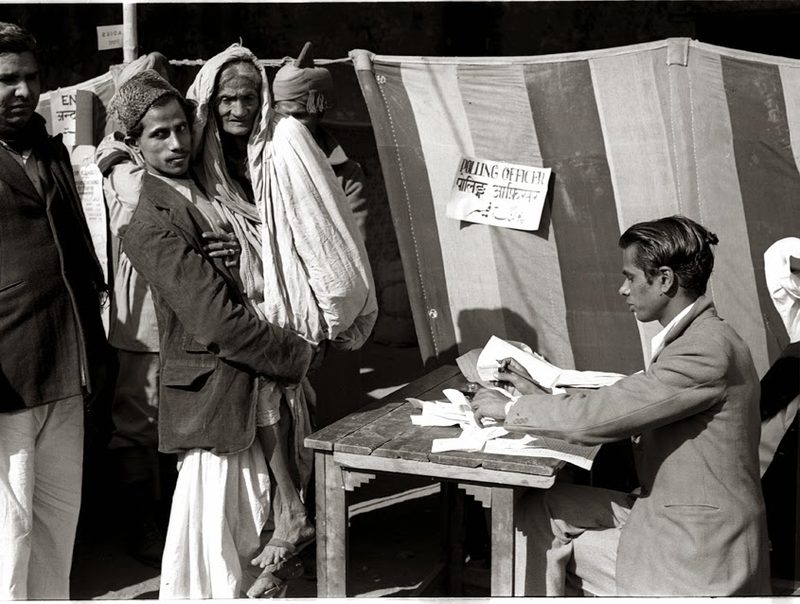
In 1951, the newly independent Republic of India attempted something no one had ever tried: a general election on the basis of universal adult franchise in a largely illiterate, impoverished country of 360 million people. Western observers predicted chaos; many expected the experiment to fail. Instead, the election of 1951-52, conducted over nearly four months, became the founding act of the world’s largest democracy and a logistical marvel that still inspires awe.
The audacity of universal franchise
The Constituent Assembly’s decision to grant every adult the vote, regardless of literacy, property or gender, was revolutionary. At a stroke, 173 million people became voters, including tens of millions of women voting for the first time. The principle was radical equality: the illiterate peasant’s vote would count exactly as much as the urban graduate’s. Sukumar Sen, India’s first Chief Election Commissioner, was charged with converting this principle into reality, with barely two years to prepare the rolls, the booths and the ballot boxes.
How the election was conducted
The scale beggars belief. Over 224,000 polling booths were set up, staffed by hundreds of thousands of officials, many travelling for days to reach remote villages. Separate ballot boxes for each candidate, colour-coded and marked with symbols, were used since a single ballot paper was deemed too confusing for illiterate voters. More than 2 million steel ballot boxes were manufactured. Polling was staggered from October 1951 to February 1952 to allow officials and security to move between regions. Voters dipped their fingers in indelible ink, a practice that continues today.
The campaign and the contenders
The Congress, led by Jawaharlal Nehru, campaigned on the prestige of the freedom movement and the promise of planned development. The opposition was fragmented but spirited: the Socialist Party, the Communist Party of India, the Hindu nationalist Bharatiya Jana Sangh, and a host of independents and regional groups. Nehru toured the country tirelessly, addressing enormous crowds, while the Election Commission enforced a code of conduct that was the ancestor of today’s Model Code. For most voters, it was their first encounter with democratic choice.
The results and what they meant
The Congress won a sweeping victory, taking 364 of the 489 Lok Sabha seats with about 45 per cent of the vote, a result that established the pattern of Congress dominance. But the opposition won a respectable foothold: Communists became the largest opposition group, Socialists polled strongly, and the Jana Sangh won its first three seats. Voter turnout was about 45 per cent, remarkable for a first election in such conditions. The results were accepted by winners and losers alike, the true miracle of the exercise.
Why 1951-52 still matters
The first election proved three things that shaped everything after. First, that universal franchise could work in a poor, illiterate society, demolishing the colonial argument that Indians were unfit for democracy. Second, that an independent Election Commission could conduct a credible poll at continental scale, establishing the institution’s legendary authority. Third, that electoral defeat would be accepted peacefully, the essential convention of democratic life. Every subsequent Indian election, all the way to the billion-voter exercises of today, descends directly from the winter of 1951-52.
The world watches
The world watched with a mixture of admiration and disbelief. Foreign correspondents filed awestruck reports of illiterate villagers grasping the ballot’s meaning with complete seriousness, and the orderly conduct confounded predictions of chaos. The election became a standing refutation of the claim that democracy required Western levels of wealth and literacy. For newly independent nations across Asia and Africa, India’s example suggested that self-government was possible without preconditions, making 1951-52 an event of global democratic significance.
FAQs
How many voters were there in 1951-52? About 173 million registered voters, of whom roughly 45 per cent turned out to vote.
Why did polling take four months? The sheer scale required staggering: officials, ballot boxes and security moved in phases across the subcontinent.
Who was the first Chief Election Commissioner? Sukumar Sen, who built the electoral machinery from scratch and oversaw the first two general elections.
The 1951-52 election was India’s tryst with democracy made real: a promise written in the Constitution, kept in 224,000 polling booths across a newborn nation. It remains the gold standard against which every Indian election is measured.
Compiled by the Khabar 24h Editorial Desk from publicly available sources.

Khabar 24h Editorial Desk — our explainers are prepared by the Khabar 24h editorial team using AI-assisted research tools, and every piece is reviewed by a human editor before publishing. We do not claim original reporting: our work is turning complex topics into simple, accurate summaries. Spotted an error? Write to contact@khabar24h.com — our corrections policy aims for same-day review.
More from this author →