How India’s Cabinet System Works: Cabinet, Council of Ministers and Collective Responsibility
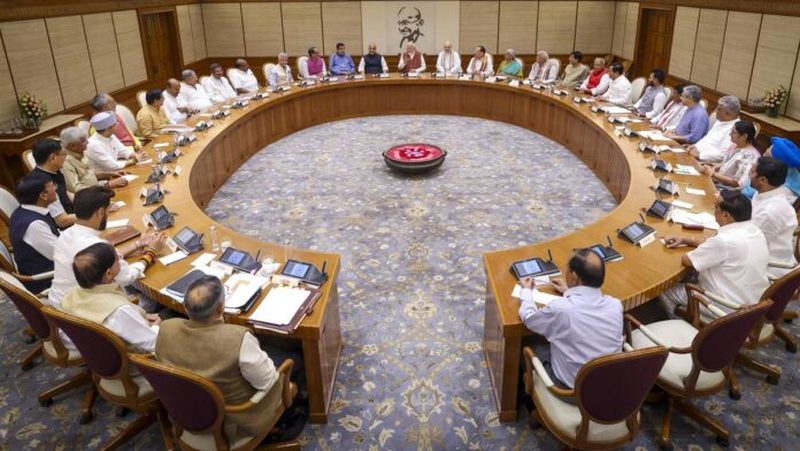
India’s Constitution names the President as the head of the executive, but real power lies elsewhere: in the Council of Ministers, headed by the Prime Minister, which exercises executive authority in the President’s name. This is the Cabinet system, borrowed from Britain and adapted to Indian conditions, and its central doctrine is collective responsibility. Understanding it is essential to understanding how India is actually governed.
The Council of Ministers and the Cabinet
The Council of Ministers has three tiers. At the top is the Cabinet, the small inner circle of senior ministers who take the major policy decisions. Below it are Ministers of State, some with independent charge of ministries and some assisting Cabinet ministers, and at the base are Deputy Ministers. The Constitution requires the total strength of the Council to stay within 15 per cent of the Lok Sabha’s membership. While the full Council meets rarely, the Cabinet meets frequently, often weekly, under the Prime Minister’s chairmanship, and its decisions bind the entire government.
How ministers are chosen
The Prime Minister is appointed by the President, conventionally the leader who commands a Lok Sabha majority, and then advises the President on appointing the other ministers. In coalition governments, portfolios are negotiated among alliance partners, with key ministries like finance, home, defence and external affairs carrying the greatest political weight. The Prime Minister may reshuffle portfolios or drop ministers at will, keeping the Council’s composition firmly under their control. Every minister must become a member of either House of Parliament within six months of appointment, preserving the link between the executive and the legislature that defines parliamentary government.
Collective responsibility: the core doctrine
Article 75 declares that the Council of Ministers is collectively responsible to the Lok Sabha. This means the government stands or falls together: if the Lok Sabha passes a vote of no confidence, the entire Council must resign, not just the Prime Minister. It also means ministers must publicly defend Cabinet decisions even when they privately disagreed; dissent is expressed inside the Cabinet room, and once a decision is taken, all ministers own it. A minister who cannot support a decision is expected to resign. This doctrine fuses the executive into a single accountable unit.
Individual responsibility and the Prime Minister’s dominance
Alongside collective responsibility runs individual ministerial responsibility: each minister answers to Parliament for their ministry’s actions. In practice, the Indian system has tended toward prime ministerial government, with power concentrated in the Prime Minister’s Office, especially under strong single-party majorities. The Cabinet’s role as a deliberative body varies with the Prime Minister’s style and the politics of coalition: in coalition eras, the Cabinet genuinely negotiates; under dominant leaders, it often ratifies. The Cabinet Secretariat and its committees provide the institutional machinery that keeps this system running.
Cabinet committees: where the work gets done
Much of the Cabinet’s business is handled by standing committees, such as those on security, economic affairs, political affairs and appointments. These smaller groups allow detailed examination of proposals before they reach the full Cabinet, and their decisions often carry the Cabinet’s authority. The committee system lets the government process a vast range of decisions, from infrastructure approvals to senior appointments, without bringing everything to the full ministerial table.
Caretaker conventions
When a government loses its majority or the Lok Sabha is dissolved, the outgoing Council continues as a caretaker government. It handles routine administration but avoids major policy decisions, senior appointments and new financial commitments until a successor takes office. This convention preserves continuity without allowing a defeated executive to bind the next government.
FAQs
What is the difference between the Cabinet and the Council of Ministers? The Cabinet is the senior inner circle that takes key decisions; the Council of Ministers is the full body of all ministers, including junior ranks.
Can a non-MP become a minister? Yes, but they must get elected to either House within six months, failing which they must step down.
What happens if the government loses a confidence vote? The entire Council of Ministers must resign, and the President explores alternatives or calls fresh elections.
The Cabinet system makes India’s executive uniquely accountable: power is exercised by ministers who must face Parliament daily, and who survive only so long as the people’s House retains confidence in them.
Compiled by the Khabar 24h Editorial Desk from publicly available sources.

Khabar 24h Editorial Desk — our explainers are prepared by the Khabar 24h editorial team using AI-assisted research tools, and every piece is reviewed by a human editor before publishing. We do not claim original reporting: our work is turning complex topics into simple, accurate summaries. Spotted an error? Write to contact@khabar24h.com — our corrections policy aims for same-day review.
More from this author →