Puri Rath Yatra: How the Chariots of Jagannath Are Built and Pulled
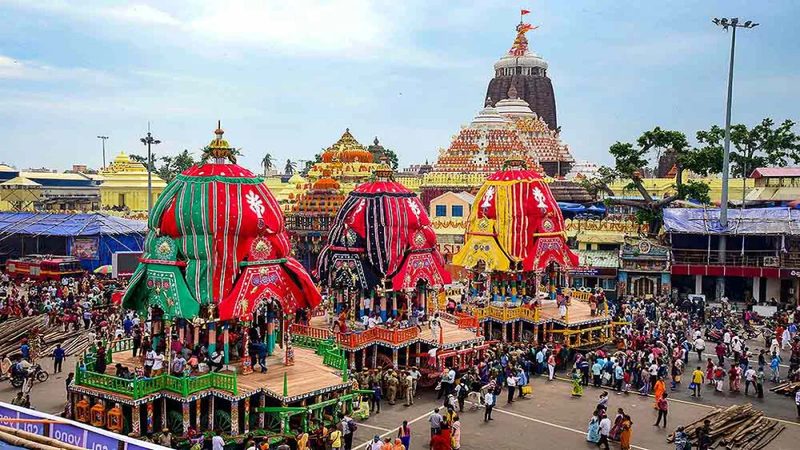
On a summer day in Puri, Odisha, three colossal wooden chariots, each as tall as a four-storey building, roll through streets packed with lakhs of devotees pulling them with thick ropes. The Rath Yatra, the chariot festival of Lord Jagannath, his brother Balabhadra, and sister Subhadra, is one of Hinduism’s most spectacular public rituals, watched by millions more on television and livestreams. The 2025 yatra drew record crowds to the temple town. Behind the pageantry lies a year-round cycle of craftsmanship, ritual precision, and civic management. This is how the chariots are built, consecrated, and pulled.
The deities and the journey
The festival reenacts the annual journey of the three deities from the 12th-century Jagannath Temple to the Gundicha Temple, their aunt’s house, about three kilometres away, where they stay for nine days before the return journey, the Bahuda Yatra. The theology is intimate: the gods leave their sanctum to be among the people, and uniquely, the Rath Yatra is one of the few occasions when non-Hindus, who cannot enter the temple, can see the deities. The three chariots have distinct identities: Nandighosa for Jagannath, with sixteen wheels; Taladhwaja for Balabhadra, with fourteen; and Darpadalana for Subhadra, with twelve. Each is newly constructed every single year, a tradition that makes the Rath Yatra as much a festival of craftsmanship as of devotion.
Building the chariots: a hereditary craft
Chariot construction is the work of hereditary artisan families, the maharanas, carpenters, and the chitrakaras, painters, who hold the traditional knowledge of proportions, joinery, and decoration. Work begins months before the festival, after the ceremonial wood-cutting on Saraswati Puja day; the timber, traditionally specific species, is procured through forest department allocations. The chariots are assembled without a single nail in the classical technique, using wooden joinery, then wrapped in colourful applique canopies, the famous Pipili chandua work, and painted in the deities’ colours: red and yellow for Jagannath, red and green for Balabhadra, red and black for Subhadra. The scale is staggering: the largest chariot stands some 13 to 14 metres tall and weighs many tonnes. The entire construction happens in front of the temple palace, where pilgrims watch the chariots rise over weeks, a public spectacle of making that is part of the festival’s charm.
The rituals of the festival days
The yatra’s ritual calendar is precise. On Snana Purnima, weeks earlier, the deities are bathed in 108 pitchers of water and then fall symbolically ill, withdrawing for the fortnight of Anasara, during which the temple’s public darshan is suspended and the deities are treated with herbal remedies. Then comes Rath Yatra day itself: the Pahandi, the ceremonial procession of the deities to their chariots, swaying and pausing to the beat of drums; the Chhera Pahanra, when the Gajapati king of Puri sweeps the chariot platforms with a golden broom, the festival’s great symbol of humility before god; and finally the pulling, as lakhs haul the ropes and the chariots lurch forward. At the Gundicha Temple, the deities rest for nine days, with the Hera Panchami ritual marking Lakshmi’s visit, before the Bahuda return, crowned by the Suna Besha, when the deities are adorned in gold.
Managing lakhs in a temple town
Puri, a town of a couple of lakhs, absorbs several lakhs of visitors for the festival, and the administration treats the yatra as a full-scale civic operation. The Grand Road, the Bada Danda, is cleared and barricaded; crowd flow is managed in sectors; medical posts, drinking water stations, and sanitation facilities line the route; and security is tight, with the temple’s safety a perennial concern. The chariot pulling itself is carefully choreographed: the ropes are manned in sections, volunteers and police manage the crush around the wheels, and the chariots move in sequence with pauses. Heat is a real danger, the festival falls in June or July, and the administration issues advisories while setting up shelters and water points. In recent years, live broadcasting and drone coverage have brought the festival to global audiences, and the diaspora’s parallel Rath Yatras, from London to New York, testify to its worldwide pull.
A festival that belongs to everyone
What makes the Rath Yatra distinctive is its radical accessibility. The deities come out to the street; the king sweeps the floor; rich and poor pull the same rope. The poet-saints of the Bhakti tradition celebrated exactly this democratisation of the divine, and Puri’s festival institutionalises it annually. For Odisha, it is the cultural event of the year, the pivot of the state’s ritual calendar and a major tourism draw. For the millions who pull, watch, or simply glimpse the chariots on a screen, it is a reminder that some traditions do not merely survive the modern world but gather it in: the ropes of Jagannath’s chariot now include hands from every continent.
FAQs
When is Rath Yatra held? On the second day of the bright fortnight of Ashadha, usually in June or July; the deities return nine days later on Bahuda Yatra.
Why are new chariots built every year? Tradition requires fresh chariots annually; the old ones are dismantled, with the wood used for temple purposes.
Can non-Hindus participate? Yes, the Rath Yatra is open to all, unlike entry into the Jagannath Temple sanctum, which is restricted to Hindus.
Three chariots, three kilometres, lakhs of hands on the ropes. The Rath Yatra is engineering, art, ritual, and crowd management fused into a single moving spectacle, and it has rolled through Puri, in one form or another, for centuries.
Compiled by the Khabar 24h Editorial Desk from publicly available sources.

Khabar 24h Editorial Desk — our explainers are prepared by the Khabar 24h editorial team using AI-assisted research tools, and every piece is reviewed by a human editor before publishing. We do not claim original reporting: our work is turning complex topics into simple, accurate summaries. Spotted an error? Write to contact@khabar24h.com — our corrections policy aims for same-day review.
More from this author →