Sanskrit’s Revival: Universities, Funding, and the State’s Role in an Ancient Language
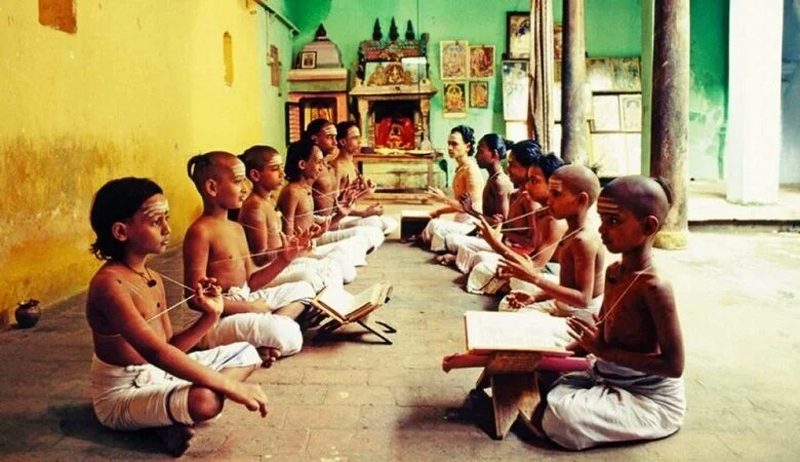
Sanskrit, the language of the Vedas, the Upanishads, Kalidasa’s plays, and Panini’s grammar, is experiencing one of the most concerted revivals in its modern history. Central universities dedicated to it have been upgraded, crores in funding flow into manuscript digitisation and research, and the National Education Policy 2020 explicitly names Sanskrit as a language to be strengthened at every level of schooling. For supporters, this is a long-overdue reclamation of a civilisational treasure. For critics, it raises hard questions about priorities, secularism, and whether state patronage can or should revive a language. This article examines the institutions, the money, and the arguments on both sides.
The institutional backbone
The revival rests on a network of dedicated institutions. Three deemed universities, the Rashtriya Sanskrit Sansthan, the Shri Lal Bahadur Shastri Rashtriya Sanskrit Vidyapeetha, and the Rashtriya Sanskrit Vidyapeetha at Tirupati, were brought together under a single Central Sanskrit University by an Act of Parliament in 2020, giving Sanskrit higher education a unified central institution with campuses across the country. Beyond this, Sanskrit departments exist in dozens of conventional universities, and states like Uttarakhand have gone further: Uttarakhand declared Sanskrit its second official language back in 2010, the first state to do so. The Rashtriya Sanskrit Sansthan runs schemes supporting traditional pathshalas and Sanskrit teachers, while the Ministry of Education funds the development of Sanskrit teaching materials, dictionaries, and digital resources. The institutional message is unambiguous: Sanskrit is to be treated not as a relic but as a living academic discipline with a national infrastructure.
Where the money goes
Funding flows through several channels. The Central Sanskrit University and its constituent campuses receive annual central grants running into hundreds of crores. The National Mission for Manuscripts, established to survey, document, and digitise India’s vast manuscript wealth, a large share of it in Sanskrit, has catalogued lakhs of manuscripts and digitised a substantial portion. Schemes support the publication of critical editions of Sanskrit texts, fellowships for researchers, and financial assistance to scholars and traditional pundits. The NEP 2020’s push for Sanskrit in schools, including its recommendation that Sanskrit be offered at all levels of school and higher education, implies further expenditure on teacher training and textbooks. Defenders of the spending argue it is modest compared to the cultural and scholarly payoff; critics counter that per-student outcomes remain thin and that the money would be better spent on primary education in living languages.
What the revival looks like on the ground
Beyond budgets, the revival has visible cultural dimensions. Spoken Sanskrit movements, led by organisations like Samskrita Bharati, run ten-day spoken Sanskrit camps that have taught conversational Sanskrit to lakhs of people over the decades, and there are villages, most famously Mattur in Karnataka, where Sanskrit is used in daily conversation. Digital initiatives have put classical texts online with searchable editions, and universities now offer Sanskrit through online and distance programmes reaching students far beyond traditional centres. The language has also found new life in unexpected places: Sanskrit verses appear in popular culture, yoga’s global spread has carried Sanskrit terminology worldwide, and computational linguists continue to mine Panini’s grammar, the Ashtadhyayi, for insights relevant to modern linguistics and computer science. The 2020s have also seen Sanskrit promoted in diplomacy and cultural outreach, presented as part of India’s soft power.
The debates around state patronage
The revival is not without controversy. Critics argue that the state’s enthusiastic patronage of Sanskrit reflects a majoritarian cultural agenda, and that it comes at the expense of other classical and minority languages that receive far less attention and funding. They point out that despite decades of institutional support, Sanskrit remains a language of scholarship and ritual rather than a living mother tongue, with census figures for Sanskrit speakers remaining tiny, and they question whether public money should chase a revival that shows limited organic demand. Supporters respond that Sanskrit is the root of much of India’s vocabulary and literary heritage, that its manuscripts contain scientific, philosophical, and literary knowledge of global significance, and that every major civilisation invests in its classical heritage. The debate often maps onto broader disagreements about the role of tradition in a modern republic, and it is unlikely to be settled by budgets alone.
Can a classical language be revived by policy?
The deeper question is whether state action can actually revive a language. Linguists distinguish between corpus revival, documenting and studying texts, and living revival, creating new native speakers. On the first count, India’s Sanskrit infrastructure is genuinely formidable: manuscripts are being preserved, texts edited, and scholarship funded at a scale few countries match for a classical language. On the second count, the record is more modest; spoken Sanskrit remains a niche enthusiasm rather than a mass movement. But the two are connected: a generation of well-funded scholars, teachers, and digital resources keeps the language accessible, and accessibility is the precondition for any wider renaissance. Whether Sanskrit becomes more widely spoken or remains primarily a language of learning, the current moment represents the most serious institutional bet on its future since independence.
FAQs
Is Sanskrit an official language of India? It is in the Constitution’s Eighth Schedule and is the second official language of Uttarakhand, but it is not an official language of the Union; Hindi and English serve that role.
What is the Central Sanskrit University? A central university created by a 2020 Act of Parliament, merging three deemed Sanskrit universities, with campuses across India offering Sanskrit education from school to research level.
How many people speak Sanskrit? Census figures record only tens of thousands of Sanskrit speakers as a mother tongue, though lakhs have studied it and organisations teach spoken Sanskrit widely.
Sanskrit’s revival is a test case for what a modern state can do for an ancient language: fund it, institutionalise it, digitise it, and teach it. Whether that adds up to a living renaissance or a well-preserved heritage is the question the next decade will answer.
Compiled by the Khabar 24h Editorial Desk from publicly available sources.

Khabar 24h Editorial Desk — our explainers are prepared by the Khabar 24h editorial team using AI-assisted research tools, and every piece is reviewed by a human editor before publishing. We do not claim original reporting: our work is turning complex topics into simple, accurate summaries. Spotted an error? Write to contact@khabar24h.com — our corrections policy aims for same-day review.
More from this author →