Digi Yatra Explained: How Face Authentication Works at Indian Airports
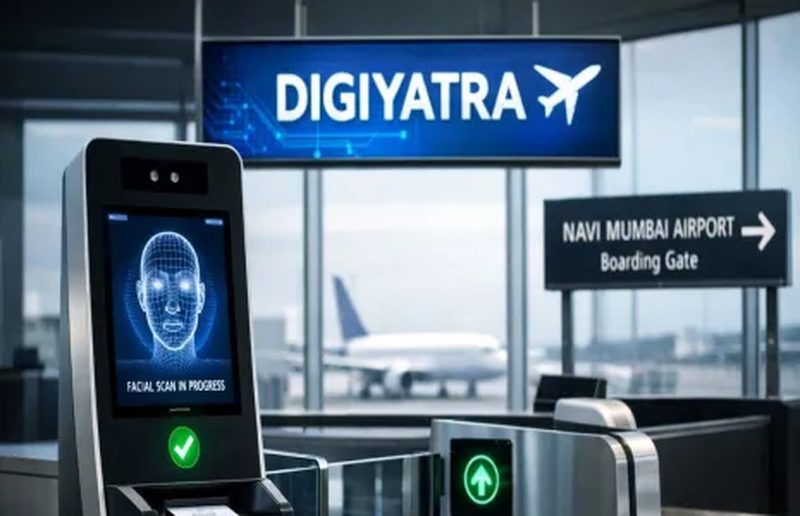
At major Indian airports, a growing number of passengers now glide past entry gates, check-in counters and boarding gates without showing a single document. Their face is their boarding pass. Digi Yatra, the civil aviation ministry’s biometric boarding system, uses face authentication to verify identity at each airport touchpoint, promising shorter queues and a paperless journey. Launched in 2022 and expanded to dozens of airports, it is one of the world’s largest deployments of face-based passenger processing. But a system that scans faces at national infrastructure also raises sharp questions about data storage, consent and surveillance. This explainer covers how Digi Yatra works and where the privacy debate stands.
How the journey works
Passengers enrol through the Digi Yatra app, linking their face biometrics to their identity documents and boarding pass. At the airport, cameras at the entry gate, check-in, security and boarding capture the face and match it against the enrolled credential, opening each gate in seconds. The process is opt-in: passengers who prefer conventional document checks can still use them, and enrolment requires explicit consent. The system is designed around a decentralised model in which the passenger’s data travels with them: credentials are stored in the app’s wallet on the phone, shared with the airport’s systems only for the duration of travel, and then purged.
The technology behind the face match
Face authentication compares a live camera capture against the enrolled reference image, generating a match score rather than storing raw photographs in a central honeypot, at least in the official design. The airports’ biometric systems are built by private technology vendors under contracts with airport operators, with the Digi Yatra Foundation, a joint venture of airport operators, overseeing the ecosystem. Liveness detection guards against spoofing with photographs. The aviation ministry presents the architecture as privacy-by-design: no central database of faces, data shared only with consent, and automatic deletion after the flight. Independent audits of these claims, however, have been limited.
Why airports want it
For airports, Digi Yatra solves a capacity problem. Indian air traffic has grown far faster than terminal space, and processing passengers faster is cheaper than building new terminals. Biometric gates move a passenger through in seconds versus the better part of a minute for manual document checks, which multiplies throughput at fixed infrastructure. For passengers, the payoff is shorter queues and a genuinely smoother experience, frequent flyers at Delhi, Bengaluru and Hyderabad report noticeably faster transits. Airlines benefit too, from faster boarding and fewer document-related delays. In an industry where minutes are money, the face lane is a compelling proposition.
The privacy concerns
Privacy advocates raise several objections. First, consent in practice may be thinner than on paper: reports of passengers being enrolled without clear understanding, or of staff steering travellers toward the biometric lane, have surfaced repeatedly. Second, the decentralised design depends on implementation by multiple vendors across dozens of airports, and verifying that data is truly purged is difficult for outsiders. Third, there is the spectre of function creep: a face-authentication infrastructure built for boarding could, in principle, be repurposed for surveillance. India’s data protection law now provides a framework for challenging misuse, but enforcement in practice remains untested. The debate mirrors global unease about biometrics at borders and airports.
Where the system is headed
Digi Yatra continues to expand to more airports and is being extended to international travel, where passport and immigration integration add complexity. The government has also proposed interoperable digital identity for the broader transport ecosystem. The system’s future will be shaped by two forces: passenger adoption, which remains voluntary and uneven, and regulatory scrutiny, as data protection authorities begin to examine biometric systems in earnest. The technology works; the question is whether the governance around it earns the trust it needs.
FAQs
Is Digi Yatra mandatory? No. It is opt-in, and passengers can use conventional ID and boarding-pass checks at every touchpoint.
Where is my face data stored? According to the official design, credentials stay in the app on your phone, are shared with airport systems only during travel, and are purged afterwards; there is no central face database.
Which airports have Digi Yatra? Dozens, including Delhi, Bengaluru, Hyderabad, Mumbai, Kolkata, Chennai, Pune and Ahmedabad, with the list expanding.
Digi Yatra is a glimpse of the airport of the future: no queues, no documents, just your face. Whether that future feels like convenience or surveillance will depend on how seriously the system takes the privacy promises it was launched with.
Compiled by the Khabar 24h Editorial Desk from publicly available sources.
Related stories
View all →
Maharashtra Declares Drought in 265 Talukas, Announces Relief
The Maharashtra government has declared drought in 265 of the state’s 358 talukas after deficient monsoon rainfall damaged Kharif crops this season.…

9 Killed as Sleeper Bus Catches Fire on Yamuna Expressway
Nine people were killed after a sleeper bus caught fire on the Yamuna Expressway near Greater Noida. CM Yogi Adityanath has taken…

Asian Games 2026: India’s Medal Tally After Day 6
India's campaign at the Asian Games 2026 crossed the Day 6 mark with medals flowing across disciplines. Here is where the tally…

Khabar 24h Editorial Desk — our explainers are prepared by the Khabar 24h editorial team using AI-assisted research tools, and every piece is reviewed by a human editor before publishing. We do not claim original reporting: our work is turning complex topics into simple, accurate summaries. Spotted an error? Write to contact@khabar24h.com — our corrections policy aims for same-day review.
More from this author →