Sleep Cycles Explained: REM, Deep Sleep and Why You Wake Up Tired
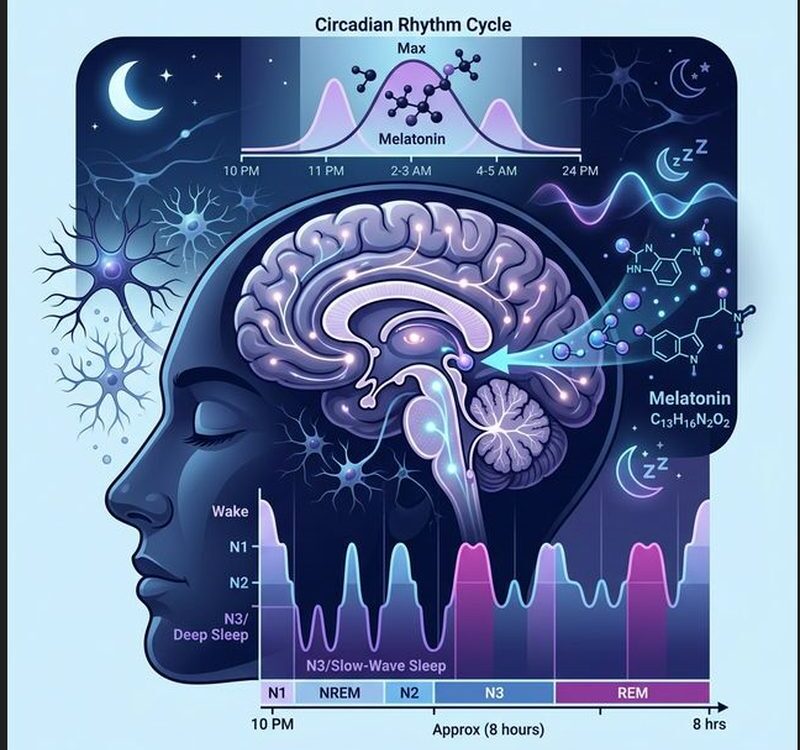
You wake up after eight hours in bed and still feel like you have not slept at all. The explanation lies not in how long you slept but in how your sleep was organised. Sleep is not a single uniform state. Across the night, the brain cycles through distinct stages, light sleep, deep sleep and rapid eye movement sleep, roughly every 90 to 110 minutes, and each stage does different repair work. When that architecture is disrupted by noise, alcohol, medication, sleep apnoea or an irregular schedule, you can spend a full night in bed and wake up with the groggy, unrestored feeling that tells you something important did not happen.
The four stages of sleep
Sleep scientists divide the night into stages N1, N2 and N3, followed by REM. N1 is the brief transition between wakefulness and sleep, lasting only a few minutes; the familiar hypnic jerk, that sudden falling sensation, happens here. N2 is light sleep, where heart rate and breathing slow and the brain begins producing sleep spindles and K-complexes, electrical patterns believed to help consolidate memory. Roughly half the night is spent in N2. N3 is deep sleep, also called slow-wave sleep, dominated by very slow, high-amplitude brain waves. This is the physically restorative stage: growth hormone is released, tissues repair, and the immune system consolidates its work. Waking someone from N3 produces the confusion and disorientation called sleep inertia. Finally comes REM, rapid eye movement sleep, when the brain is almost as active as when awake, the eyes dart beneath the lids, and most vivid dreaming occurs. The body is temporarily paralysed during REM, a safety mechanism that stops you acting out dreams.
How the cycles unfold across the night
A full cycle through N1, N2, N3 and REM takes about 90 to 110 minutes, and a typical night contains four to six cycles. The composition changes as the night progresses. The first half of the night is rich in deep N3 sleep, which is why going to bed very late is so costly: you lose the deep-sleep-heavy portion of the night and cannot simply shift it later. The second half of the night is dominated by REM sleep, which is why early alarms that cut the last two hours steal a disproportionate amount of dreaming and emotional processing. Each REM period grows longer through the night, from around 10 minutes early on to nearly an hour by morning.
What each stage does for you
Deep sleep handles the body’s physical restoration and is linked to immune function and metabolic health. REM sleep handles emotional processing and the integration of memories; studies show that people deprived specifically of REM are more reactive to negative stimuli the next day. Light N2 sleep, far from being filler, contributes to motor learning and memory consolidation, which is why students who sleep after studying remember more than those who cram through the night. The clinical message is that all stages matter, and fragmented sleep, where frequent micro-awakenings prevent the brain from settling into deep stages, is functionally similar to short sleep even when the clock shows eight hours.
Why do you wake up tired?
Waking unrefreshed has a short list of usual suspects. The first is sleep apnoea: repeated partial collapses of the airway cause dozens of unconscious arousals per hour, and the person remembers none of them. Loud snoring with pauses is the classic clue. The second is alcohol: it sedates you into sleep quickly but fragments the second half of the night and suppresses REM, which is why a nightcap produces sleep that feels shallow. The third is an inconsistent schedule, which misaligns the circadian rhythm so that the brain’s sleep stages do not match the time spent in bed. The fourth is late caffeine and heavy meals. The fifth, increasingly common, is fragmented by screens and notifications. When someone reports unrefreshing sleep, sleep physicians do not start with sleeping pills; they start by looking for these architectural saboteurs.
Can you improve your sleep architecture?
You cannot consciously control your cycles, but you can protect the conditions that let them run normally.
- Keep a consistent sleep and wake time so your circadian rhythm and sleep pressure align.
- Get morning daylight and exercise during the day; both deepen slow-wave sleep at night.
- Avoid alcohol within three hours of bed; it is the single biggest REM suppressor in ordinary life.
- Treat snoring with apnoea signs seriously; CPAP therapy restores normal architecture dramatically.
- Keep the bedroom cool, dark and quiet; heat and light fragment the deeper stages.
FAQs
How many sleep cycles do I need per night? Four to six full cycles, which is exactly what 7 to 9 hours provides. Five complete 90-minute cycles is about 7.5 hours, a good practical target.
Do sleep trackers measure sleep stages accurately? Consumer wearables estimate stages from heart rate and movement and are reasonable at detecting total sleep and wake, but poor at distinguishing REM from deep sleep. Treat their stage graphs as rough impressions, not medical data.
Why do I wake up right before my alarm sometimes? The brain can anticipate a regular wake time and begins lightening sleep in the final cycle. It is a sign of a healthy, well-entrained circadian rhythm.
Is dreaming a sign of good sleep? Remembering dreams means you woke from REM, but everyone dreams several times a night whether they remember or not. Frequent vivid nightmares, though, can indicate stress or REM disruption.
The 90-minute cycle is one of the most robust findings in human biology, and it carries a practical lesson: the timing of sleep matters almost as much as the duration. Protect the first half of the night for deep sleep by going to bed at a reasonable hour, and protect the second half for REM by letting the night run its full course. Your brain organised the schedule long before you were born; the job is simply to stop interrupting it.
Compiled by the Khabar 24h Editorial Desk from publicly available sources.
Related stories
View all →
Single-Dose In Vivo CAR-T Shows 90% Response in Myeloma Trial
An experimental cancer therapy that turns a patient’s own cells into treatment inside the body has shown a 90% response rate in…

Punjab Drug Crisis Takes Centre Stage Ahead of 2027 Polls
Punjab's drug crisis dominates debate ahead of the 2027 polls, with the BJP, SAD, AAP and Congress all making it a key…
West Bengal Orders FIRs Over Missing Covid Equipment
West Bengal has ordered FIRs after medical equipment bought during the Covid-19 pandemic was found missing at 64 health centres across the…

Khabar 24h Editorial Desk — our explainers are prepared by the Khabar 24h editorial team using AI-assisted research tools, and every piece is reviewed by a human editor before publishing. We do not claim original reporting: our work is turning complex topics into simple, accurate summaries. Spotted an error? Write to contact@khabar24h.com — our corrections policy aims for same-day review.
More from this author →