Breast Cancer Screening: Self-Exams, Mammograms and When to Start
Breast cancer has overtaken cervical cancer as the most common cancer among Indian women, and it is arriving younger: a significant share of Indian patients are under 50, a decade earlier than in the West. The encouraging counterpoint is that breast cancer found early is among the most curable cancers, with five-year survival above 90 per cent for localised disease. The difference between early and late is usually awareness: noticing a change, getting it evaluated promptly, and screening at the right age. In India, where most cases still present at advanced stages, that awareness gap is measured in lives.
Why India faces a younger burden
Several factors shape the Indian picture. Changing reproductive patterns, later first childbirth, fewer children, less breastfeeding, nudge risk upward, as do rising obesity, alcohol use and sedentary lifestyles. Genetic factors, including BRCA mutations, contribute in a subset. But the dominant problem is late presentation: women ignore lumps out of fear, modesty or the belief that a painless lump is harmless, consult traditional healers first, or face family resistance to medical examination. Dense breast tissue, commoner in younger women, makes lumps harder to feel and mammograms harder to read. The result is a stage distribution skewed toward advanced disease, where treatment is harsher and survival lower.
Breast self-awareness: what to watch for
Formal monthly self-exams have fallen out of favour in guidelines, replaced by breast self-awareness: knowing how your breasts normally look and feel so changes register. Warning signs include a new lump or thickening, swelling of part or all of the breast, skin dimpling or puckering, nipple retraction or discharge (especially bloody), redness or scaling of nipple or breast skin, and persistent pain in one spot. Most lumps are benign, fibroadenomas and cysts are common, especially in young women, but any new persistent lump deserves medical evaluation within weeks, not months. The rule is simple: notice, do not panic, but do not postpone either.
Mammograms: when to start and how often
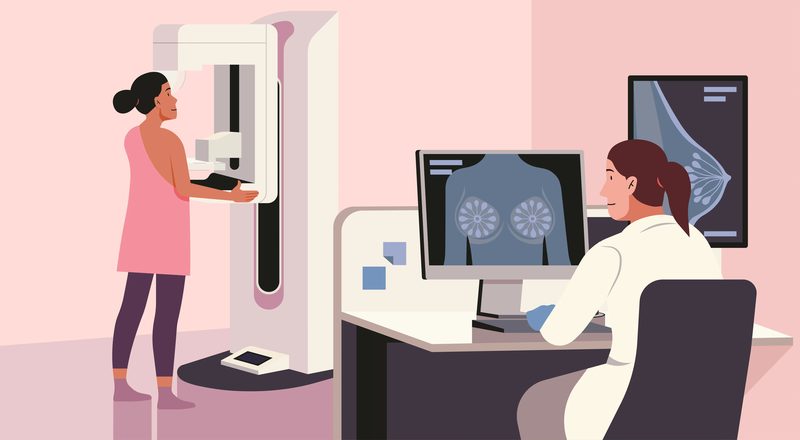
Mammography, low-dose X-ray imaging, remains the only screening test proven to reduce breast cancer deaths. International guidelines generally suggest starting between 40 and 50 and repeating every one to two years; for India, many oncologists advise beginning at 40, earlier with family history. Women with a first-degree relative with breast or ovarian cancer, known BRCA mutations, or chest radiation history need earlier, intensified screening, often adding MRI. Mammograms are safe: the radiation dose is tiny, and while compression is briefly uncomfortable, it is brief. In India, quality-assured mammography is concentrated in cities, a gap mobile units and government programmes are slowly closing. Clinical breast examination by a trained provider every one to three years complements imaging where mammography access is limited.
What happens after a suspicious finding
An abnormal mammogram usually leads to additional imaging, targeted ultrasound or tomosynthesis, and if suspicion persists, a core needle biopsy, a quick procedure using a hollow needle under local anaesthesia. Biopsy is the only definitive diagnosis; imaging alone never confirms cancer. If cancer is found, staging scans map its extent, and treatment is planned by a tumour board: surgery (lumpectomy or mastectomy), often followed by radiation, chemotherapy, hormonal therapy or targeted drugs depending on the tumour’s biology. Indian centres now routinely offer breast-conserving surgery and oncoplastic techniques that preserve appearance. Early-stage treatment is dramatically less gruelling than late-stage, which is the entire argument for screening.
Reducing risk
Not all risk is modifiable, but meaningful levers exist: maintain healthy weight, exercise regularly, limit alcohol, avoid smoking, breastfeed when possible, and discuss the risks and benefits of long-term hormone therapy with a doctor. There is no proven diet or supplement that prevents breast cancer, despite abundant claims. For high-risk women, risk-reducing medications or even preventive surgery are options discussed in specialist clinics. Awareness itself is prevention of the deadliest kind, late presentation.
FAQs
Does a mammogram cause cancer? No. The radiation dose is extremely low, far below the level of concern, and the benefit vastly outweighs the theoretical risk.
Are lumps in young women usually cancer? Usually not; fibroadenomas and cysts dominate. But age is not immunity, so any persistent lump needs evaluation.
Do men get breast cancer? Rarely, but yes; men with chest lumps should also seek evaluation.
Breast cancer in India is a race between awareness and delay, and awareness is winning slowly. Know your breasts, respect any change with a prompt check-up, and begin mammograms at the right age. Caught early, this is a curable disease; the tragedy is only in finding it late.
Compiled by the Khabar 24h Editorial Desk from publicly available sources.

Khabar 24h Editorial Desk — our explainers are prepared by the Khabar 24h editorial team using AI-assisted research tools, and every piece is reviewed by a human editor before publishing. We do not claim original reporting: our work is turning complex topics into simple, accurate summaries. Spotted an error? Write to contact@khabar24h.com — our corrections policy aims for same-day review.
More from this author →