Cash That Lives in Your Phone: Inside India’s Digital Rupee Pilots in 2026
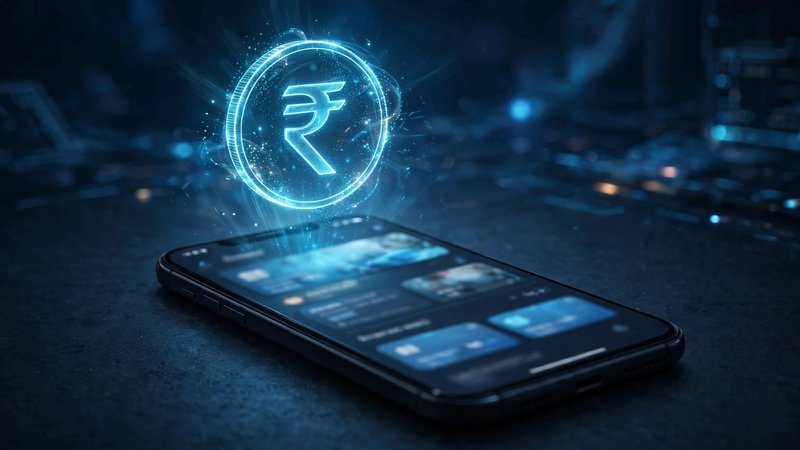
Indians moved roughly 300 billion dollars’ worth of value through UPI in a typical month of 2026. Against that backdrop, a far quieter monetary experiment has been running in parallel for more than three years: the digital rupee, or e-rupee, India’s central bank digital currency. In 2026 it reached a turning point, moving out of pure experimentation and into welfare payments, even as its headline numbers slipped. Here is how the e-rupee works, what the pilots have actually achieved, and where the project stands now.
What the digital rupee is, and what it is not
The e-rupee is the digital form of India’s physical currency, issued by the Reserve Bank of India and carrying the same legal-tender status as a banknote. It comes in two variants. The wholesale version, e-rupee-W, was piloted from November 1, 2022, for settling secondary-market transactions in government securities between financial institutions. The retail version, e-rupee-R, followed on December 1, 2022, within closed user groups of banks and customers, beginning with four banks across four cities. It is important to separate the e-rupee from two things it resembles. It is not UPI: UPI is a payment rail that moves existing bank deposits, while the e-rupee is itself money, a direct claim on the central bank. And it is not cryptocurrency: it carries sovereign backing and a one-to-one value with the physical rupee, unlike private crypto assets.
Why central banks want their own digital money
India is not alone — more than 130 countries, representing the vast majority of global GDP, are exploring central bank digital currencies. The motivations vary. For China, whose e-CNY is the most advanced large-scale CBDC pilot in the world, the goal is partly about payment-system resilience and partly about extending the renminbi’s reach. For smaller economies, CBDCs promise cheaper remittances and financial inclusion. For the RBI, three rationales stand out.
First, sovereignty over money: as private digital payments grow, central banks worry about a future where most transactions settle in commercial-bank money or, worse, in private stablecoins beyond their control. A CBDC keeps the central bank’s money relevant in a digital economy. Second, settlement efficiency: wholesale CBDC can make interbank and securities settlement instant and final, reducing the collateral and time that today’s systems tie up. Third, programmability — the feature that sets CBDCs apart from every existing form of money. Funds can carry conditions: spendable only on food, only at certain merchants, only before a certain date. No banknote or bank deposit can do that.
How the pilot actually works
The RBI issues e-rupee tokens, and banks distribute them to users’ digital wallets, which can hold up to 10,000 rupees in the pilot. Money can move person to person or person to merchant, with settlement that is immediate and final, much like handing over cash. The wallets are interoperable with UPI QR codes, so merchants need no new hardware. The feature that sets the e-rupee apart is programmability: funds can be restricted by purpose, merchant or validity. That single capability is where the pilot has found genuine traction. In 2026, food subsidies were reportedly credited as programmable digital rupees to public distribution system beneficiaries in Gujarat, Puducherry and Chandigarh, redeemable only for entitled foodgrains at fair price shops, a direct attack on the leakages that have long plagued welfare delivery.
The state of play in 2026
The numbers tell a story of real usage that is still small in the national scheme of things. The RBI’s annual report put retail e-rupee in circulation at roughly 770 crore rupees at the end of March 2026, down about a quarter from a year earlier. Yet usage metrics kept climbing: by early 2026 the retail pilot reportedly counted around 10 million users, and by the middle of the year reported cumulative transactions had crossed 150 million. In 2026 the RBI acknowledged that the digital rupee was being used for actual transactions, even as the project formally remained a pilot. The central bank has also been developing tokenisation platforms for financial assets that use wholesale digital rupees for settlement, and exploring cross-border pilots.
The paradox deserves a closer look. Falling circulation alongside rising transactions suggests people are using e-rupee wallets as conduits — money flows through rather than sitting in them. That is rational behaviour: with a 10,000-rupee wallet cap and no interest paid on balances, there is little reason to hold e-rupees the way one holds a savings deposit. It also hints at the project’s central tension, discussed below.
The hard questions: banks, privacy and adoption
Disintermediation. Every rupee held as e-rupee is a rupee not held as a bank deposit — and deposits fund bank lending. If CBDC adoption ever scaled dramatically, it could drain the banking system’s cheapest funding source. Central banks everywhere manage this with holding limits (India’s 10,000-rupee cap is exactly such a guardrail) and by paying no interest on CBDC balances. The design question never goes away: make the CBDC too attractive and you weaken banks; make it unattractive and nobody uses it.
Privacy. A central bank digital currency creates, in principle, a record of every transaction at the central bank. The RBI has said the e-rupee offers anonymity comparable to cash for small values, with traceability rising for larger ones — but the architecture of that promise matters enormously, and privacy advocates worldwide remain sceptical of CBDCs on these grounds. How India resolves the anonymity-auditability trade-off will shape public trust.
The UPI problem. The e-rupee’s toughest competitor is not crypto but UPI itself — free, instant, and already ubiquitous. For ordinary checkout payments, the e-rupee offers merchants and users little that UPI does not. Its honest use cases are the ones UPI handles poorly: programmable welfare, offline payments in low-connectivity areas (a feature the RBI has been testing), and institutional settlement. Judging the e-rupee by UPI’s metrics misses the point; judging it at all requires patience the news cycle rarely allows.
What comes next
The e-rupee is not trying to replace cash or to outdo UPI at the checkout counter. Its future lies in the things neither can do well: programmable welfare transfers that cannot leak, instant settlement between institutions, and eventually cheaper cross-border payments — an area where the RBI is already running exploratory pilots, since correspondent banking remains slow and expensive. The challenges are equally clear. Adoption remains voluntary and tiny compared with UPI, merchants see little reason to switch, and the RBI must manage the delicate question of how much bank deposit money should be allowed to migrate into central bank money. For now, the digital rupee remains a pilot, but it is a pilot that has quietly started paying for real food on real plates.
FAQs
Is the digital rupee the same as UPI?
No. UPI moves money between bank accounts; the e-rupee is money — a direct liability of the RBI, like a banknote in digital form.
Can the government track my e-rupee spending?
The RBI says small-value transactions carry cash-like anonymity, with traceability increasing for larger amounts. The exact technical guarantees are still being defined as the pilot evolves.
Will the e-rupee replace cash?
That is not its stated goal. The RBI presents it as an additional payment option, and cash in circulation in India has continued to grow alongside the pilot.
Compiled by the Khabar 24h Editorial Desk from publicly available sources.

Khabar 24h Editorial Desk — our explainers are prepared by the Khabar 24h editorial team using AI-assisted research tools, and every piece is reviewed by a human editor before publishing. We do not claim original reporting: our work is turning complex topics into simple, accurate summaries. Spotted an error? Write to contact@khabar24h.com — our corrections policy aims for same-day review.
More from this author →
Leave a Reply