Tap, Scan, Pay: How UPI Went From India to 11 Countries
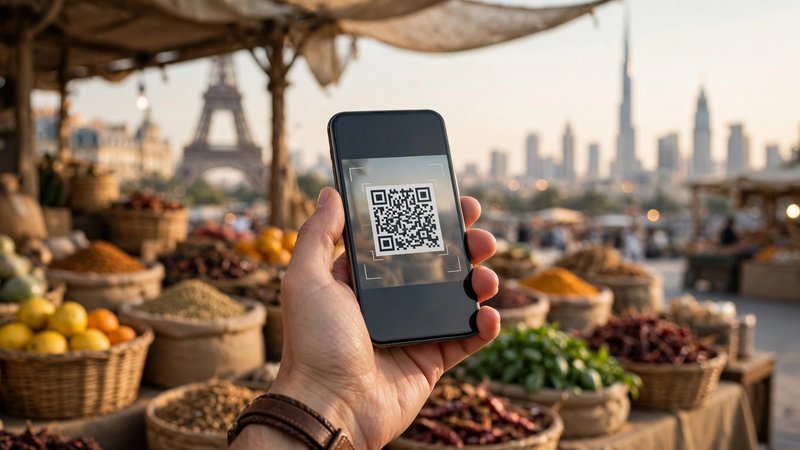
A decade ago, India’s Unified Payments Interface was a domestic convenience — a way to split a dinner bill or pay the vegetable vendor by scanning a square of black and white. Today, that same QR scan works on street corners from Paris to Singapore to Doha. According to recent government statements, UPI is now accepted in more than ten countries outside India, turning an Indian innovation into one of the world’s most exported payment rails.
How UPI actually works
Beneath the QR code sits elegant architecture. UPI is not an app — it is a protocol run by the National Payments Corporation of India (NPCI), a non-profit owned by banks. Payment apps (Google Pay, PhonePe, BHIM) are just interfaces; the actual money moves between bank accounts over NPCI’s rails, addressed by Virtual Payment Addresses like name@bank instead of account numbers. Settlement is instant, 24×7, including on holidays — a feature most countries’ bank-transfer systems still lack. And crucially, UPI charges merchants nothing: the zero merchant discount rate (MDR) is what made the vegetable vendor adopt it, since card machines would have eaten her margin.
That zero-MDR design is also UPI’s great economic puzzle. Somebody pays for every payment system — card networks charge merchants, who pass costs to consumers. UPI’s costs are absorbed by banks and subsidised by the government, which treats digital payments as public infrastructure, like roads. The model works at Indian scale but is exactly what makes foreign bankers hesitate: their business models depend on payment fees that UPI gives away.
Why it conquered India first
UPI’s domestic triumph was not an accident of technology but of timing and policy. The JAM trinity — Jan Dhan bank accounts, Aadhaar identity, mobile phones — put a bank account in nearly every adult’s pocket. Demonetisation in 2016 forced a cash-dependent economy to try digital alternatives. And the NPCI’s decision to make UPI an open, interoperable protocol meant any app could build on it — unlike the walled gardens of wallets or card networks. The result: from launch in 2016 to hundreds of billions of dollars in monthly transaction value a decade later, the fastest-scaling payment system in history.
The countries on the list
The countries most commonly cited are the United Arab Emirates, France, Bhutan, Sri Lanka, Nepal, Singapore, Mauritius and Qatar, with Cambodia, Greece and the Maldives reported as the newest additions. In most of them, Indian travellers can use UPI for everyday merchant payments — scanning local QR codes to pay for shopping, dining and travel. Cambodia was reported in 2026 as a new merchant-payment market, with a linkage letting Indian visitors scan the country’s KHQR codes at participating merchants.
Two flavours of global UPI
It helps to know that “UPI accepted” does not mean the same thing everywhere. The merchant-payment countries work like UPI at home: you open your payment app, scan, enter your PIN, and the money moves instantly, converted from rupees into the local currency at the going exchange rate — often beating the markups on conventional credit cards.
Greece and the Maldives are the two exceptions. In Greece, UPI was reported to have gone live in 2026 through a partnership between NPCI International Payments Limited (NIPL) and Eurobank, and in the Maldives the country’s Favara instant-payment system was reportedly linked with UPI in 2026 — but both linkages currently support cross-border remittances rather than routine shop-floor payments. That means sending money home or between accounts, not buying a coffee by scanning a QR.
How the network was built
The international push is led by NIPL, the overseas arm of the National Payments Corporation of India, which signs partnerships with foreign banks and payment networks one market at a time. Bhutan was the first foreign country to adopt UPI, back in July 2021, through the Royal Monetary Authority. Singapore’s tie-up with its PayNow system made transfers between the two countries nearly instant. France marked UPI’s entry into Europe, launching at the Eiffel Tower in Paris in 2024 before expanding to other tourist and retail locations in France. Mauritius, Nepal, Sri Lanka, the UAE and Qatar followed, each plugging UPI into the local QR ecosystem.
The appeal is obvious for the roughly 20 million-plus overseas Indians and millions of Indian tourists: no carrying wads of foreign cash, no hunting for forex cards, no opaque conversion fees. For host countries, it opens the wallets of one of the world’s fastest-growing outbound travel markets.
The bigger game: remittances and payment diplomacy
Merchant payments for tourists are the visible tip; the strategic prize is remittances. India is the world’s largest recipient of migrant remittances — well over a hundred billion dollars a year — and every percentage point shaved off transfer fees is billions saved by working families. UPI’s remittance linkages (Singapore’s PayNow, the Maldives’ Favara, and pilots elsewhere) attack the correspondent-banking chain that makes cross-border transfers slow and expensive. There is also a diplomatic dimension: exporting payment infrastructure builds the kind of deep economic integration that trade deals alone cannot, and positions India as a provider of digital public goods — the same pitch behind the global offer of the India Stack.
The competition is real. China’s Alipay and WeChat Pay pursued a similar tourist-first expansion a decade ago, and card networks are not standing still. UPI’s advantage is its open-protocol, zero-fee DNA — but converting that into foreign adoption means convincing other countries’ banks to embrace a system that undercuts their fee income. The pilots reportedly underway in markets like Japan and Malaysia will test whether the model travels beyond corridors with heavy Indian travel flows.
Using UPI abroad: what travellers should know
- Activate before you fly: in your UPI app’s profile settings, find “UPI International” or “UPI Global” and enable it for your bank account, authenticating with your UPI PIN. Most apps let you set an activation window of up to 90 days.
- Check acceptance: UPI works only at participating merchants in each country, not universally — look for supported QR codes and ask if unsure.
- Expect exchange conversion: payments convert from rupees to local currency at the prevailing rate; keep an eye on it for large purchases.
- Know the exceptions: Greece and Maldives currently support cross-border transfers, not QR-based shopping payments.
- Keep a backup: carry a credit card or some cash — even in the full merchant-payment markets, UPI acceptance varies by store and network.
FAQs
Is UPI free to use abroad?
UPI itself charges no fee, but currency conversion applies at the prevailing exchange rate, and your bank’s terms for international UPI may include charges — check before travelling.
Can foreigners use UPI in India?
Visitors from G20 countries can get prepaid UPI wallets linked to their foreign mobile numbers at select airports and banks — a separate facility from international UPI for Indians abroad.
Why don’t more countries have UPI yet?
Each linkage needs bilateral agreements between NPCI International and the foreign payment system, plus commercial willingness from local banks — a slow, market-by-market process.
The list keeps growing — pilots are reportedly underway in markets like Japan and Malaysia — and the ambition is clear: for the Indian traveller, the foreign-payment friction that defined the pre-UPI era may soon be a footnote.
Compiled by the Khabar 24h Editorial Desk from publicly available sources.

Khabar 24h Editorial Desk — our explainers are prepared by the Khabar 24h editorial team using AI-assisted research tools, and every piece is reviewed by a human editor before publishing. We do not claim original reporting: our work is turning complex topics into simple, accurate summaries. Spotted an error? Write to contact@khabar24h.com — our corrections policy aims for same-day review.
More from this author →
Leave a Reply