Moon dust yields new magnetic iron fossil
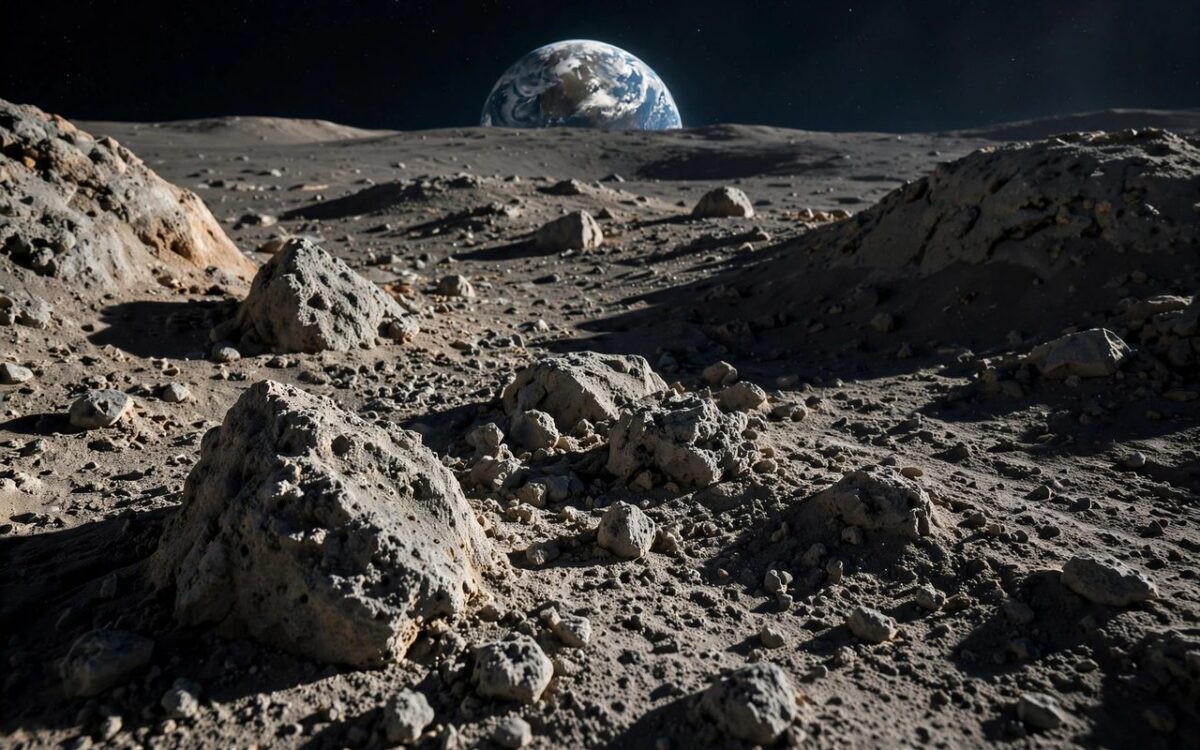
Scientists analyzing soil returned from the Moon’s far side by China’s Chang’e-6 mission have identified a form of magnetic iron never before found in natural lunar material.
The researchers found face-centered cubic gamma iron preserved as nanoparticles inside impact glass from the South Pole-Aitken Basin. The discovery was published in the Proceedings of the National Academy of Sciences on September 16.
Gamma iron is normally stable only at high temperatures, between roughly 912 and 1,394 degrees Celsius, and transforms into the common alpha form as it cools. The team proposes that rapid cooling of impact-generated melts, plus traces of carbon and the surrounding glassy matrix, preserved the unusual phase.
Electron holography showed that larger gamma-iron particles can form stable magnetic vortex states, meaning they may preserve ancient magnetic information.
Team member Long Li called it a tiny magnetic fossil that may help scientists understand the Moon’s ancient magnetic history. The finding could eventually help separate signals from the Moon’s ancient core dynamo from short-lived fields generated during major impacts.
Related stories
View all →
ISRO’s NVS-03 NavIC satellite eyes mid-October launch
ISRO is preparing to launch the NVS-03 navigation satellite in mid-October, according to reports. The launch window is said to be between…
NASA’s SPHEREx telescope maps brown dwarf atmospheres
NASA's SPHEREx telescope analysed 37 nearby brown dwarfs and found atmospheres rich in water, carbon dioxide and methane. The telescope takes 3,600…

Most Distant Blazar Found Eight Billion Light-Years Away
Scientists have detected blazar OP 313, the most distant ever recorded, eight billion light-years away.

Khabar 24h Editorial Desk — our explainers are prepared by the Khabar 24h editorial team using AI-assisted research tools, and every piece is reviewed by a human editor before publishing. We do not claim original reporting: our work is turning complex topics into simple, accurate summaries. Spotted an error? Write to contact@khabar24h.com — our corrections policy aims for same-day review.
More from this author →
Leave a Reply