The Mongol Empire Explained: How Genghis Khan Built History’s Largest Land Empire
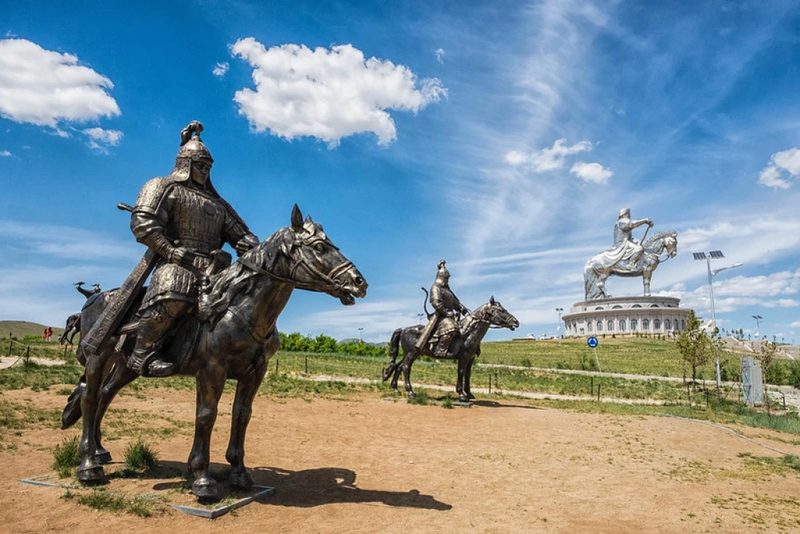
In the early 1200s, a man born as Temujin on the Mongolian steppe united the fractious nomad tribes and unleashed the most rapid conquest in history. Within 25 years, Genghis Khan’s armies had seized more territory than Rome conquered in four centuries, eventually ruling an empire stretching from Korea to Hungary, the largest contiguous land empire ever. The Mongols were history’s great disruptors: terrifying conquerors and, paradoxically, builders of a connected world.
Who was Genghis Khan?
Temujin was born around 1162 into a world of tribal feuding; his father was poisoned, his family abandoned, and he survived captivity and betrayal before uniting the Mongol tribes in 1206, taking the title Genghis Khan, universal ruler. He was a political genius as much as a warrior: he broke tribal aristocracies, promoted on merit, codified law in the Yassa, and forged absolute loyalty. His personal story, from outcast to world conqueror, remains one of history’s most extraordinary arcs.
The Mongol war machine
The Mongol army was the finest the pre-modern world produced. Every warrior was a horseman from childhood, armed with a powerful composite bow accurate at range, and armies moved with shocking speed, each rider leading spare horses. Mongol tactics, feigned retreats, encirclements, coordinated signals across vast distances, were generations ahead of their enemies. They adopted siege engineers from conquered peoples, built a spy network spanning continents, and practised psychological warfare: cities that surrendered were spared, those that resisted were annihilated, and the word spread.
The conquests
The roll call is staggering: northern China and the Jin dynasty, Central Asia’s great cities, Samarkand, Bukhara, Persia’s Khwarezmian Empire, destroyed utterly for killing Mongol envoys, then Russia’s principalities, the Caucasus, and into Eastern Europe, where Mongol horsemen crushed Hungarian and Polish armies in 1241. Only the Great Khan’s death recalled them from Europe’s gates. Later khans added southern China, Baghdad (1258), and Korea. At its height the empire covered some 23 million square kilometres.
The Pax Mongolica: the empire as connector
Conquest was only half the story. The Mongols secured the Silk Road as never before, creating the Pax Mongolica: a single political space from China to Europe where merchants, missionaries and envoys travelled in relative safety. Paper money, gunpowder knowledge, Persian astronomy and Chinese technologies flowed west; European travellers like Marco Polo reached the Khan’s court. The Yam relay system, with stations every few dozen miles, was the medieval world’s fastest information network. The Mongols globalised Eurasia.
Why the empire fell apart
The empire was too vast to hold. Genghis divided it among his sons, and succession disputes fractured it into four khanates: the Yuan in China, the Ilkhanate in Persia, the Chagatai in Central Asia, and the Golden Horde in Russia. Each assimilated into local cultures, Mongol rulers becoming Chinese emperors, Persian sultans, Turkic khans. Plague, which likely spread along Mongol trade routes, devastated the 1300s. By 1368 the Yuan had fallen; the Golden Horde faded; only the idea of the world-conqueror remained, inherited by Timur and, distantly, the Mughals.
The Mongol legacy: destroyers or builders?
The debate endures. The Mongols killed millions, some estimates suggest tens of millions, and destroyed cities and irrigation systems that took centuries to recover. Yet they also ended the fragmentation of Eurasia, spread technologies, enabled the Renaissance’s Eastern knowledge, and created the conditions for the modern world system. Russia’s autocracy, China’s borders, and even the Black Death’s pathways are Mongol legacies. Genghis Khan is Mongolia’s founding father and, to much of the world, history’s greatest conqueror. Both are true.
FAQs
How big was the Mongol Empire? About 23 million square kilometres at its peak, the largest contiguous land empire in history, spanning from Korea to Eastern Europe.
Was Genghis Khan cruel? By modern standards, undeniably: resisting cities were massacred. But he was also religiously tolerant, meritocratic, and a lawgiver, a complexity historians still debate.
What ended the Mongol Empire? Succession divisions split it into khanates that assimilated locally; plague and rising local powers finished the job by the late 1300s.
The Mongols proved that nomads could conquer the world, and that conquest could connect it. Their empire lasted barely a century and a half, but the world it stitched together never came apart again.
Source: History.com

Khabar 24h Editorial Desk — our explainers are prepared by the Khabar 24h editorial team using AI-assisted research tools, and every piece is reviewed by a human editor before publishing. We do not claim original reporting: our work is turning complex topics into simple, accurate summaries. Spotted an error? Write to contact@khabar24h.com — our corrections policy aims for same-day review.
More from this author →