Angkor Wat Explained: The World’s Largest Religious Monument
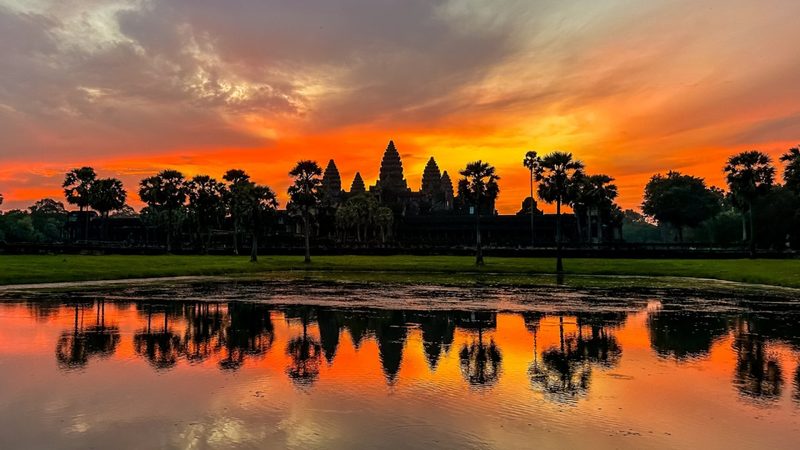
In the jungles of Cambodia stands the largest religious monument ever built: Angkor Wat, a 12th-century temple complex covering 400 acres, its five lotus towers reflected in still moats at dawn. Built by the Khmer Empire at its zenith, it is Hindu cosmology in stone, later a Buddhist sanctuary, and today Cambodia’s national symbol, emblazoned on its flag. How was it built, what do its carvings mean, and how should you experience it?
The Khmer Empire that built it
Between the 9th and 15th centuries, the Khmer Empire dominated Southeast Asia from its capital at Angkor, ruling millions through hydraulic engineering, rice surpluses and formidable armies. At its height around 1200, Angkor may have been the world’s largest city, sprawling across 1,000 square kilometres. King Suryavarman II built Angkor Wat in the early 1100s as his state temple and probable mausoleum. The empire’s later decline, through war, climate shifts and Theravada Buddhism’s rise, left the temples to the jungle.
A mountain of cosmic symbolism
Angkor Wat is the universe in architecture: its five towers represent Mount Meru, the Hindu cosmic mountain; the moat is the primordial ocean; the causeway, the bridge between worlds. The temple’s bas-reliefs, hundreds of metres of them, narrate the Churning of the Ocean of Milk, the epics Ramayana and Mahabharata, and the king’s own glory, with thousands of apsara dancers carved in endless variety. Every alignment is astronomical: the equinox sun crowns the central tower. It is theology you can walk through.
How it was built
The logistics stagger: an estimated 300,000 workers and 6,000 elephants, sandstone floated down canals from quarries 40 km away, blocks fitted without mortar, carvings executed by master artisans. All this without the wheel for heavy transport or iron scaffolding as we know it. The construction consumed a kingdom’s surplus for decades, a statement of divine kingship in stone. That it was accomplished in roughly 30 years testifies to the Khmer state’s organisational genius.
From Hindu temple to Buddhist shrine
Angkor Wat began as a Vaishnavite Hindu temple, dedicated to Vishnu, unusual among Khmer state temples. As the empire embraced Theravada Buddhism, the complex was gradually converted: Buddha statues replaced or joined Hindu gods, and it became a Buddhist pilgrimage site, which likely saved it from the abandonment that claimed other temples. This layered sanctity, Hindu cosmology housing Buddhist devotion, makes Angkor Wat a living palimpsest of Southeast Asian faith.
Rediscovery and the modern era
Angkor never fully vanished, Buddhist monks maintained Wat through the centuries, but French naturalist Henri Mouhot’s 1860 account introduced it to the West, launching colonial archaeology. The Khmer Rouge era brought looting and landmines; restoration since the 1990s, led internationally, has been heroic. UNESCO listing in 1992 and relative peace turned Angkor into Cambodia’s economic engine, drawing millions. The temples survived war; managing peace, and mass tourism, is the current challenge.
Visiting: sunrise and beyond
The classic experience is sunrise at the reflecting pool, arriving by 5 am to watch the towers ignite. But Angkor rewards depth: the Bayon’s 216 enigmatic faces, Ta Prohm’s trees strangling ruins, Banteay Srei’s pink perfection, and the vast barays (reservoirs) that made the empire possible. Hire a knowledgeable guide, rent a bicycle for the flat circuits, and buy the multi-day pass: one day barely scratches the surface. Go in the cool dry season, November to February.
Angkor’s water engineers
The Khmer built vast barays, reservoirs larger than many modern lakes, and a canal network that watered the rice feeding a million people. Recent lidar scans revealed the true scale of Angkor’s engineered landscape. The empire ran on water management as sophisticated as its temples, and its decline may trace to the system’s failure.
FAQs
How big is Angkor Wat? The temple complex covers about 400 acres (162 hectares), the largest religious monument in the world.
Was it built by aliens? No, by the Khmer Empire’s engineers, workers and artisans in the 12th century; its construction is well documented archaeologically.
Is it Hindu or Buddhist? Originally Hindu (Vishnu), converted to Theravada Buddhism centuries ago; both layers remain visible.
Angkor Wat is the Khmer Empire’s immortal signature: cosmic order rendered in sandstone, as moving at dawn today as when Suryavarman’s priests first consecrated it nine centuries ago.
Compiled by the Khabar 24h Editorial Desk from publicly available sources.

Khabar 24h Editorial Desk — our explainers are prepared by the Khabar 24h editorial team using AI-assisted research tools, and every piece is reviewed by a human editor before publishing. We do not claim original reporting: our work is turning complex topics into simple, accurate summaries. Spotted an error? Write to contact@khabar24h.com — our corrections policy aims for same-day review.
More from this author →