Vizhinjam Port: Inside India’s First Deepwater Transshipment Hub
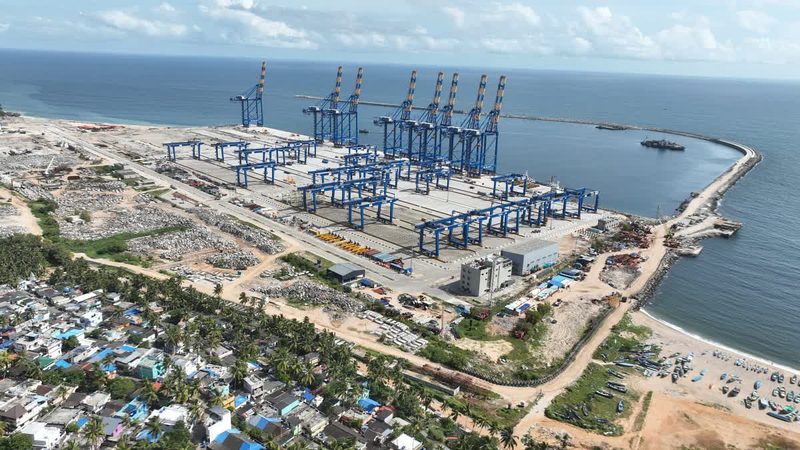
For decades, Indian containers bound for Europe and America took a detour: they were first shipped on small feeder vessels to Colombo, Singapore or Port Klang, transferred to giant mother vessels, and only then began their ocean journey. India, despite its vast coastline, had no port deep enough and equipped enough to receive the biggest ships directly. Vizhinjam, a fishing village near Thiruvananthapuram in Kerala, changed that. Built by the Adani Group under a public-private partnership with the Kerala government, Vizhinjam International Seaport is India’s first dedicated deepwater transshipment hub, with a natural draft of 18 to 20 metres that needs no dredging. Since trial operations began, mother vessels have started calling, and the battle for Indian transshipment cargo has begun.
Why location is everything
Vizhinjam sits barely 10 nautical miles from the main east-west international shipping route that connects Asia with Europe through the Suez Canal. This is the port’s decisive advantage: giant vessels can deviate minimally to call at Vizhinjam, unlike detours to ports deeper inside the coast. The natural depth, among the deepest of any Indian port site, means the port can receive the largest container ships afloat, the ultra-large container vessels that carry over 20,000 TEUs, without the endless dredging that shallower ports require. Geography gave Vizhinjam the opportunity; the port’s job is to convert geography into business.
The port and its machines
Vizhinjam is being built as a highly automated terminal. Ship-to-shore cranes among the largest in India unload the mother vessels, automated rail-mounted gantry cranes stack containers in the yard, and the terminal operating system orchestrates the choreography. The breakwater, one of India’s longest, shelters the berths from the Arabian Sea’s monsoon fury. The first phase provides capacity for around a million TEUs annually, with expansion phases planned to multiply that. Automation matters because transshipment is a speed business: a hub wins when it can turn a giant ship around faster and cheaper than the rival hub.
Taking on Colombo
The strategic prize is the Indian transshipment cargo currently handled at Colombo, which handles a large share of India’s container transshipment. Every container that shifts to Vizhinjam saves Indian trade the feeder leg to Sri Lanka, cutting costs and transit time, and keeps the value within India. Colombo will not surrender the business quietly: it has its own expansion plans and deep relationships with shipping lines. The competition will be decided on turnaround times, tariffs, connectivity to Indian hinterland ports, and the willingness of global shipping alliances to reconfigure their networks. Early mother-vessel calls at Vizhinjam suggest the lines are interested; converting interest into regular calls is the next step.
The controversies
Vizhinjam’s construction was not smooth. Fishing communities protested that the breakwater and dredging were causing coastal erosion and damaging livelihoods, leading to prolonged agitations. Environmentalists raised concerns about the impact on the coastline. The project’s costs escalated and timelines slipped, with the state government and the concessionaire renegotiating terms. Cyclone Ockhi’s devastation of the local fishing community added emotional weight to the protests. The port’s supporters argue that the long-term gains, jobs, industry, cheaper trade, outweigh the disruption; the fishing villages that lost shoreline remain unconvinced. The tension between port-led development and coastal communities, familiar from Sagarmala’s story, is sharpest at Vizhinjam.
What success looks like
A successful Vizhinjam would handle several million TEUs of transshipment annually, anchor a logistics and industrial ecosystem in southern Kerala, and measurably cut India’s dependence on foreign hubs. It would also validate the landlord-port PPP model for greenfield ports. The port’s progress will be measured in shipping-line schedules: each new weekly mother-vessel service is a vote of confidence. India has waited decades for a transshipment hub of its own; Vizhinjam is the first serious attempt, and the shipping world is watching whether geography plus automation can beat Colombo’s head start.
FAQs
Where is Vizhinjam Port? Near Thiruvananthapuram in Kerala, about 10 nautical miles from the main Asia-Europe shipping route.
What is transshipment? Transferring containers between large mother vessels and smaller feeder ships at a hub port; India historically relied on Colombo and Singapore for this.
Who built Vizhinjam? The Adani Group under a PPP concession with the Kerala government.
Vizhinjam is India’s bid to stop renting its gateway to the world from other countries’ ports. The water is deep enough; the question is whether the business will follow.
Compiled by the Khabar 24h Editorial Desk from publicly available sources.

Khabar 24h Editorial Desk — our explainers are prepared by the Khabar 24h editorial team using AI-assisted research tools, and every piece is reviewed by a human editor before publishing. We do not claim original reporting: our work is turning complex topics into simple, accurate summaries. Spotted an error? Write to contact@khabar24h.com — our corrections policy aims for same-day review.
More from this author →