The Three-Language Formula Explained: Where India’s Language Policy Gets Contested
Every few years, India’s language policy returns to the front pages, and at the centre of the storm is usually the three-language formula: the idea that schoolchildren should learn three languages, including one from a different part of the country. Born in the 1960s as a compromise between Hindi-promoting and Hindi-resisting states, the formula has been reaffirmed by every major education policy since, including the National Education Policy of 2020. Yet in practice it has never worked the way its framers intended. This explainer traces the formula’s history, how it is supposed to work, and why it remains one of India’s most durable political flashpoints.
Where the formula came from
The three-language formula emerged from the Kothari Commission of 1964-66 and was formally adopted in the National Policy on Education of 1968. The context was the fierce anti-Hindi agitation in Tamil Nadu in the 1960s, when attempts to make Hindi the sole official language of the Union provoked violent protests and deaths. The compromise was elegant on paper: in Hindi-speaking states, students would learn Hindi, English, and a modern Indian language, preferably from the south; in non-Hindi-speaking states, they would learn the regional language, English, and Hindi. The 1986 education policy retained the formula, and the National Education Policy 2020 reaffirmed it again, explicitly stating that no language would be imposed on any state. The intent was national integration through mutual linguistic exposure: northern children would encounter a southern language, southern children would learn Hindi, and English would serve as the link language for all.
How it is supposed to work in schools
Under the formula, the first language is typically the mother tongue or regional language, the second is usually English or Hindi depending on the state, and the third is meant to broaden horizons. In practice, the combinations vary enormously. Kendriya Vidyalayas and Navodaya Vidyalayas, the central government’s own school chains, implement a fairly standard version: Hindi, English, and a regional language. State boards, however, have wide latitude, and many have quietly adapted the formula to local political realities. Some states teach only two languages seriously, with the third reduced to a token subject. Others, like Tamil Nadu, have historically operated a two-language policy of Tamil and English, rejecting the third language outright.
Why Tamil Nadu keeps saying no
No discussion of the formula is complete without Tamil Nadu, where opposition to imposed Hindi learning is woven into the state’s political identity. The Dravidian parties have maintained a two-language policy for decades, arguing that a third compulsory language, in practice always Hindi, is an imposition that burdens students and privileges the Hindi belt. Every time the centre has been perceived as pushing Hindi through the education system, from the 1960s to the NEP 2020 debates, Tamil Nadu’s politics have flared. The state’s position is that it already teaches Tamil and English, which together serve identity and opportunity, and that it will not accept a third language dictated from Delhi. The NEP’s assurance that no language will be imposed has not fully settled the matter, because the suspicion runs deep: Tamil Nadu’s leaders and commentators read the fine print of every policy document for signs of compulsion.
What actually happens in classrooms
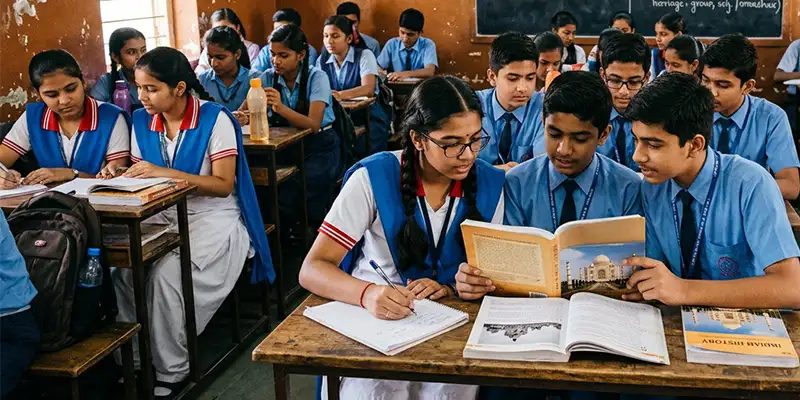
The gap between policy and classroom reality is the formula’s quiet scandal. Studies of language learning in Indian schools have repeatedly found that the third language is often the worst taught and least learned of the three, saddled with fewer periods, less trained teachers, and lower stakes in examinations. In many Hindi-speaking states, the designated third language, often Sanskrit or a southern language, is taught perfunctorily or not at all. Learning outcomes in the second and third languages are frequently poor even where the formula is formally followed. Meanwhile, English-medium aspirations have reshaped the landscape: parents across the country increasingly want English from Class 1, and private schools market themselves on English fluency, whatever the official formula says. The result is a system where the stated policy and the lived classroom experience diverge sharply, and where the formula’s integrative purpose, children in the north learning a southern language and vice versa, is rarely realised.
Why the debate will not die
The three-language formula survives because it is the only compromise that has ever commanded even notional national consensus, and it is contested because language in India is never just about pedagogy. Every iteration of the debate replays the same underlying questions: who decides what children learn, whether Hindi should have a special national role, and how to balance national integration against linguistic federalism. The NEP 2020’s version, with its emphasis on mother-tongue instruction and its no-imposition clause, tried to defuse the politics, but implementation, particularly around the third language in states like Tamil Nadu, continues to generate friction. Until India finds a way to discuss language policy without it becoming a proxy war over identity, the formula will remain what it has been for nearly sixty years: adopted on paper, adapted in practice, and argued about in public.
FAQs
What are the three languages in the formula? Broadly: the regional language or mother tongue, Hindi or English, and a third modern Indian language. The exact combination varies by state and school board.
Is the third language compulsory everywhere? In principle yes under central policy, but Tamil Nadu follows a two-language policy and several states implement the third language only nominally.
Did NEP 2020 impose Hindi? The policy explicitly says no language will be imposed on any state, though critics in Tamil Nadu and elsewhere remain unconvinced by the assurances.
The three-language formula is less a curriculum design than a political settlement, renewed every generation and renegotiated every decade. Understanding it means understanding that in India, what children learn in language class is never only about language.
Compiled by the Khabar 24h Editorial Desk from publicly available sources.

Khabar 24h Editorial Desk — our explainers are prepared by the Khabar 24h editorial team using AI-assisted research tools, and every piece is reviewed by a human editor before publishing. We do not claim original reporting: our work is turning complex topics into simple, accurate summaries. Spotted an error? Write to contact@khabar24h.com — our corrections policy aims for same-day review.
More from this author →