Sundarbans: Tigers, Tides, and Life in the World’s Largest Mangrove Delta
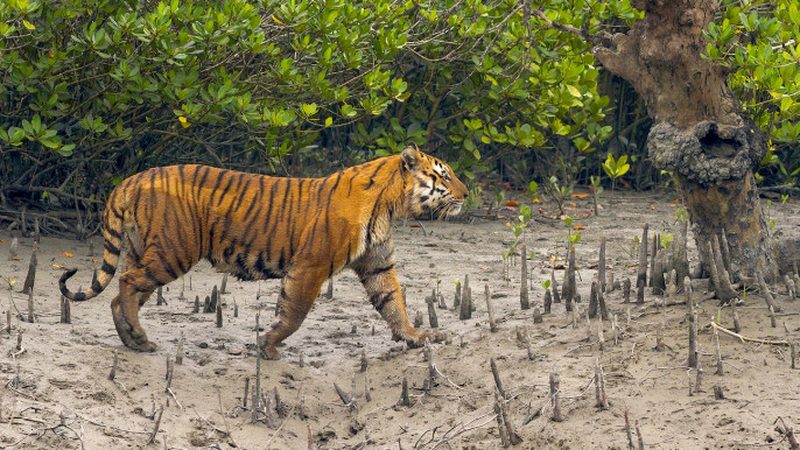
Where the Ganga, Brahmaputra, and Meghna meet the Bay of Bengal, they build the world’s largest mangrove delta: the Sundarbans, 10,000 square kilometres of tidal waterways, mudflats, and mangrove forest straddling India and Bangladesh. It is the last great stronghold of the Bengal tiger, adapted to a life of swimming between islands; a UNESCO World Heritage Site; and home to millions of people who live by fishing, honey collection, and farming on the delta’s fragile edge. Climate change is now rewriting the delta’s future faster than at any point in its history. This is life in the Sundarbans.
The delta and its tides
The Sundarbans are defined by water: a labyrinth of tidal creeks and rivers where the land appears and disappears with the tide, twice daily. The mangroves, dominated by the sundari tree that gives the forest its name, with their stilt roots and breathing pneumatophores, are among the most productive ecosystems on earth: nurseries for fish and shrimp, buffers against storm surges, and massive carbon sinks. The Indian side, about 40 per cent of the delta, includes the Sundarbans National Park, the tiger reserve core, and the inhabited islands where 45 lakh people live. The tides dictate everything: boat schedules, fishing, the tigers’ movements, and the slow, measurable rise of the sea that is drowning the delta’s edges. Islands have vanished within living memory, and the sea advances measurably each year.
The swimming tigers
The Sundarbans’ tigers are unlike any others: they swim between islands, drink brackish water, and navigate a landscape with no fixed landmarks. Elusive and rarely seen, their population, estimated in the around-100 range on the Indian side through camera-trap studies, is the delta’s conservation priority. Tiger-human conflict is the defining tension: honey collectors, fishermen, and woodcutters entering the forest face real risk, and the forest department records casualties each year, while tigers that stray into villages are captured or, rarely, killed. Conservation here is uniquely difficult: the terrain defeats fences and patrols, and the tigers’ range ignores the India-Bangladesh border. Yet the mangrove tiger persists, a symbol of adaptation, and the delta’s protected areas, national park, wildlife sanctuaries, and the transboundary cooperation with Bangladesh, represent one of conservation’s most challenging commitments.
Life on the edge: honey, fish, and risk
For the delta’s people, the forest is livelihood and hazard. The moulis, honey collectors, venture into tiger territory each spring in a tradition wrapped in ritual, praying to Bonbibi, the forest goddess shared by Hindus and Muslims, for protection. Fishermen and crab collectors work the creeks daily; farmers cultivate paddy on islands increasingly poisoned by saline intrusion. Cyclones, Aila in 2009, Amphan in 2020, periodically devastate the islands, breaching embankments and salting fields for seasons. The economy is precarious and increasingly untenable: young people migrate to cities, leaving ageing populations on eroding islands. Government programmes, embankment repair, cyclone shelters, mangrove replantation, and alternative livelihoods, help but cannot reverse the underlying physics: the sea is rising, the delta is subsiding, and the margin for human habitation narrows.
Climate change and the sinking delta
The Sundarbans are among the world’s most climate-vulnerable landscapes. Sea-level rise, among the fastest-measured in the region, combined with delta subsidence and reduced upstream sediment, as dams trap silt, means the delta is losing the race against the sea. Salinity intrusion degrades farmland and drinking water; the mangroves themselves, while resilient, face dieback where salinity exceeds tolerance. Projections suggest significant land loss in coming decades, with millions facing displacement, a slow-motion climate migration already underway. The policy debate is stark: protect and hold the line with embankments and mangrove restoration, or plan managed retreat from the most vulnerable islands. Both are pursued; neither is sufficient. The Sundarbans are where climate change stops being abstract: it is measured in vanished islands, salted wells, and migrating families.
The delta’s future
The Sundarbans’ future will be decided by forces larger than the delta: global emissions, upstream river management, and national adaptation policy. Within those constraints, the agenda is clear: strengthen the mangrove bioshield, the best defence against storms and erosion; secure tiger habitat and reduce human-wildlife conflict; build climate-resilient livelihoods, from sustainable aquaculture to ecotourism; and plan honestly for the displacement that cannot be prevented. The delta has survived by adapting for millennia; the question is whether its people and tigers can adapt fast enough now. In the Sundarbans, the tide comes in twice a day, and each time, it comes a little higher.
FAQs
Where are the Sundarbans? The Ganga-Brahmaputra-Meghna delta on the Bay of Bengal, shared by India (West Bengal) and Bangladesh; about 10,000 sq km total.
How many tigers live there? Around 100 on the Indian side, estimated through camera-trap studies; they are strong swimmers adapted to the tidal forest.
Can tourists visit? Yes, through regulated boat safaris from gateway towns like Canning and Godkhali, with permits for the national park zones.
Tigers, tides, and millions of lives on the edge: the Sundarbans are where India’s wild and human worlds meet most dramatically, and where climate change writes its most legible warnings.
Source: Down To Earth

Khabar 24h Editorial Desk — our explainers are prepared by the Khabar 24h editorial team using AI-assisted research tools, and every piece is reviewed by a human editor before publishing. We do not claim original reporting: our work is turning complex topics into simple, accurate summaries. Spotted an error? Write to contact@khabar24h.com — our corrections policy aims for same-day review.
More from this author →