Kumbh Mela Explained: How India Runs the World’s Largest Human Gathering
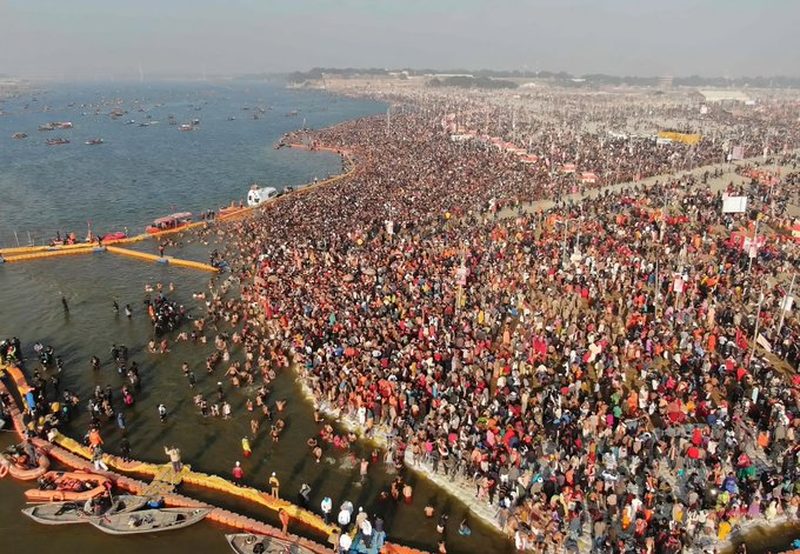
Every few years, a city larger than most metropolises rises on the floodplains of the Ganga, exists for less than two months, and then vanishes. The Kumbh Mela, held in rotation at Prayagraj, Haridwar, Nashik, and Ujjain, is widely described as the largest peaceful gathering of humanity on earth. The 2019 Prayagraj Kumbh drew an estimated 24 crore visitors; the 2025 Maha Kumbh at Prayagraj, held after the twelve-year cycle, drew footfalls estimated in the tens of crores, with single bathing days seeing several crore pilgrims. Behind the spectacle lies one of the most complex logistical operations any government undertakes. This is how India runs the world’s largest human gathering.
What the Kumbh is, and when it happens
The Kumbh Mela is a Hindu pilgrimage centred on ritual bathing at the confluence of sacred rivers, believed to wash away sins. It rotates among four sites: Prayagraj at the Triveni Sangam of the Ganga, Yamuna, and the mythical Saraswati; Haridwar on the Ganga; Nashik on the Godavari; and Ujjain on the Shipra. The timing follows the Hindu calendar and planetary positions, with the full Kumbh every three years at one of the sites in rotation, the Ardh Kumbh every six years at Prayagraj and Haridwar, and the Maha Kumbh every twelve years at Prayagraj. UNESCO recognised the Kumbh Mela as Intangible Cultural Heritage of Humanity in 2017. The scale has grown relentlessly: better roads, railways, and publicity have turned what was once a regional pilgrimage into a national and increasingly international event, with foreign tourists and global media now a fixture.
Building a temporary megacity
The mela ground at Prayagraj sprawls across thousands of hectares of riverbank, laid out on a grid with sectors, each with its own administration. For the duration of the mela, the government builds what is effectively a new city: tens of thousands of tents and temporary shelters, hundreds of kilometres of temporary roads, pontoon bridges across the rivers, vast tented townships for akharas and religious organisations, hospitals and first-aid posts, police stations, fire stations, and sanitation blocks. Electricity and water supply are extended across the entire site; in recent melas, lakhs of toilets were installed as part of the sanitation push. A dedicated mela authority, headed by a senior officer, coordinates dozens of departments, from the railways running special trains to the power utility stringing temporary lines. Planning begins years in advance, and the budget runs into thousands of crores, shared between the state and the centre.
How crores of people are kept safe
Crowd management is the central challenge, and the nightmare scenario is a stampede. The administration divides the mela into sectors with controlled entry and exit routes, designates one-way movement corridors on peak bathing days, and deploys tens of thousands of police and paramilitary personnel. In recent melas, technology has been layered on top: CCTV networks with video analytics, drone surveillance, GPS tracking of emergency vehicles, and mobile apps guiding pilgrims to less crowded ghats. The bathing ghats themselves are engineered with barricaded lanes, and the most auspicious bathing days, the Shahi Snans, see the akharas given staggered time slots to prevent surges. Despite these precautions, the Kumbh’s history includes tragic stampedes, and each mela’s planning is haunted by them; the 2025 Maha Kumbh saw a deadly crush on a peak bathing day, a reminder that at this scale, crowd safety is never a solved problem.
The akharas and the pageantry
The soul of the Kumbh is the gathering of akharas, the monastic orders whose processions, with caparisoned horses, silver maces, and ash-smeared Naga sadhus, provide the mela’s most iconic images. The thirteen recognised akharas, divided among Shaivite, Vaishnavite, and Udasi traditions, camp in vast allotted sectors and bathe in a strict order of precedence on Shahi Snan days, a hierarchy negotiated over centuries and occasionally disputed. Alongside them, the mela hosts thousands of religious discourses, cultural programmes, and exhibitions, and in recent editions, a deliberate effort to present the event to the world: tent cities for tourists, curated cultural zones, and heavy media facilitation. The economics are significant too: studies of recent melas have estimated economic impacts running into lakhs of crores when tourism, transport, and hospitality are counted, making the Kumbh one of India’s largest temporary economic engines.
Sanitation, health, and the river
Two quieter battles define the modern Kumbh: sanitation and river health. The Swachh Bharat push transformed mela sanitation, with the 2019 Kumbh deploying lakhs of toilets, mechanised cleaning, and a dedicated sanitation workforce, earning praise from international observers. Health infrastructure includes temporary hospitals equipped for everything from minor injuries to cardiac emergencies, plus disease surveillance to catch outbreaks early in a dense, transient population. The river itself is the other concern: crores of bathers, ritual offerings, and temporary settlements strain water quality, and the administration works with pollution control agencies to monitor the Ganga, regulate waste discharge, and manage the river’s flow. The tension is inherent: the Kumbh celebrates the river even as the gathering threatens it, and each mela is judged partly on whether the Ganga emerges no worse than before.
FAQs
How often is the Kumbh Mela held? The Kumbh rotates every three years among Prayagraj, Haridwar, Nashik, and Ujjain; the Ardh Kumbh comes every six years and the Maha Kumbh every twelve years, at Prayagraj.
How many people attend? Recent Prayagraj melas have drawn footfalls in the tens of crores across the event, with several crores on the biggest single bathing days.
What is a Shahi Snan? The royal bath: the most auspicious bathing days, when the akharas process to the river in order of precedence amid massive crowds.
The Kumbh Mela is at once a religious observance, a logistical marvel, and a mirror of India: ancient in origin, modern in management, and vast beyond easy comprehension. Running it safely is one of the hardest administrative tasks in the world, and India does it again and again.
Compiled by the Khabar 24h Editorial Desk from publicly available sources.

Khabar 24h Editorial Desk — our explainers are prepared by the Khabar 24h editorial team using AI-assisted research tools, and every piece is reviewed by a human editor before publishing. We do not claim original reporting: our work is turning complex topics into simple, accurate summaries. Spotted an error? Write to contact@khabar24h.com — our corrections policy aims for same-day review.
More from this author →