Kaziranga: How Assam’s Floodplains Became the Last Stronghold of the One-Horned Rhino
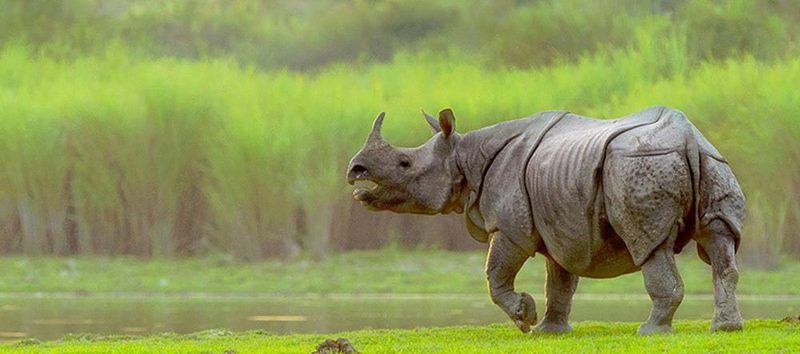
In the floodplains of the Brahmaputra in Assam lies one of conservation’s greatest success stories: Kaziranga National Park, home to around two-thirds of the world’s great one-horned rhinoceroses. A century ago, the species was down to a few dozen individuals, hunted nearly to extinction; today, Kaziranga alone holds over 2,600 rhinos. The park is a UNESCO World Heritage Site, a tiger reserve with one of the world’s highest tiger densities, and a landscape defined by the annual drama of flood and renewal. This is how Assam’s floodplains became the rhino’s last stronghold.
From a dozen rhinos to thousands
Kaziranga’s conservation story begins in 1904, when Mary Curzon, wife of the Viceroy, visited and reportedly saw not a single rhino, prompting the creation of a reserve in 1905. At the time, the one-horned rhino, hunted for its horn, prized in traditional medicine, and for sport, numbered perhaps a few dozen in the wild. Protection worked slowly and then decisively: the reserve became a national park in 1974, UNESCO listed it in 1985, and sustained anti-poaching efforts drove numbers upward. The rhino census, conducted every few years by the forest department, now counts over 2,600 in Kaziranga, part of an Assam-wide population exceeding 3,000. It is among the most dramatic recoveries of any large mammal: from the edge of extinction to the world’s stronghold, achieved through a century of protection.
The anti-poaching war
The recovery was never secure, because the threat never left: rhino horn fetches enormous prices in illegal markets, driven by demand in East Asia. Kaziranga’s response became one of the world’s most intensive wildlife protection regimes: armed forest guards with shoot-on-sight authorisation against poachers, a dedicated Assam Forest Protection Force, intelligence networks, and surveillance including drones and camera traps. Poaching, which killed dozens of rhinos annually in the 2010s, has been driven down to single digits in recent years, a remarkable achievement. The approach is controversial: shoot-on-sight policies and the militarisation of conservation raise human rights concerns, and the park’s protection has involved difficult trade-offs with local communities. But the results, measured in living rhinos, are undeniable, and Kaziranga is studied worldwide as a model of what determined protection can achieve.
Floods: the park’s annual drama
Every monsoon, the Brahmaputra floods Kaziranga, submerging up to 80 per cent of the park and forcing animals to higher ground, including the Karbi Anglong hills to the south, across a highway that becomes a death trap. The floods are ecologically essential: they deposit the silt that renews the grasslands, the rhino’s habitat, and the park’s ecology evolved with them. But they are also deadly: hundreds of animals drown or are hit by vehicles each year, hog deer in the largest numbers, and rhino calves are separated from mothers. The park’s response is elaborate: raised highlands built as refuges, speed restrictions and animal corridors on the highway, rescue centres like the Centre for Wildlife Rehabilitation and Conservation that hand-rear orphaned calves, and time-area closures. Climate change threatens to intensify the floods beyond the ecosystem’s tolerance, making flood management the park’s defining future challenge.
Beyond rhinos: tigers, elephants, and birds
Kaziranga’s fame as a rhino park understates its biodiversity: it holds one of the world’s highest densities of Bengal tigers, large elephant herds, wild water buffalo, swamp deer, and over 480 bird species, making it a premier birding destination. The tall elephant grass, the wetlands, and the riverine landscape create a mosaic that supports this abundance. The park’s UNESCO status recognises the whole ecosystem, not just the rhino. Tourism is carefully managed: jeep and elephant safaris in designated zones, with the park closed during the monsoon. The local economy benefits significantly, though, as elsewhere, the distribution of tourism’s gains remains contested. For the visitor, Kaziranga offers what few places on earth can: the sight of a one-horned rhino grazing in morning mist, with the Himalayas on the horizon.
The stronghold’s future
Kaziranga’s challenges are evolving: poaching suppressed but not eliminated, floods intensifying, human-wildlife conflict on the park’s fringes, infrastructure pressures, and the genetic risks of concentrating so much of a species in one landscape. The response includes expanding the park’s area through additions, strengthening corridors to the hills, and supporting rhino populations in other Assam parks, Manas, Orang, Pobitora, to spread the risk. The vision is a Kaziranga landscape, not just a park: connected habitats across the Brahmaputra valley. A century after Mary Curzon’s visit, the rhino’s stronghold stands as proof that extinction is not inevitable, and as a reminder that keeping it so requires eternal vigilance.
FAQs
How many rhinos are in Kaziranga? Over 2,600, around two-thirds of the world’s great one-horned rhinoceroses.
When should I visit? November to April; the park closes during the monsoon floods, roughly May to October.
Why do animals die in floods? The Brahmaputra’s annual floods submerge most of the park; animals drown or are hit crossing to high ground, though floods are ecologically essential.
From a few dozen to thousands, Kaziranga’s rhinos are conservation’s great comeback. Guarded by armed patrols, renewed by annual floods, they are the living proof that determined protection can pull a species back from the edge.
Compiled by the Khabar 24h Editorial Desk from publicly available sources.

Khabar 24h Editorial Desk — our explainers are prepared by the Khabar 24h editorial team using AI-assisted research tools, and every piece is reviewed by a human editor before publishing. We do not claim original reporting: our work is turning complex topics into simple, accurate summaries. Spotted an error? Write to contact@khabar24h.com — our corrections policy aims for same-day review.
More from this author →