Home Workouts Without Equipment: A Practical Starter Plan
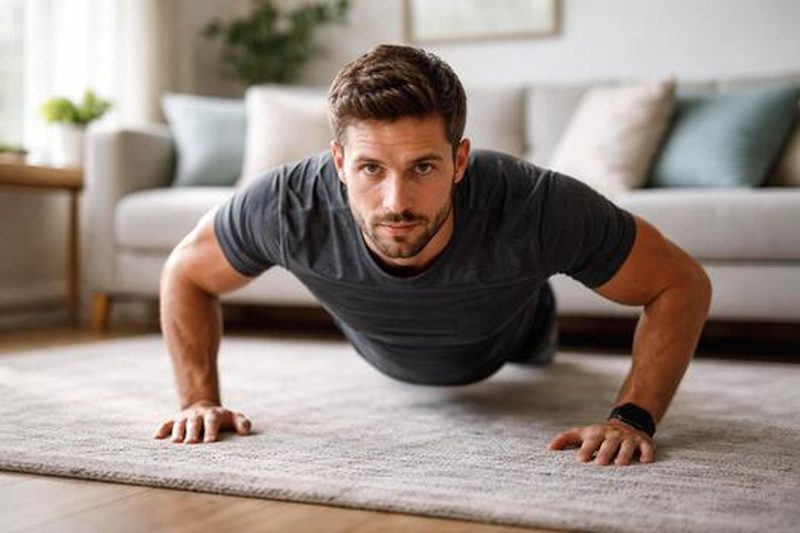
Gym memberships in India have a familiar lifecycle: enthusiastic signup in January, regular attendance through February, and a card gathering dust by April, still billing. For millions, the barriers are real: cost, distance, crowds, timings that clash with work, and for many women, discomfort in male-dominated weight rooms. Home workouts remove every one of these barriers, and exercise science is clear that they work. Bodyweight training builds meaningful strength, muscle and cardiovascular fitness when programmed with progression; the living room is a legitimate gym that happens to have no commute.
Why bodyweight training works
Muscles respond to tension, not to equipment brands. Push-ups load the chest, shoulders and triceps with a substantial fraction of body weight; single-leg squats challenge the legs intensely; planks and hollow holds build core stability. Studies comparing bodyweight programmes with gym-based training find comparable gains in strength and muscle for beginners over 8 to 12 weeks, provided the bodyweight exercises are progressed in difficulty. The limitation appears at advanced levels, where loading beyond body weight requires creativity, but beginners are nowhere near that ceiling. For the first year, the body is plenty of resistance.
The essential movement patterns
A complete home programme covers the same patterns as a gym one. Push: standard, incline and eventually decline push-ups. Squat: bodyweight squats progressing to split squats and Bulgarian split squats using a chair. Hinge: glute bridges progressing to single-leg bridges. Pull: the hardest pattern at home, solved with a sturdy table for inverted rows or a doorway pull-up bar, a worthwhile 1,500-rupee investment. Core: planks, dead bugs and mountain climbers. Lunge: walking or reverse lunges for legs and balance. Six to eight exercises, performed for 2 to 4 sets, cover the entire body.
A practical starter plan: weeks 1 to 8
- Schedule: three full-body sessions weekly, e.g. Monday, Wednesday, Friday, 30 to 40 minutes each, with rest or walking on other days.
- Session structure: 5-minute warm-up of marching, arm circles and leg swings; 25 minutes of 6 exercises in circuit or straight sets; 5-minute cool-down stretch.
- Weeks 1 to 2: learn form with easier variants, incline push-ups on a table, assisted squats holding a chair, 2 sets of 8 to 12 repetitions.
- Weeks 3 to 5: progress to standard variants, 3 sets; add a second of pause at the hardest point of each rep.
- Weeks 6 to 8: increase difficulty, slower tempos, harder variants like decline push-ups and split squats; add a fourth set to one or two exercises.
- Progression rule: when you can do 3 sets of 15 with good form, move to a harder variant rather than endless repetitions.
Adding cardio at home
Strength alone is incomplete. Skipping, if knees and neighbours permit, is superb cardio; stair climbing in apartment buildings is brutally effective; dancing, shadow boxing and high-knee circuits need no equipment at all. Two 20-minute cardio sessions weekly, or 10-minute finishers after strength days, satisfy the aerobic requirement. Interval formats, 30 seconds hard with 60 seconds easy, repeated 8 to 10 times, deliver strong cardiovascular stimulus in minimal time.
Staying consistent without a gym’s structure
Adherence is the home workout’s real challenge, and it is solved with systems, not willpower. Fix specific days and times; lay out workout clothes the night before; follow a written programme rather than improvising; track sessions in a notebook or app; and consider a workout partner or online community for accountability. Keep the workout space ready, a cleared corner with a mat, so starting takes seconds. The data on habit formation is encouraging: after 8 to 10 weeks of consistent sessions, the routine largely runs itself.
FAQs
Can I build visible muscle at home? Yes, as a beginner, for many months. Progressive bodyweight training plus adequate protein produces visible change; advanced lifters eventually need external load.
Do I need to buy anything? Not to start. A mat adds comfort; a doorway pull-up bar and resistance bands, together under 2,500 rupees, greatly expand the programme later.
Is it safe to exercise at home without a trainer? For healthy beginners doing bodyweight movements, yes, with attention to form via reputable video instruction and the rule of stopping at sharp pain.
The most expensive gym membership is the one unused, and the best workout programme is the one performed. Home training strips fitness to its essentials: a floor, a body, a plan and consistency. Start this week with push-ups against a table and squats in the living room; in three months, the only thing you will miss about the gym is the excuse for not going.
Compiled by the Khabar 24h Editorial Desk from publicly available sources.

Khabar 24h Editorial Desk — our explainers are prepared by the Khabar 24h editorial team using AI-assisted research tools, and every piece is reviewed by a human editor before publishing. We do not claim original reporting: our work is turning complex topics into simple, accurate summaries. Spotted an error? Write to contact@khabar24h.com — our corrections policy aims for same-day review.
More from this author →