The Roman Empire Explained: Rise, Fall and Lasting Legacy
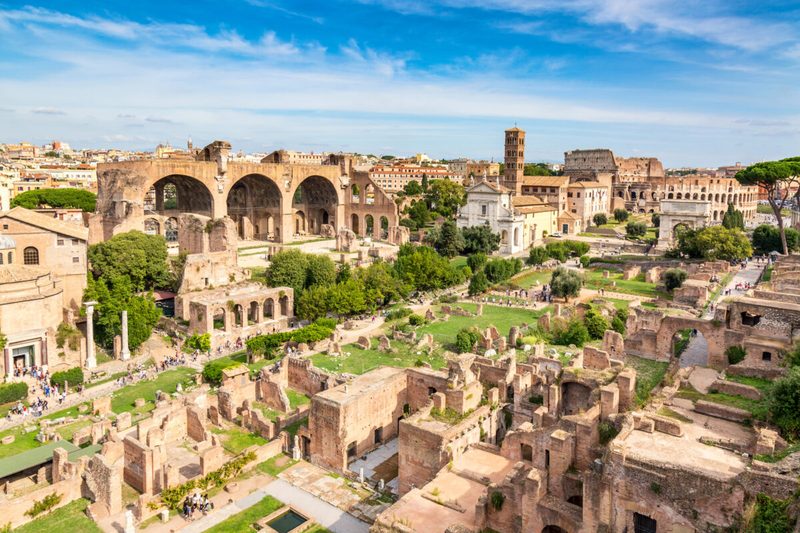
At its height, the Roman Empire ruled some 70 million people, a fifth of humanity, across three continents, and its capital held a million residents, a scale no city would match for a thousand years. Rome’s rise from village to superpower, its centuries of dominance, and its long fall form the most consequential story in Western history. Its legacy is everywhere: in our laws, languages, calendars, architecture and the very idea of Europe. This is how it happened.
From republic to empire
Rome began as a monarchy, became a republic around 509 BCE, and conquered Italy, then the Mediterranean, through citizen legions of extraordinary discipline. But success broke the republic: inequality, slave labour and ambitious generals led to a century of civil war, ending when Augustus, Julius Caesar’s heir, established the Principate in 27 BCE, monarchy disguised as restored republic. The Pax Romana that followed brought two centuries of relative peace, prosperity and expansion, the empire’s golden age, stretching from Britain to Egypt.
How Rome ruled the world
Rome’s genius was organisation. A professional army, eventually 30 legions, backed by engineering: roads, aqueducts, ports and frontier walls that still dot the landscape. Law, the empire’s greatest export, gave a unified legal framework from Spain to Syria, the ancestor of civil law systems used across Europe and Latin America today. Citizenship was extended strategically, co-opting elites, and cities replicated Roman urbanism everywhere. The empire was a machine for turning conquest into administration.
The peak and the problems
Under Trajan (98-117 CE) the empire reached its greatest extent. But structural strains grew: the economy depended on conquest and slavery, both finite; succession had no stable mechanism, inviting civil wars; the army’s cost ballooned; and plagues and climate shifts hit hard. The third century brought near-collapse, fifty years of chaos, inflation and breakaway empires, before Diocletian and Constantine rebuilt a more bureaucratic, more Christian state. Constantine’s conversion made Christianity the empire’s religion, reshaping both.
Why the West fell
The Western Empire’s fall was less a single event than a slow failure. Historians debate causes endlessly: barbarian invasions, economic decay, administrative bloat, lead poisoning, Christianity’s otherworldliness, take your pick. The proximate story: pressure from migrating peoples, especially the Huns’ domino effect, overwhelmed frontier defences; the West, poorer and less urbanised than the East, could not pay or organise its armies. In 476 CE the last western emperor was deposed, a date more symbolic than decisive. The Eastern, Byzantine, half survived another thousand years.
What Rome left behind
Rome’s afterlife dwarfs its life. Latin evolved into French, Spanish, Italian, Portuguese and Romanian, spoken by nearly a billion people. Roman law underpins legal systems worldwide. Christianity, Rome’s adopted faith, carried its organisation and calendar global. Architecture, from domes to arches to basilicas, quotes Rome endlessly; so does political language, senate, republic, empire, dictator. The Catholic Church is in many ways the Roman Empire’s ghost, its dioceses, Latin and hierarchy inherited directly. We still live in Rome’s ruins, literally and figuratively.
The fall: lesson or myth?
Every age reads its anxieties into Rome’s fall: Victorians saw moral decay, moderns see migration, climate and inequality. Historians now stress transformation over catastrophe: much of Roman life, law, language and faith continued under new rulers. The useful lesson may be institutional: empires fall when they can no longer adapt, pay their soldiers, or integrate newcomers. Rome lasted two millennia in various forms because it adapted constantly, until it couldn’t. Decline is a choice made daily, not a fate.
Rome’s engineering marvels
Roman engineering still astonishes: the Pantheon’s unreinforced concrete dome, the largest for 1,300 years; aqueducts delivering a million cubic metres of water daily to Rome; roads so well built that modern highways follow their lines. Concrete, the arch and standardised construction let Rome build at imperial scale, fast. Much of it survives because it was over-engineered by modern standards, a reminder that infrastructure built for centuries, not quarters, is the true measure of a civilisation.
FAQs
When did the Roman Empire fall? The Western Empire effectively ended in 476 CE; the Eastern (Byzantine) Empire survived until Constantinople fell in 1453.
What caused Rome’s fall? A combination of invasions, economic troubles, political instability and administrative overload; historians still debate the mix.
What did the Romans give us? Latin-based languages, Roman law, Christianity’s spread, republican political ideas, and foundational engineering and architecture.
Rome built the template for Western civilisation and then demonstrated, at length, how even the mightiest systems end. Its stones still stand across three continents, reminding every later empire whether it asked for the comparison or not.
Source: History.com

Khabar 24h Editorial Desk — our explainers are prepared by the Khabar 24h editorial team using AI-assisted research tools, and every piece is reviewed by a human editor before publishing. We do not claim original reporting: our work is turning complex topics into simple, accurate summaries. Spotted an error? Write to contact@khabar24h.com — our corrections policy aims for same-day review.
More from this author →