The World’s Writing Systems Explained: Alphabets, Logograms and Scripts
Every text message you send rides on one of humanity’s most improbable inventions: writing. It has been invented independently only a few times in history, in Mesopotamia, Egypt, China and Mesoamerica, yet today it takes hundreds of forms, from the 26 letters of English to the thousands of characters of Chinese. The world’s writing systems fall into a few great families, and understanding them explains why some languages are easy to spell and others take a decade of schooling.
The alphabet: a few dozen signs
An alphabet gives each sound of a language its own symbol. The idea emerged around 1800 BCE among Semitic-speaking workers in Egypt, was refined by the Phoenicians into 22 consonant letters, and passed to the Greeks, who added vowels, creating the first true alphabet. Rome adapted it into Latin script, which now writes more languages than any other, from English to Vietnamese to Swahili. Alphabets are brilliantly economical: learn a few dozen signs and you can write anything. Their weakness is that sounds change while spelling stays put, which is why English spelling is famously chaotic.
Abjads and abugidas: the middle paths
Not every script writes every sound. An abjad, used by Arabic and Hebrew, writes mainly consonants and leaves vowels to be inferred, which works because Semitic grammar packs meaning into consonant roots. An abugida, used across South and Southeast Asia, writes each consonant with an inherent vowel that diacritics then modify; Devanagari, the script of Hindi and Sanskrit, is the most widely used. These systems fit their languages beautifully: what looks like missing information to an outsider is redundancy a native reader never needed.
Syllabaries: one sign per syllable
A syllabary assigns a symbol to each syllable. Japanese kana are the most familiar: hiragana and katakana each cover about 46 syllables and handle native words and foreign borrowings respectively, working alongside Chinese-derived kanji. The Cherokee syllabary, invented by Sequoyah in the 1820s, famously made his nation literate within a generation, one of history’s great literacy miracles. Syllabaries suit languages with simple syllable structures; for English, with its thousands of possible syllables, one would be impossibly bulky.
Logograms: meaning in a sign
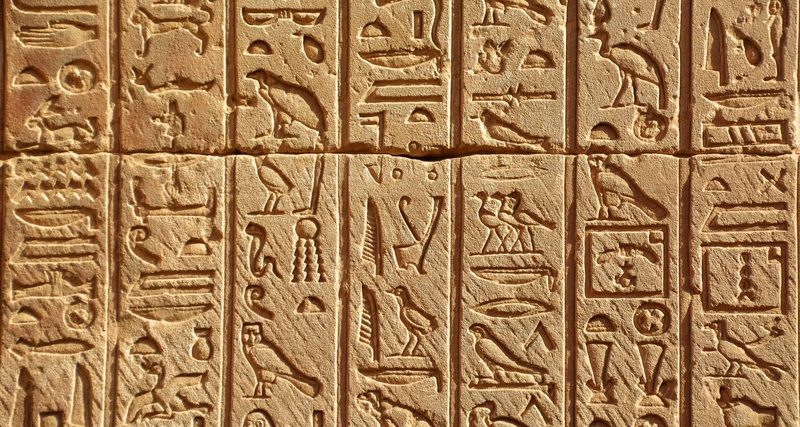
Logographic systems give each word or morpheme its own character. Chinese characters are the great survivor, in continuous use for over 3,000 years, with each sign carrying meaning directly rather than sound. Egyptian hieroglyphs and Maya glyphs worked similarly before their civilisations fell. The price is memorisation: thousands of signs. The payoff is durability across dialects and millennia, a Cantonese speaker and a Mandarin speaker can read the same text, and a modern reader can puzzle out inscriptions from the Bronze Age.
How scripts spread, collide and die
Scripts travel with religion, empire and trade. The Latin alphabet rode Roman legions and later European colonialism; the Arabic script spread with Islam; Cyrillic followed Orthodox Christianity. Sometimes scripts are imposed, as when Turkey’s Ataturk switched Turkish from Arabic to Latin letters overnight in 1928, or Vietnam abandoned Chinese characters for a Latin alphabet. The digital age is a new filter: scripts that adapted early to keyboards and phones thrive, while some minority scripts struggle for Unicode support, and with it, a future online.
The perfect alphabet that was designed, not evolved
Most scripts evolved messily, but Korea’s Hangul was deliberately designed in 1443 by King Sejong’s scholars to be easy to learn, with letter shapes mimicking the mouth’s positions. Literacy soared, and linguists now call it the world’s most scientific writing system. It proves a point the whole history of scripts suggests: writing systems are tools, and like tools they can be engineered. The Latin alphabet dominates through historical luck, but Hangul shows what happens when a writing system is built on purpose rather than accumulated by accident.
FAQs
How many writing systems exist? Over 290 scripts are encoded in Unicode, though only a few dozen are in daily use by large populations.
Which is the oldest writing? Cuneiform from Mesopotamia, emerging around 3400 BCE, slightly predating Egyptian hieroglyphs.
Is Chinese harder to learn to read than English? It takes longer to reach basic literacy, but Chinese spelling is perfectly regular, while English spelling is famously irregular.
Writing is technology, and like all technology it shapes its users. Alphabets democratised literacy, characters preserved civilisation across millennia, and every script on your phone’s keyboard carries the fossil record of the empire, faith or genius that spread it.
Source: Smithsonian Magazine

Khabar 24h Editorial Desk — our explainers are prepared by the Khabar 24h editorial team using AI-assisted research tools, and every piece is reviewed by a human editor before publishing. We do not claim original reporting: our work is turning complex topics into simple, accurate summaries. Spotted an error? Write to contact@khabar24h.com — our corrections policy aims for same-day review.
More from this author →