Sprinting Technique Explained: How Elite 100m Runners Train
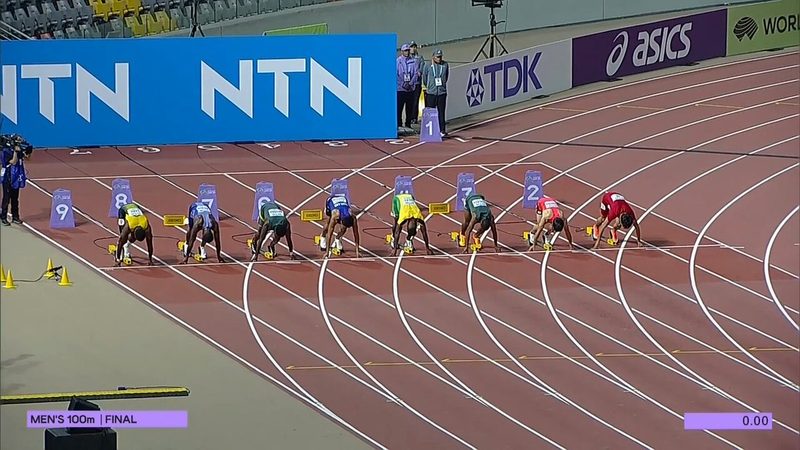
The 100 metres is decided in under ten seconds, but those seconds contain some of the most refined technique in all of sport. Elite sprinters do not simply run fast; they execute a precisely choreographed sequence from the blocks to the line, where a misplaced foot or a tense shoulder can cost the hundredths that separate gold from fourth. This is how sprinting technique works and how the fastest humans on earth train.
What happens in the starting blocks?
The race begins long before the gun. In the blocks, sprinters set their feet at personalised positions, with the front block roughly two foot-lengths from the line. On set, the hips rise above the shoulders, weight shifts forward onto the hands, and the body coils like a spring. Reaction time is critical: the gun fires, and elite starters react in around 0.12 to 0.15 seconds. But the start is not just reaction; it is the first push. The rear leg drives explosively, the arms punch in opposition, and the athlete explodes forward at roughly a 45-degree angle. A poor start cannot be recovered in 100 metres, which is why sprinters rehearse block clearances thousands of times.
What is the drive phase?
The first 30 metres constitute the drive phase, where the sprinter stays low and builds speed through powerful, piston-like strides. The body angle rises gradually: from the deep lean out of the blocks to upright running by around 30 to 40 metres. Foot strikes land beneath the hips, not ahead of them, because overstriding acts as a brake. Coaches cue triple extension, the ankle, knee and hip extending fully on each push, to maximise force into the track. Patience is the key coaching point: athletes who pop upright too early sacrifice the acceleration that the drive phase is designed to build.
How do sprinters reach and hold top speed?
Around 50 to 70 metres, elite sprinters hit maximum velocity, often exceeding 12 metres per second in men and 10.5 in women. At top speed, the mechanics change: strides lengthen to over 2.5 metres, stride frequency peaks, and the runner appears almost to float. The cues are relaxation and rhythm: the face stays loose, the shoulders stay down, and the arms drive from the shoulder in a straight line, not across the body. Ground contact times shrink to under 0.1 seconds. Nobody truly holds top speed; from about 70 metres, deceleration begins, and the final 30 metres are about decelerating less than everyone else. Championship 100 metres are won by the athlete whose speed endurance fades slowest.
Why is the finish so technical?
Races are regularly decided at the line, and the dip, the final lean, is a trained skill. Sprinters throw their chest forward in the last stride, timing the lean so the torso crosses the line at maximum extension without breaking stride rhythm early. Dipping too soon kills speed; dipping too late wastes the advantage. Photo-finish cameras, which record thousands of frames per second, judge the winner by the torso, not the head, hands or feet, which is why the lean targets the chest. Sprinters practise the dip so it becomes automatic, because thinking about it at 12 metres per second is impossible.
How do elite sprinters structure their training?
Sprint training is a year-round science built around periodisation. The off-season emphasises general strength: heavy squats, Olympic lifts and plyometrics build the power that acceleration demands. As competition approaches, training shifts to specific speed work: block starts, 30-metre accelerations, flying sprints and speed endurance sessions like 150-metre repetitions. Recovery is sacred, because the nervous system, not just the muscles, must be fresh to sprint maximally; elite sprinters rarely sprint all-out more than twice a week. Sports science support includes video analysis of every stride, force-plate testing and meticulous management of hamstrings, the sprinter’s eternal vulnerability.
What role does psychology play?
In a race with no second chances, the mental game is decisive. Sprinters train visualisation, rehearsing the perfect race from blocks to dip in their minds. They develop pre-race routines that channel nerves into focus, because tension is the enemy of speed: tight muscles cannot contract and relax rapidly. Handling the rounds, heat, semifinal and final across two days, demands emotional control; celebrating a fast heat too hard can drain the final. The great champions share a trait beyond speed: an almost eerie calm in the minutes before the gun.
FAQs
What is a good 100m time? Under 11 seconds is excellent for men and under 12.5 for women at amateur level; the world records stand at 9.58 and 10.49 seconds.
Why are sprinters disqualified for false starts? One false start means disqualification, with electronic blocks detecting reactions faster than 0.1 seconds, to ensure fair, fast races.
Do sprinters breathe during the 100m? Most take just one or two breaths; the race is run almost entirely on stored energy, with breathing kept minimal to avoid disrupting rhythm.
Ten seconds of sprinting contains a lifetime of technique: the coiled start, the patient drive, the floating top speed and the desperate lean. Master each phase, and the clock becomes the only opponent left.
Source: World Athletics sprint coaching library
Related stories
View all →
Roberto Carlos: I lost 99% of my football fortune
Brazil legend Roberto Carlos has revealed he lost 99 percent of everything he earned during his playing career, blaming bad agents and…

Oregon Beats USC 41-27 After Moore Injury
No. 20 Oregon defeated No. 12 USC 41-27 on Saturday night after losing star quarterback Dante Moore to a frightening injury. Moore…

Uzbekistan, China Win 2026 Chess Olympiad Gold
Uzbekistan and China are the champions of the 46th Chess Olympiad, which ended Sunday in Samarkand. The hosts won the Open section…

Khabar 24h Editorial Desk — our explainers are prepared by the Khabar 24h editorial team using AI-assisted research tools, and every piece is reviewed by a human editor before publishing. We do not claim original reporting: our work is turning complex topics into simple, accurate summaries. Spotted an error? Write to contact@khabar24h.com — our corrections policy aims for same-day review.
More from this author →